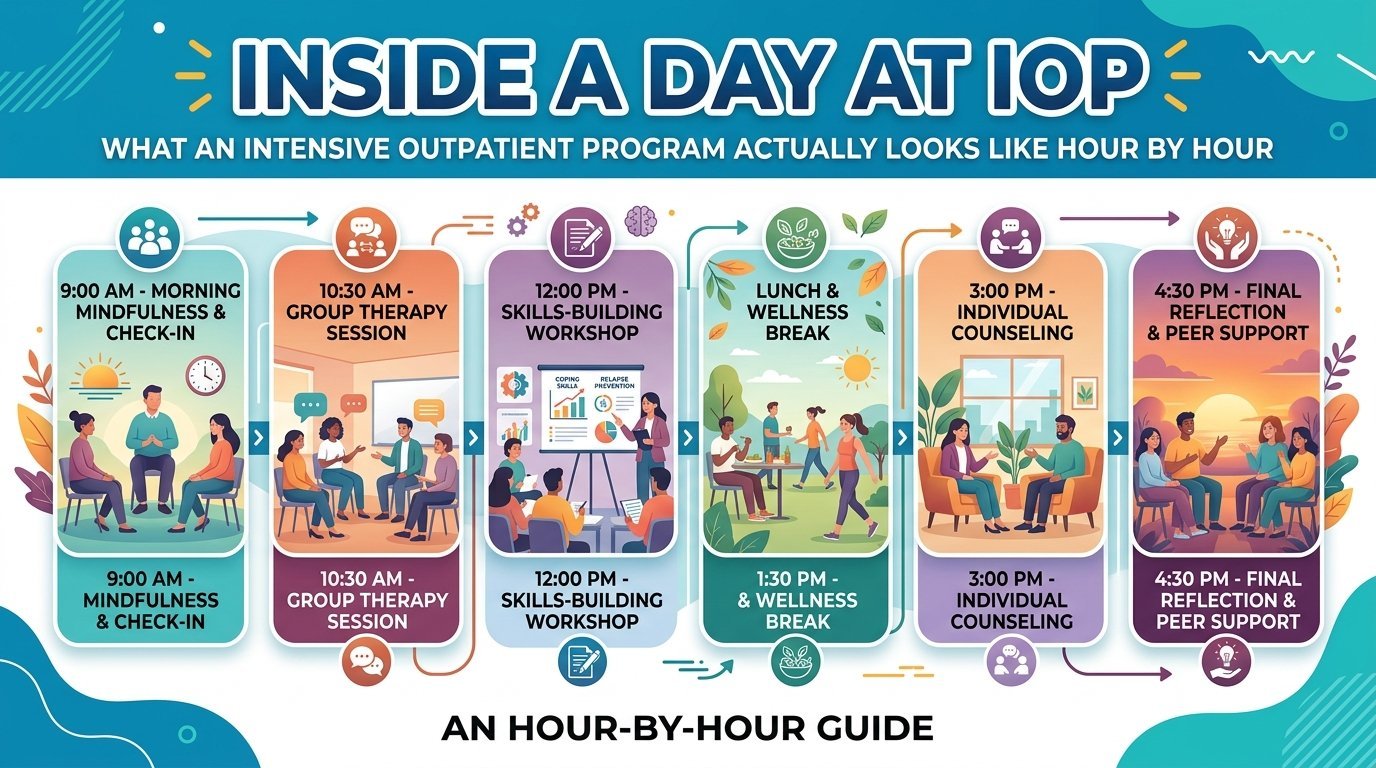
A Real Day in an Intensive Outpatient Program
People hear the words “intensive outpatient program” and picture something between rehab and weekly therapy without a clear sense of what actually happens during the program day. The vagueness keeps many patients from accepting a step-up referral when their mental health care needs more than standard outpatient can deliver. This article walks through a representative day in an IOP, hour by hour, so the program becomes concrete enough to consider seriously.
IOPs vary in structure, focus, and population, but the core architecture is consistent across most programs in the United States. Three program days per week, three hours per session, six to twelve weeks total, with a small group of seven to twelve patients moving through together. What follows is a composite based on common patterns at general behavioural health IOPs, substance use IOPs, and dual diagnosis programs.
5:30 PM: Arrival and Settling In
Most adult IOPs run evening hours, between five and eight PM, so participants can keep their day jobs. You arrive at the program location, often a clinical office or a wing of a community mental health center, fifteen minutes before start time. You check in at the front desk, sign a daily attendance form, and are sometimes asked to complete a brief mood and craving rating scale on a tablet or paper form. The ratings are reviewed by clinicians and inform the day’s group focus.
The waiting area is small, often a hallway with a few chairs. Other group members are arriving. You will recognise them by week two and know their stories by week four. The cohort itself becomes part of the treatment. The slight awkwardness of arriving for the first few sessions gives way to something closer to walking into a workplace or a class with familiar faces.
5:45 PM: Check-In Group
The first thirty minutes is a structured check-in. Each participant briefly shares how the past forty-eight hours have gone, including any specific events, struggles, victories, cravings, intrusive thoughts, or shifts in mood. The clinician facilitating notes themes and decides how the rest of the evening will unfold. Check-ins are not freeform venting. They follow a structure, often called Subjective, Objective, Assessment, Plan or a similar framework, that keeps each participant’s update to a few minutes and surfaces material the group can work with.
The first few times you do this, sharing in front of relative strangers feels exposing. By week three, you will discover that listening to other participants share is sometimes more useful than your own sharing. You will hear someone describe a struggle that mirrors yours and realise you are not alone in it. You will hear someone describe a coping strategy you have not tried and decide to try it that night.
6:15 PM: Skills Group
The largest single block of the evening is a structured skills group, usually ninety minutes. The skills taught vary by program. Many use dialectical behaviour therapy modules, including emotion regulation, distress tolerance, interpersonal effectiveness, and mindfulness. Others teach cognitive behavioural therapy techniques for identifying and challenging unhelpful thought patterns. Substance use IOPs often follow the Matrix Model or twelve-step facilitation. Trauma-focused IOPs may teach grounding skills, the window of tolerance concept, and titrated trauma processing.
The format is part lecture, part discussion, part practice. The clinician introduces a concept, walks through examples, asks the group to apply the concept to their own recent week, and assigns homework to practice the skill before the next session. The homework matters. The skills are useless if they are only practised inside the group room. Patients who use them in real life between sessions are the ones who finish mental health care at this level with durable change.
7:45 PM: Process Group or Individual Time
The final block of the evening is process-oriented. Some IOPs use this hour for a process group, where participants discuss the emotional content of the week in a less structured format. Others use it for individual therapy slots, with each participant pulled out of the larger group to meet with their assigned therapist for thirty minutes once or twice a week. Some programs alternate between the two formats.
Family work is woven into this period in many programs. Once or twice during the program, family members are invited to a session, either individually or as part of a multifamily group. The family component is one of the strongest predictors of long-term outcome, particularly for adolescents and for substance use treatment. Patients whose families participate engage more, relapse less, and report better functioning a year out.
Medication Management Built In
Most IOPs include weekly or biweekly medication management appointments with a psychiatrist or psychiatric nurse practitioner, scheduled before or after group time. The integration matters. Therapists in the program communicate with the prescriber daily, which means medication adjustments are responsive to what is showing up in groups. A patient struggling with sleep that is undermining group participation can have a sleep medication tweaked within a week. A patient experiencing emerging side effects can be heard quickly.
If you are entering an IOP and are not currently taking medication, the program may recommend a psychiatric evaluation. The recommendation is not a verdict. It is an invitation to consider whether medication might support the work you are doing in groups. Many participants accept the evaluation, decide medication is not for them, and continue without it. Many others discover that a low-dose medication clears just enough fog to make the group work meaningful.
What the Program Is Not
IOP is not residential treatment. You sleep at home every night, and what happens at home matters as much as what happens in group. IOP is not punitive, despite the language some patients bring from older addiction-treatment cultures. Clinicians are not trying to break you down. They are trying to teach you skills and stabilise your symptoms so that you can return to a less intensive level of mental health care.
IOP is also not a replacement for individual therapy with the therapist you saw before the program. In most cases, your previous therapist will pause your work during the IOP, since the program provides its own individual time, and resume after discharge. Building a discharge plan that includes a return to your previous therapist is one of the most important conversations to have in the second half of the program.
Insurance, Cost, and Practical Logistics
Insurance plans, including networks behind UnitedHealthcare therapists, Optum, Aetna, Cigna, and Blue Cross Blue Shield variants, cover IOP under their behavioural health benefit. Preauthorisation is typically required, and the program’s intake clinician handles it. The patient cost depends on plan design, with copays per program day in the range of zero to seventy-five dollars after deductible. Some plans bill a single copay per week for the full nine to twelve hours, which is dramatically less than the equivalent number of standard outpatient sessions.
Logistically, plan for transportation. Three evenings a week of programming on top of a full-time job can be exhausting. Some participants take the program time as work flex, others use FMLA leave, and others move into reduced hours during the program. Building an honest plan with your employer or your support network before starting reduces the chance of dropping out due to logistical strain.
What to Expect at the End
The last week of an IOP is structured around discharge planning. You will work with clinicians to write a relapse prevention plan, identify the warning signs that would indicate you need a step-up to PHP or higher, and schedule the first appointments with your post-discharge providers. Most graduates step down to weekly or twice-monthly outpatient therapy with a community-based therapist. Some step down to a less intensive group programme. Some begin a longer course of medication management with the program’s psychiatrist if their original prescriber lacks experience with their medication regimen.
Graduating an IOP, when the program is done well, feels less like leaving treatment and more like returning to life with new tools. The hour-by-hour structure of the evenings becomes a familiar internal scaffold even after the program ends. The skills practised in groups become ways of moving through difficult moments at home. The work of an IOP is not finishing a course of mental health care. It is becoming the kind of person who can carry the work forward on their own.
This article is for educational purposes and does not replace personalised guidance from a licensed clinician. If you or someone you know is in crisis, call or text 988 in the United States.