The Discharge Most Patients Are Not Ready For
The American psychiatric emergency department is a remarkable but limited intervention. It can keep a person alive through a crisis, run urgent labs and toxicology, restart medications, and sometimes negotiate an inpatient admission. What it cannot do is provide the kind of continuous mental health care a recovering patient actually needs in the seventy-two hours after discharge. Most patients leave the ER with a paper aftercare list, two or three new prescriptions, and almost no idea what the next week is supposed to look like.
This article describes the post-ER landscape candidly. What the discharge papers actually mean, what the next forty-eight hours typically look like, what to do if symptoms return, and how to use the experience to build a longer arc of care rather than treating it as an isolated incident. The goal is to walk patients and families from the ER door into a recovery pathway rather than back into the conditions that produced the crisis.
Reading the Discharge Paperwork Like a Clinician Would
The packet you receive when you leave a psychiatric ED has several specific components. There is a discharge summary describing the visit, the diagnosis, and the recommended follow-up. There is a list of new medications with dosing instructions. There is, almost always, a list of community providers and crisis resources, sometimes with a fax number for a behavioural health intake line. There is, in better-resourced systems, a follow-up appointment already scheduled within seven days, with a name and phone number printed on the page.
The single most important sentence in the packet is the follow-up plan. If a specific appointment was scheduled, the follow-up rate climbs dramatically over self-directed search. If only a list of resources was provided, the follow-up rate plummets. If you leave the ER without a scheduled appointment, ask before you walk out: can you schedule a next-step appointment for me before I leave. Many emergency departments will, especially since federal funding has emphasised warm handoffs as a quality measure.
The First Forty-Eight Hours
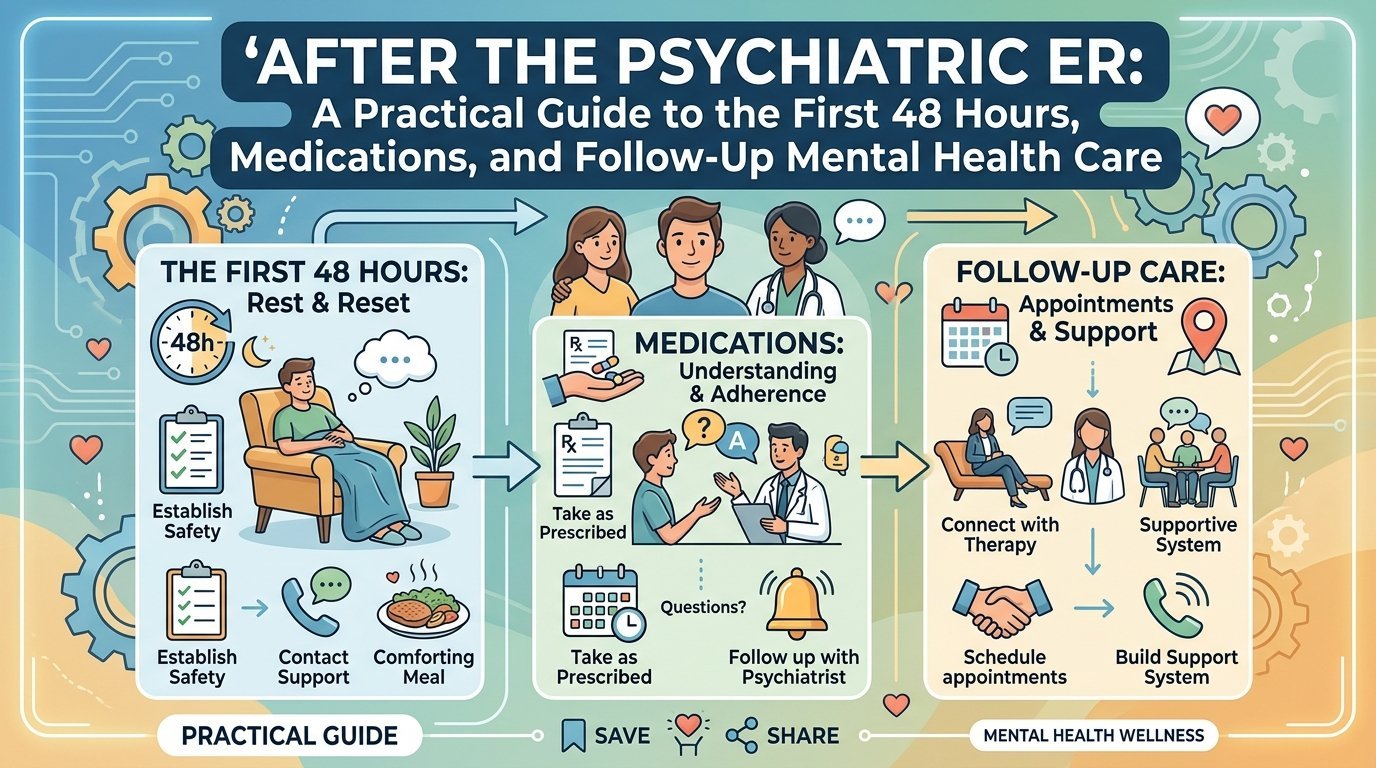
The two days after a psychiatric ED visit are the highest-risk window in the post-discharge period. Patients are exhausted from the visit, overwhelmed by medication changes, and often disoriented by the abrupt return to ordinary life. The plan for these forty-eight hours should be simple and external. Sleep on a regular schedule. Eat regular meals. Stay at home with at least one supportive person. Do not drive long distances. Do not make major decisions. Do not return to work the next day if at all possible.
If symptoms return or worsen, the plan is to call the same ED’s psychiatric service or a mobile crisis team rather than returning to triage from scratch. Many EDs maintain a brief follow-up call protocol for psychiatric discharges, where a social worker calls within twenty-four hours. If you receive that call, take it seriously. The clinician on the other end can adjust the plan, expedite an appointment, or arrange a step-up in care if needed.
Medication Changes and Pharmacy Logistics
Most psychiatric ED discharges include a new medication, a dose change, or a discontinued medication. The new prescriptions are typically written for a short bridge supply, often a week or two, until the patient sees an outpatient prescriber. Filling them quickly matters. Do not wait until the bottle runs out. Pharmacies sometimes need prior authorisation for specific psychiatric medications, and the lag can leave a patient without the medication that just stabilised them.
If your insurance plan, including networks behind UnitedHealthcare therapists, Optum behavioural health, Aetna, Cigna, or Blue Cross Blue Shield, requires preauthorisation for the prescribed medication, the pharmacy will alert you. The fastest path is to call the prescribing physician’s office, share the rejection, and request a peer-to-peer review or a tier exception. The process usually clears within seventy-two hours. While waiting, the prescriber can sometimes provide a short supply directly or substitute a covered alternative.
Connecting With Outpatient Providers Quickly
The discharge plan typically calls for an outpatient psychiatric appointment within seven days. In real life, the seven-day window is met for fewer than half of psychiatric ED discharges in the United States. Provider availability is thin, intake processes are slow, and patients in fragile post-crisis states often struggle to advocate for themselves. The result is a follow-up gap that drives the high readmission rates the system has not solved.
If a follow-up appointment was not scheduled before you left the ED, the most reliable path is your community mental health center. CMHCs typically reserve same-week intake slots for ED discharges. Call within forty-eight hours, identify yourself as a recent ED discharge, and ask for an urgent intake. If you have commercial insurance and prefer a private-practice option, ask the ED social worker to arrange a warm referral to a partnering practice. Many private practices hold post-acute intake slots for hospital partners and will see ED discharges quickly.
If neither path produces a quick appointment, consider an IOP or PHP intake instead of waiting for a single weekly therapy slot. Intensive outpatient programs can typically schedule an intake within forty-eight to seventy-two hours and provide nine to twenty hours of weekly mental health care, which is much more responsive than a once-weekly appointment for someone fresh out of an ED.
Family and Support Network Engagement
The post-ED period is one of the most useful moments to involve family and close friends in the patient’s recovery, with the patient’s consent. The crisis has already disrupted the household. Pretending it did not happen is rarely successful. A brief family meeting, often facilitated by a clinician at the discharge appointment, can clarify what each person is willing to do, what symptoms would prompt a call to a mobile crisis team, and how the household will adjust during the early weeks of recovery.
If you are a family member of a patient who has just been discharged from a psychiatric ED, the most useful thing you can offer is calm, undemanding presence. Not interrogation. Not problem-solving. Not lectures about adherence. Sit with the person. Make food. Drive them to the pharmacy. Take them to the follow-up appointment. The relational signal of stability and care has measurable effect on outcome.
When to Return to the ED
Returning to the ED is sometimes the right call. If suicidal thoughts return with intent and means, return. If a medication side effect is dangerous, such as severe drowsiness, abnormal movements, or confusion, return. If a person who was discharged is unable to care for themselves at home, return. The ED is not a one-time service. Coming back is not a failure of the previous visit.
The judgement call is usually whether the situation is acute enough for an ED or whether a mobile crisis team or a same-day clinic visit can handle it. The default for fresh post-discharge patients should be to err toward an ED return when in doubt. The system’s tolerance for repeat visits in the first month after a discharge is high, and the cost of missing a deteriorating patient is much higher than the cost of an extra ED visit.
Building a Longer Arc
An ED visit is, in clinical terms, a sentinel event. It marks a place where the existing mental health care arrangement was not enough. The recovery period is also an opportunity to redesign the longer arc. A higher level of outpatient care, a different medication strategy, a stronger family plan, a written safety plan, a peer support connection, a new therapist whose expertise matches the actual problem more closely. The redesign is the project of the first three months after discharge.
Patients who do this redesign work tend to avoid future ED visits at much higher rates than patients who treat the discharge as the end of the story. The visit was not the failure. The failure would be returning to exactly the same arrangement that produced the crisis. Use the experience as the prompt to build the mental health care arrangement you actually need.
This article is for educational purposes and does not constitute personalised medical advice. If you or someone you know is in crisis, call or text 988 in the United States, or go directly to your nearest emergency department.