The Decision Most Families Make Without Information
When a clinician recommends that a patient step up beyond outpatient mental health care to a higher level of treatment, the conversation usually narrows quickly to two options: a partial hospitalisation program at a local clinical setting, or a residential treatment program at a facility where the patient lives during the stay. The choice has enormous financial, emotional, and clinical consequences. It is also a choice most families make in distress, often within days, with limited information about what each option actually delivers.
This article describes the comparison directly, with the kind of practical detail that referral conversations rarely include. The choice is not always obvious, and there are situations where each is plainly the right answer. The aim here is to put structure around the decision so families can ask better questions and make a more confident call.
What PHP Is
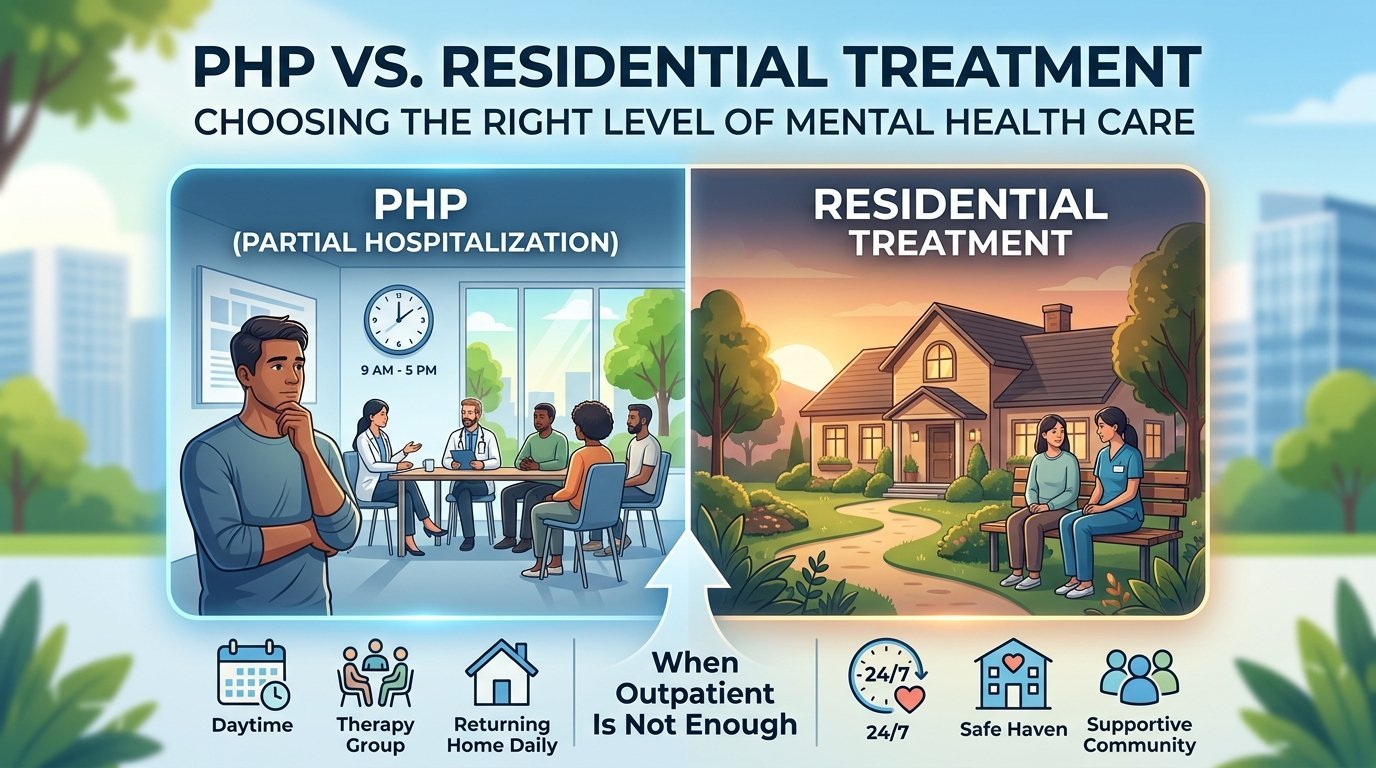
A partial hospitalisation program is the most intensive level of outpatient mental health care. Patients attend treatment six hours per day, five days per week, for two to four weeks on average. They sleep at home each night. The day is structured around groups, individual sessions, medication management, and skill-building activities, with clinical supervision present throughout the day and a treatment team meeting weekly to coordinate care.
PHP is most commonly used as a step-down from inpatient hospitalisation, allowing patients to leave a locked unit while continuing intensive treatment, or as a step-up from intensive outpatient or standard outpatient when symptoms have escalated. It is also the level of care many mental health providers near me recommend when a patient needs significant clinical structure during the day but has a stable enough home environment to return to each evening.
What Residential Treatment Is
Residential treatment removes the patient from their home environment entirely. They live at the program for the duration of the stay, typically twenty-eight to ninety days, sometimes longer. Daily life is structured by clinicians: meals, group sessions, individual therapy, recreation, medication, and sleep on a fixed schedule. Cell phones are restricted. Outside contact is bounded. The whole environment becomes part of the treatment.
Residential treatment is most commonly used for substance use disorders, severe and treatment-resistant eating disorders, complex post-traumatic stress disorder, and adolescents whose home environment is itself part of what is keeping them unwell. It is also used for patients whose previous attempts at lower levels of mental health care have not produced sufficient stabilisation, and who would benefit from an extended interruption of their daily patterns.
When PHP Is Plainly the Right Choice
PHP is the right level when the patient has a stable home environment, an existing support system that can manage evenings and weekends, and primary mental health concerns that can be effectively treated within a daytime structure. Conditions like severe depression, severe anxiety, post-acute recovery from suicidality, and stabilisation following an inpatient discharge typically respond well to PHP. The patient sleeps in their own bed, eats some meals with their family, and maintains continuity with their existing mental health care providers when relevant.
PHP is also the right choice when finances, work commitments, or family responsibilities make a residential stay impractical. The cost of PHP is significantly lower than residential treatment, and most insurance plans, including networks behind UnitedHealthcare therapists, Aetna, Cigna, Anthem, and Blue Cross Blue Shield variants, cover PHP under standard behavioural health benefits with prior authorisation. The patient can sometimes maintain partial work involvement, particularly with FMLA leave protecting their position.
When Residential Is Plainly the Right Choice
Residential treatment is the right level when the home environment is itself contributing to the problem, when the patient cannot reliably maintain safety overnight, or when twenty-four-hour clinical containment is needed. Active substance use that requires medical detox followed by extended structure, severe eating disorders that need round-the-clock meal supervision, and chronic dissociative trauma that requires consistent grounding all benefit from residential care.
Residential is also often the right choice when prior PHP or IOP attempts have not produced sufficient stabilisation. The clinical case for stepping further up is strongest when intensive outpatient mental health care has been delivered with fidelity and the patient has not improved. At that point the limiting factor is often the home environment itself, and the residential interruption is the intervention.
The Cost Difference Is Substantial
PHP typically costs in the range of three hundred fifty to seven hundred fifty dollars per program day, billed to insurance under standard behavioural health benefits. The patient’s out-of-pocket cost for a four-week PHP stay, after deductible and co-insurance, often runs in the low thousands of dollars on commercial plans, and substantially less on Medicaid or Medicare.
Residential treatment runs from approximately six hundred to two thousand dollars per day, with luxury programs charging several thousand. A thirty-day residential stay can carry a sticker price of fifteen to sixty thousand dollars before insurance. Coverage varies dramatically by plan and by program network status. Out-of-network residential treatment is one of the most common sources of catastrophic out-of-pocket costs in mental health care. Always obtain written preauthorisation before admission, and confirm in writing whether the program is in-network or out-of-network for your specific plan.
Outcomes: What the Research Shows
For most general behavioural health conditions, PHP and residential treatment produce roughly comparable outcomes when matched for severity. The choice is less about which level is more effective in absolute terms and more about which level is the right fit for the specific patient’s situation. For substance use disorders, residential treatment shows a small but measurable advantage for severe cases, while PHP shows comparable outcomes for moderate cases. For eating disorders, residential is often necessary when meals cannot be supervised at home, but PHP works well when the home environment supports recovery.
The strongest predictor of outcome at either level is not the level itself. It is the quality of the program, the engagement of the patient, the involvement of the family, and the strength of the discharge plan that connects the intensive mental health care to longer-term outpatient support. A mediocre residential program is rarely better than an excellent PHP. The choice should be made primarily on clinical fit and only secondarily on level.
Asking the Right Questions Before Admission
Before committing to either PHP or residential, ask the program specific questions. What is the staff-to-patient ratio. Who provides medication management and how often. What therapeutic modalities are used. What is the length of stay typically recommended. What is the discharge planning process. What insurance preauthorisation has already been completed. What are the total expected out-of-pocket costs.
The answers will distinguish strong programs from weak ones. A good PHP or residential program answers all of these questions readily. A weaker program will deflect or generalise. Trust the specifics. Programs that operate transparently are usually the ones that produce strong outcomes.
The Decision Is Usually Reversible
One reassuring fact about both PHP and residential treatment is that the decision can usually be revised in either direction. A patient who starts in PHP and finds it inadequate can step up to residential. A patient who enters residential and stabilises faster than expected can step down to PHP, then to IOP, then to standard outpatient. The continuum of mental health care is built precisely for this kind of recalibration.
What matters most is starting at a level that gives the patient a real chance of stabilising and engaging, then adjusting as needed. The wrong choice is rarely permanent. The worst outcome is delaying any choice at all. When intensive treatment is being recommended, the call to make is whichever option you can actually start in a reasonable timeframe.
This article is for educational purposes and does not constitute personalised medical advice. If you or someone you know is in crisis, call or text 988 in the United States.