The Telehealth Therapy Market Has Matured Quickly
Five years ago, virtual therapy was an emergency adaptation. Today, it is a permanent and dominant mode of mental health care delivery in the United States, with several distinct categories of platforms competing for patients. Most prospective patients hear two or three brand names and assume those are the options, missing important differences in pricing, provider quality, insurance acceptance, and clinical depth. This guide compares the major telehealth therapy networks and explains how to choose the right one for your specific situation.
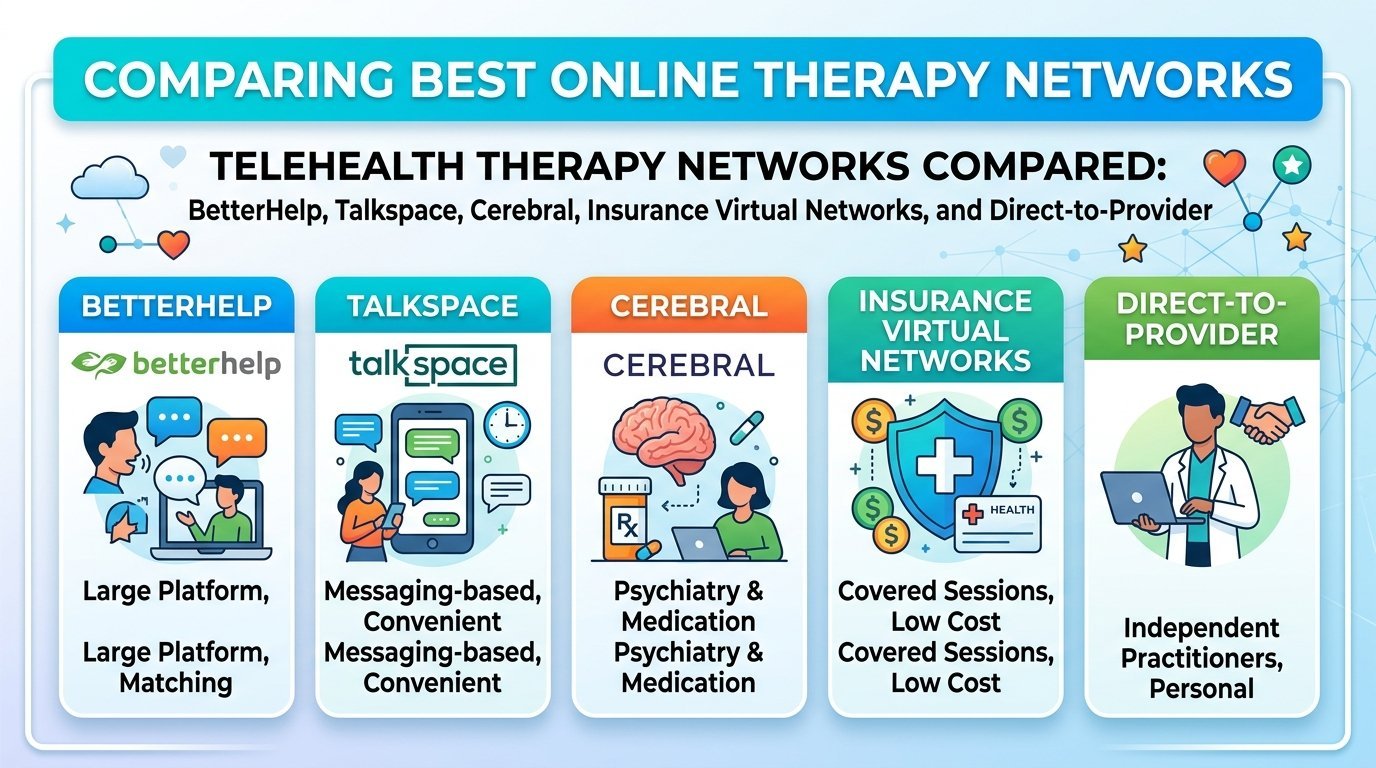
The market has roughly four tiers. Direct-to-consumer subscription platforms like BetterHelp and Talkspace. Hybrid models like Cerebral and Brightside that combine therapy and psychiatric medication management. Insurance-aligned virtual networks operated by major carriers and integrators including Optum and Teladoc. And direct-to-provider arrangements where a licensed therapist sees patients via their own telehealth platform. Each tier serves a different patient profile.
BetterHelp: The Largest Subscription Network
BetterHelp is the largest subscription-based therapy network in the United States, with tens of thousands of licensed therapists and several million users across its history. The model is membership-based: patients pay a flat monthly fee, typically in the range of two hundred to three hundred fifty dollars per month, and receive weekly live sessions plus unlimited messaging with their assigned therapist. The platform handles matching, scheduling, and payment without traditional insurance involvement.
The strengths of BetterHelp are accessibility and convenience. Sign-up is fast, the app is well-designed, and a patient can usually be matched and seeing a therapist within a few days. The unlimited messaging is a meaningful benefit for patients who want low-stakes contact between sessions. The trade-offs include limited insurance acceptance, variability in therapist quality and approach, and the inability to pay only for the sessions you actually use.
BetterHelp is the right choice for patients who are paying out of pocket, want fast access, and value the convenience and flexibility of a subscription model. It is a less ideal choice for patients with complex mental health care needs, those who require specialty expertise, or those whose insurance offers strong virtual therapy coverage that BetterHelp does not accept.
Talkspace: Insurance-Aligned and Specialty-Capable
Talkspace operates a similar subscription model but has invested heavily in insurance partnerships. As of 2026, Talkspace accepts coverage from major networks including UnitedHealthcare therapists, Optum behavioural health, Cigna therapists, Aetna therapists, and several Blue Cross Blue Shield variants. For insured patients, the cost can be a standard copay rather than a full subscription fee, which substantially reduces the financial barrier.
Talkspace also offers more specialty options than BetterHelp, including a dedicated psychiatry service for medication management, a couples therapy track, and a teen therapy track for adolescents. The therapist matching process is more deliberate, and patients can switch therapists without losing their progress notes. The platform has integrated some clinical assessment tools into the app, which can be useful for tracking symptoms over time.
The trade-offs include occasional friction with insurance preauthorisation, longer wait times in some specialty areas, and variability in therapist availability. Patients with stable insurance and a willingness to navigate some administrative friction often find Talkspace’s cost structure dramatically better than BetterHelp’s flat fee.
Cerebral and Brightside: Therapy Plus Psychiatry
Cerebral and Brightside offer hybrid models that combine talk therapy with psychiatric medication management in a single subscription. The model is designed for patients whose mental health care needs include both therapy and prescription medication, particularly for depression, anxiety, ADHD, and related conditions. The integration can simplify a treatment arc that would otherwise involve coordinating between two separate providers.
Both platforms have improved their clinical governance after early controversies around prescribing practices, particularly for stimulant medications used to treat ADHD. Patients should ask explicit questions about prescribing conservatism, controlled substance availability, and clinical oversight before subscribing. Both platforms accept some insurance, particularly Cerebral, which has expanded payer partnerships over the past two years.
The strength of these platforms is integration. The trade-off is that their therapist networks are smaller than BetterHelp or Talkspace, and patients may have less choice in matching. For specific clinical needs, the integration is worth the trade-off. For patients seeking only therapy, the dedicated platforms tend to offer more choice.
Insurance-Aligned Virtual Networks
Major insurance carriers operate their own virtual mental health care networks. UnitedHealthcare and Optum operate Optum Behavioral Health Solutions and partner with Talkspace and AbleTo. Aetna partners with multiple virtual therapy networks. Cigna operates the MDLIVE platform. Most Blue Cross Blue Shield plans have a virtual therapy benefit through a partnership with one of the major telehealth integrators. The aligned networks typically offer the strongest insurance coverage and the lowest patient cost.
The trade-off is that the networks tend to be operated more like traditional insurance: provider availability varies, matching can take longer, and the therapist pool is selected by the carrier rather than being a free market. Patients with stable, decent insurance should always check what their carrier’s aligned virtual network offers before paying for a subscription elsewhere. The cost difference can be substantial.
Direct-to-Provider: An Underrated Option
Many private-practice therapists now operate their own telehealth setups, using HIPAA-compliant video tools like SimplePractice, Doxy.me, or directly within their electronic health record systems. Patients who find a clinician through Psychology Today, a referral, or a directory search can often see that clinician via telehealth without involving any of the major platforms. The clinical depth is often higher, the relationship is direct, and the financial arrangement is the same as in-person therapy: insurance copay or out-of-pocket payment.
Direct-to-provider telehealth combines the convenience of remote sessions with the relational depth of traditional mental health care. For patients who want a long-term relationship with a specific therapist, particularly one with specialty expertise, this model often outperforms subscription platforms. The catch is that the search process is the same as for in-person therapy: longer, more deliberate, and often involving more friction up front.
Choosing the Right Tier for Your Situation
The right platform depends on three factors: insurance status, complexity of need, and preferences for relationship style. Patients with insurance should check their carrier’s aligned virtual network first, since the cost is often the lowest. Patients without insurance who want fast access often choose BetterHelp or Talkspace. Patients with complex needs requiring specialty expertise often benefit from direct-to-provider arrangements. Patients needing both therapy and medication management often choose Cerebral, Brightside, or a coordinated combination of providers.
The choice does not have to be permanent. Many patients try one model, find it imperfect, and switch. The right platform for a person changes as their needs change. The market is broad enough that most patients can find a fit if they engage with the question deliberately rather than defaulting to whichever brand they saw advertised most recently.
This article is for educational purposes and does not endorse any specific platform. Coverage and pricing details may vary; verify with the platform and your insurance plan before committing. If you or someone you know is in crisis, call or text 988 in the United States.