The Hardest Situation in Family Mental Health
Few situations in family life are harder than recognising that someone you love needs mental health care and watching them refuse it. The American legal framework around adult patients prioritises autonomy, which means that absent immediate danger, you cannot force an adult into treatment, even when their condition is clearly deteriorating. The constraint protects civil liberties. It also leaves families holding a load that is exhausting and sometimes dangerous, with limited tools for changing the situation.
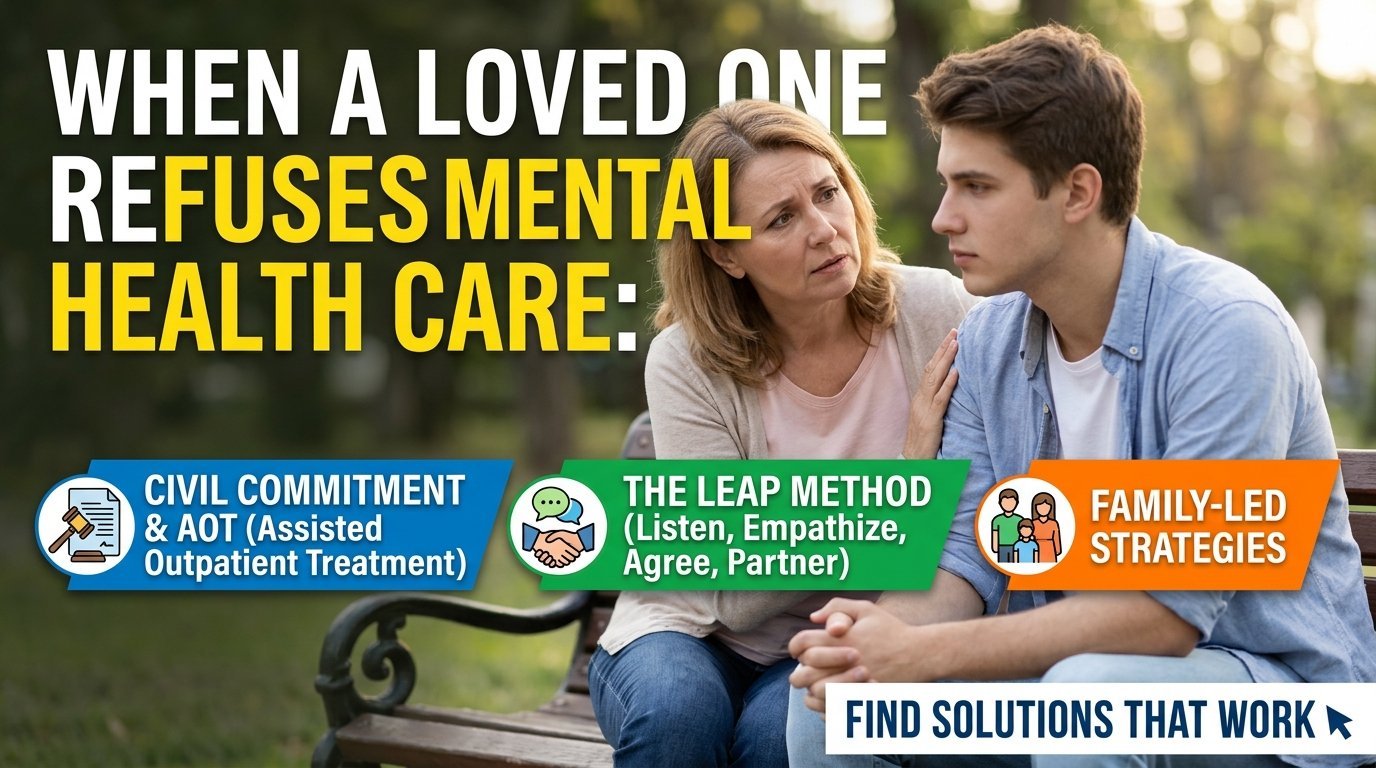
This guide describes the practical strategies that work when a loved one refuses help, including the legal mechanisms available in extreme situations, the relational approaches that sometimes shift refusal into engagement, and the family-led practices that maintain safety even when professional treatment is not yet involved. The work is not easy. The goal here is to give families a clearer sense of what is possible.
Why People Refuse Help
The reasons a person refuses mental health care are usually complex and rarely the simple stubbornness families sometimes attribute. Anosognosia, a clinical term for the lack of awareness of one’s own illness, is common in serious mental illness, particularly in psychotic disorders and severe mania. The brain function affected by the condition is the same brain function that would recognise the condition. The person is not being defiant. They genuinely do not perceive themselves as unwell.
Other refusals are driven by stigma, shame, or fear. Patients who have absorbed cultural messages that mental illness is a moral failing may resist treatment because accepting it feels like accepting a damaged identity. Patients who fear losing their job, their custody of children, their immigration status, or their sense of self-reliance often resist treatment for reasons that are at least partly rational. Patients who have had previous bad experiences with the mental health system may resist re-engaging because the previous treatment was harmful.
Understanding which of these is operating helps families respond effectively. Anosognosia requires legal and clinical interventions because the person cannot be reasoned with. Stigma and shame respond to relational engagement. Practical fears respond to practical reassurance. Previous bad experiences respond to a different clinical approach. The single response that rarely works is repeated direct argument.
Civil Commitment: When the Law Allows Intervention
Every state has a civil commitment law that allows involuntary psychiatric evaluation when specific criteria are met. The criteria vary by state but generally require evidence that the person is an immediate danger to themselves or others, or in some states, gravely disabled and unable to care for basic needs. The process involves a clinician, sometimes a family member, sometimes a law-enforcement officer, initiating an evaluation that leads to a brief involuntary hold, typically seventy-two hours, during which a psychiatric assessment determines whether further treatment is needed.
Civil commitment is a serious step. It removes the person’s autonomy temporarily and produces a record that may have downstream consequences, including for firearm rights in some states. It is also sometimes the only available intervention when a person in crisis refuses help and meets criteria. Family members considering this step should consult with a mental health attorney or a NAMI helpline, both for the specific state’s procedures and for the practical implications.
The process generally begins with a call to a county-designated examiner, a mobile crisis team, or local law enforcement. The examining clinician makes the determination based on observable evidence and statements from family members. If criteria are met, the hold is initiated. If not, families are typically referred to outpatient mental health care resources for the person to engage with voluntarily.
Assisted Outpatient Treatment
For patients with serious mental illness who have a documented pattern of treatment non-engagement and crisis cycling, some states offer assisted outpatient treatment programs, often called AOT or Kendra’s Law in New York, Laura’s Law in California, and similar names in other states. AOT involves a court order requiring the patient to engage with outpatient mental health care, including therapy, medication management, and case management, with monitoring by a designated team.
AOT is most useful for patients who have a history of inpatient hospitalisations, who tend to discontinue treatment after discharge, and whose recurrent crises produce harm to themselves, family, or community. The court order does not generally allow physical force to administer medications, but it produces a structure of monitoring and engagement that has been shown in some studies to reduce hospitalisations, reduce arrests, and improve treatment adherence.
Petitioning for AOT requires legal work and clinical documentation. Family members typically work with a designated AOT team in the county that handles the petition. The process can take months, and it is most useful for chronic situations rather than acute crises. NAMI offers state-specific guidance on AOT procedures.
Relational Strategies: LEAP and Motivational Interviewing
Outside legal intervention, relational strategies sometimes shift refusal into engagement. Two evidence-based approaches are particularly useful for family members. LEAP, developed by psychiatrist Xavier Amador, stands for Listen, Empathise, Agree, Partner. The approach emphasises building rapport with a person who refuses to acknowledge their illness, finding areas of agreement on goals the person does endorse, and partnering on those goals as a path back to mental health care.
Motivational interviewing, developed by William Miller and Stephen Rollnick, is a clinical communication style that meets resistance without confrontation. Family members can adopt aspects of motivational interviewing in their conversations with a refusing loved one, including reflecting back the person’s own statements, exploring ambivalence, and supporting the person’s autonomy while gently pointing toward change. NAMI’s Family-to-Family course teaches several of these skills explicitly.
Both approaches require patience and practice. They do not produce immediate results. They do produce, over months, the relational conditions in which a person who has refused treatment may eventually engage. The willingness to invest in the long arc is part of what these approaches require.
Maintaining Safety When Treatment Is Not Engaged
While professional mental health care is not engaged, family members can still take significant safety steps. Means restriction, particularly for firearms and large quantities of medications, reduces risk during crisis windows. Removing alcohol from the home or limiting access reduces both the disinhibition that fuels impulsive actions and the worsening of underlying symptoms.
Maintaining a written safety plan that family members know and can use, even without the patient’s full participation, is also useful. The plan should include warning signs, contacts to call, and the threshold for involving 988, mobile crisis, or 911. Having the plan ready in advance reduces the cognitive load during a crisis when speed matters.
Caring for Yourself as a Family Member
Sustained engagement with a loved one who refuses help produces measurable burnout in family members. The vigilance, the worry, the absorbed emotional weight all take a toll. Your own access to mental health care is not a luxury. NAMI Family-to-Family classes, individual therapy with a clinician familiar with caregiver dynamics, and peer support groups for family members of people with serious mental illness all reduce the long-term load.
Setting limits within your relationship with the loved one is also part of self-care. You can be deeply committed to their wellbeing while also protecting your own household, your own work, and your own relationships from being entirely consumed by the situation. The instinct to give everything is generous and sometimes counterproductive. A family member who burns out cannot continue to show up. Pacing yourself is part of the work.
A Final Acknowledgement
The situation of loving someone who refuses treatment is among the most painful in family life. The strategies in this article do not always work. Some loved ones never engage with treatment despite every reasonable effort. Some engage briefly and then disengage. Some require multiple involuntary holds across years before sustained engagement develops. The arc is long and uncertain.
What this article can offer is the language and the framework to act with more clarity. Knowing what civil commitment requires. Knowing what AOT can do. Knowing what LEAP and motivational interviewing teach. Knowing how to maintain safety. Knowing how to care for yourself. The knowledge does not eliminate the difficulty. It reduces the helplessness. The willingness to keep showing up, with whatever tools are available, is itself a form of love that produces real outcomes over time.
If you or someone you know is in crisis, call or text 988 in the United States. NAMI’s helpline at 1-800-950-NAMI offers support and information for family members navigating these situations.