Devon, a 52-year-old electrician in Cleveland, hadn’t sung anywhere except his shower since high school. After his divorce, his sister dragged him to a community choir rehearsal at a Methodist church basement on a Tuesday night, and he expected to leave at the break. He stayed three hours. The director, a former music teacher named Inez, put him in the bass section between a retired postal worker and a 19-year-old college sophomore, and somewhere in the middle of “Bridge Over Troubled Water” he realized his shoulders had dropped two inches and he was breathing in a way he hadn’t all week. He cried in the car afterward and could not have told you why. By the third rehearsal he understood. The combination of long exhalations, voices vibrating against his ribcage, and 40 strangers paying attention to the same thing at the same time was doing something his individual therapy had been trying to do for two years. He kept the therapy. He also kept showing up Tuesdays.
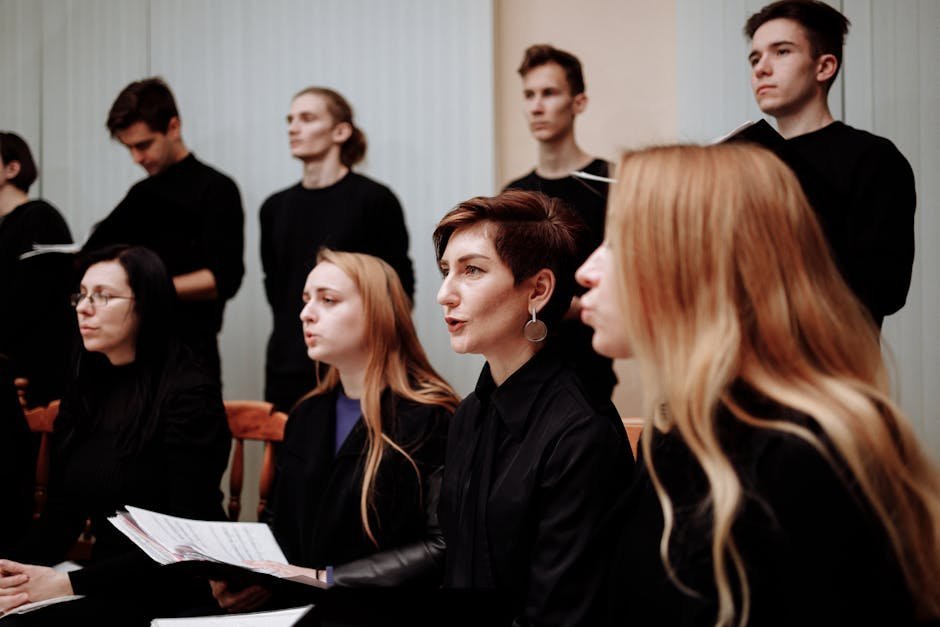
If you have ever wondered why singing for mental health shows up in research papers from London to Helsinki, the short version is that the voice is a uniquely complete intervention. It involves the breath, the body, the brain, social attention, and emotional expression all at once, and it is one of the few practices that recruits the vagus nerve directly. Choirs add the social ingredient that makes it sticky. This guide walks through the evidence, the mechanisms, the specific therapeutic protocols already in clinical use, and how to find a free or low-cost place to sing this week.
Why singing for mental health reaches the vagus nerve
The vagus nerve runs from the brainstem through the throat, lungs, heart, and gut, and is the parasympathetic switch that downshifts the body out of fight-or-flight. Sustained singing on a long exhalation lengthens the breath, vibrates the laryngeal muscles the vagus innervates, and stretches the diaphragm. Heart rate variability, a marker of vagal tone, rises measurably during group singing. The mechanism is not mystical. It is anatomy paired with attention.
Diaphragmatic singing, with a slow exhale across a held note, gets the strongest effect. Shouting along to a pop song in your car helps, but a sustained sung phrase in a choir setting is the stronger lever. The body cannot easily stay in panic mode while it is producing a long, supported tone.
What Daisy Fancourt’s research found
Daisy Fancourt and colleagues at University College London have spent more than a decade documenting the biological effects of group singing. Their studies in cancer patients and caregivers showed measurable drops in cortisol, the body’s main stress hormone, after a single 70-minute choir rehearsal, alongside improvements in mood scores. Other work in the same lab found shifts in cytokine profiles consistent with reduced inflammation. None of this means singing cures cancer or depression. It does mean a low-cost, weekly group activity produces the kind of biological signal researchers usually need a drug to elicit.
Population-level work, including the long-running Sing With Us program supported by the Tenovus Cancer Care charity, has tracked outcomes in thousands of singers and consistently shows reductions in anxiety and depression scores over months of participation. The dose appears to matter. Weekly attendance over six to twelve months produces clearer effects than occasional drop-ins.
Sweet Adelines, Sing for Hope, and the social ingredient
Sweet Adelines International is a women’s barbershop network with hundreds of chapters across North America. Members typically describe the friendships and the weekly structure as more important than the singing itself, which is the point. Sing for Hope places donated pianos in public spaces and runs programs in hospitals, schools, and shelters. Both organizations function as community medicine even though neither was designed as therapy.

The social mechanism is well documented. Singing in a group requires synchronizing breath and timing with other people, which produces the same kind of bonding effects observed in other coordinated activities like rowing or marching. Endorphin and oxytocin release have been measured after group singing sessions. For people whose depression or anxiety is rooted in social isolation, this is not a nice-to-have. It is the active ingredient. Our piece on friendship and community covers the broader case for relational intervention.
Parkinson’s-specific singing therapy and LSVT LOUD
Lee Silverman Voice Treatment, known as LSVT LOUD, is a clinically validated speech and voice therapy for people with Parkinson’s disease, developed in the 1980s and refined through dozens of randomized trials. The protocol uses high-effort vocalization, sustained vowels, and singing-adjacent exercises to push back against the soft, mumbled speech that the disease produces. Improvements in voice volume, swallowing safety, and quality-of-life measures persist for months after a four-week course.
Parkinson’s-specific community choirs, often called Parkinson Singers or Tremble Clefs, extend the practice into a weekly group context. The Parkinson Foundation maintains a directory. Mental health benefits track with the broader choir literature, with the added bonus of a voice that can still be heard at the dinner table.
Music for Dementia and the MDMC tradition
Music for Dementia and Memory Care, often abbreviated MDMC in clinical settings, draws on the well-documented preservation of musical memory in advanced dementia. People who can no longer recognize their spouse can often sing every word of a hymn from their teens. Memory care units that build a regular singing program report fewer agitation episodes, lower antipsychotic use, and easier evenings during the so-called sundowning hours.
This is a place where credentialed music therapists, board certified through the Certification Board for Music Therapists, do their best work. They can structure a session, choose era-appropriate repertoire, and collaborate with nursing staff on care goals. Volunteer choirs that visit memory care units add value, but the therapeutic-grade work happens with trained professionals. Our deeper dive on music therapy covers the difference.
Choir as community medicine for loneliness
The Surgeon General’s 2023 advisory framed loneliness as a public health emergency comparable in mortality risk to smoking. Group singing addresses loneliness on three levels at once. The weekly meeting builds routine. The shared task removes the awkwardness of small talk. The performance cycle, with its rehearsals and concerts, gives a structure of small commitments and meaningful payoffs that depression often dismantles in private life.
- The structure of weekly rehearsals creates external accountability that internal motivation cannot match during a depressive episode
- Group singing produces synchronized breathing patterns, which research links to social bonding and reduced threat reactivity
- Concerts and performances replace the isolating cycle of avoidance with manageable, meaningful exposures
- The intergenerational mix typical in community choirs interrupts age-segregated loneliness in retirement and young adulthood alike
- Many choirs build informal mutual-aid networks that surface during illness, bereavement, and life transitions
Finding a community choir near you
The Chorus America directory lists hundreds of community choirs across the United States, searchable by zip code, voice part, audition status, and repertoire. The American Choral Directors Association maintains a similar resource. Religious institutions, even ones you do not belong to, often welcome new singers and run rehearsals as much for community as for worship. Public libraries, senior centers, and community colleges frequently host non-audition choirs that cost nothing or close to nothing.
Specialty choirs exist for nearly every population. Recovery choirs for people in addiction recovery, threshold choirs that sing at bedsides, LGBTQ+ community choruses, grief choirs, dementia caregiver choirs. The GALA Choruses network is a hub for LGBTQ+ choral groups. Gospel and praise choirs are widely available in Black faith communities and many Latinx parishes. The diversity of options means the right group probably exists within driving distance of you.
Therapeutic singing versus performance singing
Performance singing, the kind taught in conservatories and Broadway studios, has technical goals and competitive pressures that can backfire for someone seeking mental health benefits. Therapeutic singing, by contrast, is process-focused. The director cares whether you showed up, breathed, and felt steadier at the end. The product matters, but the process is the medicine. Some auditioned choirs are warm and supportive enough to do both, but a non-audition group is the safer bet for someone testing the waters during a depressive episode or a grief season. We weave this kind of process-first orientation into our broader work on mindfulness meditation, where attention to the breath does much of the same work without the social ingredient.
If you cannot find a choir, sing anyway
Solo singing in the car, the shower, or while cooking has measurable effects on mood and breath quality, even though it lacks the social ingredient. Online choir platforms, including Pop-Up Choir and Sofa Singers, run live group sessions where participants sing along on muted microphones with a director leading in real time. The acoustic and social signal is thinner than in person, but the breath work remains, and many people who started in a pandemic-era online group later joined a physical choir near them.
Frequently asked questions
Do I need to be a good singer to benefit?
No. The mental health benefits documented in the research come from the breath, the body, and the social context, not from vocal quality. Non-audition community choirs welcome people who have never sung outside a car. Many directors will tell you the most useful skill is showing up consistently.
Is singing alone almost as good?
It captures the breath and embodiment piece, which is real, but it misses the social bonding ingredient that drives much of the research effect. If isolation is part of why you feel low, group singing is the higher-yield option.
Will singing help severe depression by itself?
It is an adjunct, not a replacement. People in severe depression often need therapy, medication, and sometimes more intensive care. A weekly choir adds structure, breath work, and connection that complement those treatments and may reduce relapse risk over time.
What if I am self-conscious about my voice?
Most non-audition choirs are designed for exactly that. Sit in the middle of your section, where stronger voices anchor you, and let your sound match the people around you. Within a few rehearsals, the self-consciousness usually fades because the group is paying attention to the music, not to you.
Are there singing programs for trauma survivors?
Yes. Trauma-informed choirs and programs run by music therapists exist in many cities, often connected to refugee resettlement organizations, veterans’ groups, and domestic violence shelters. The American Music Therapy Association can help locate credentialed practitioners who run trauma-aware groups.
The bottom line
Group singing is a low-cost, high-yield mental health intervention with a growing base of biological evidence behind it. The breath calms the nervous system, the vibration soothes the body, the synchrony bonds the group, and the schedule fights isolation in a way few other practices can match. You do not need talent, training, or a warm house. You need a Tuesday night and the willingness to stand in a row of people and exhale a long note together. Pair it with therapy or medication if you need those, and consider it a regular dose of community medicine for as long as you can keep going back.
If you are in crisis, please call or text the 988 Suicide and Crisis Lifeline, available 24 hours a day across the United States. You can also explore research summaries through the National Institutes of Health at nih.gov and find credentialed practitioners through the American Music Therapy Association at musictherapy.org.
This article is for educational purposes only and is not medical advice. Group singing is generally safe but is not a substitute for professional mental health treatment. If you have voice disorders, recent surgery, or significant respiratory illness, talk with a clinician before joining a choir.