Helena Vasquez, a 29-year-old paralegal in Sacramento, walked into a public library on a Saturday in February because her therapist, after fourteen sessions, had said something that surprised her. “Read Mind Over Mood, slowly, do the worksheets.” Helena had expected another referral or a new medication conversation. She got a book recommendation and a soft instruction to keep coming. She found the book on the second floor, in a section labelled, almost shyly, “self help.” She borrowed it, read three chapters that night, and started filling in the thought records the next morning. By her sixteenth session her panic attacks had dropped from three a week to one every two weeks. The book had not replaced therapy. It had made therapy work faster, because she was now arriving at sessions with clarified material and homework already done. Bibliotherapy, the clinical practice of using books as a structured part of mental health treatment, has a longer and more serious research history than most American readers realise. Bibliotherapy mental health work is not “self-help” in the airport-paperback sense. This guide explains what the evidence shows, what to read, and how reading complements rather than replaces care.

Books on Prescription: The NHS Model
The United Kingdom’s National Health Service runs a programme called Reading Well Books on Prescription. General practitioners and mental health professionals can prescribe specific titles drawn from a curated, evidence-reviewed list, and patients can collect those titles for free at participating public libraries. The titles are chosen by panels including clinicians, librarians, and people with lived experience of the conditions in question. Coverage spans common mental health concerns, dementia, long-term physical conditions, and children’s wellbeing.
The model exists because guided self-help reading, particularly cognitive behavioural workbooks, has been shown in multiple randomised trials to produce clinically meaningful improvements in mild to moderate anxiety and depression. The United States has no equivalent national programme, but the underlying research is the same. American librarians and clinicians can and do recommend the same titles informally. The list of evidence-supported workbooks is not long, and most of it has been on shelves for decades.
Mind Over Mood and the CBT Workbook Tradition
Dennis Greenberger and Christine Padesky’s Mind Over Mood, first published in 1995 and revised in 2015, is the most studied self-help workbook in cognitive behavioural therapy. Trials of the book, used either alone or as homework alongside therapy, have shown depression score reductions comparable to a partial course of in-person CBT. The workbook teaches thought records, behavioural experiments, and core belief work in language a high-school graduate can follow.
David Burns’s Feeling Good, originally published in 1980, is older but equally well-studied. Several trials of “bibliotherapy with Feeling Good” have shown reductions in mild to moderate depression that persist at three- and six-month follow-up, particularly when readers complete the embedded exercises. The book reads as dated to modern eyes. The mechanism still works. People who complete the worksheets, not just read the prose, get the benefit.
Self-Compassion: Kristin Neff’s Framework
Kristin Neff, a researcher at the University of Texas at Austin, has spent two decades studying self-compassion as distinct from self-esteem. Her book Self-Compassion: The Proven Power of Being Kind to Yourself summarises the construct and walks readers through guided exercises. Trials of self-compassion training, often using Neff’s mindful self-compassion protocol, have shown reductions in anxiety, depression, and shame across populations including military veterans, healthcare workers, and survivors of trauma.
The framework distinguishes self-compassion from self-pity, self-indulgence, and self-esteem. The distinction matters clinically because clients often resist self-compassion practices on the assumption they will lower standards or excuse harmful behaviour. The research shows the opposite. People who practise self-compassion are more likely to take responsibility for mistakes and persist after failure than those who rely on self-esteem alone. Pairing self-compassion practice with the work in our mindfulness meditation guide tends to deepen both.

The Body Keeps the Score and Trauma Reading
Bessel van der Kolk’s The Body Keeps the Score is the most widely read trauma book of the last decade. Its strengths include accessible explanations of polyvagal theory, EMDR, and somatic approaches, alongside case studies that help readers locate their own experience. Its weaknesses, often missed in popular reception, include the fact that simply reading about trauma is not, by itself, trauma treatment. People with significant trauma histories sometimes read the book and become more activated, not less, particularly if they read alone and at night.
The recommended use is to read it in tandem with therapy, ideally with a clinician trained in trauma. Reading the book before finding such a clinician can be reasonable as orientation. Reading it as a substitute for therapy is risky. Our guide on healing from adult childhood trauma covers the broader treatment landscape. The combination of curated reading and structured therapeutic work, as covered in our recovery toolkit guide, tends to be safer than any single channel.
Fiction, Empathy, and Narrative Transportation
Self-help is not the only branch of bibliotherapy with research behind it. Studies on “narrative transportation,” the experience of being absorbed into a story, suggest that fiction reading correlates with measurable improvements in theory of mind, empathy, and perspective-taking. Keith Oatley and Raymond Mar at the University of Toronto have produced much of this work. Their findings suggest that literary fiction in particular, with complex characters and ambiguous moral situations, sharpens social cognition in ways that genre fiction and non-fiction do less reliably.
For people whose mental health concerns include relational difficulty, social anxiety, or recovery from emotionally constrained childhoods, regular fiction reading can be a quiet, slow, durable form of practice. The mechanism is exposure. Spending time inside the inner lives of fictional characters expands the reader’s repertoire of recognised emotional states. The benefit shows up in subtle ways. Conversations get easier. Reading other people’s faces gets easier. The effect is small per book and substantial across years.
Librarian-Led Reading Groups
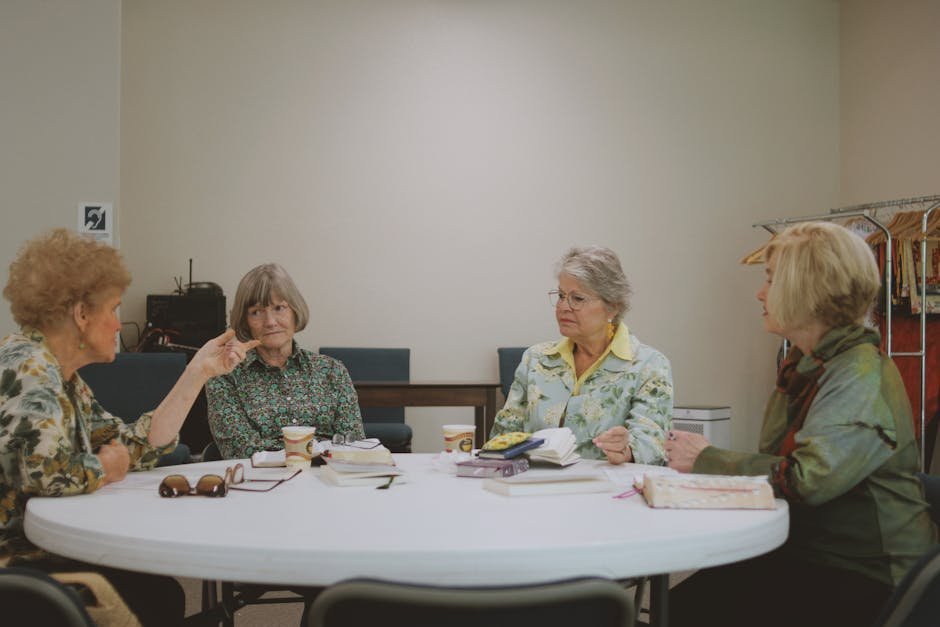
The reading group, hosted by a public library or community centre, is one of the most under-recognised mental health interventions in American civic life. The format combines several evidence-supported ingredients. It creates weak social ties through regular meeting. It gives the week a structural anchor. It exposes participants to perspectives outside their own. And it requires modest preparation between sessions, which provides the small pull of obligation that depression often dissolves.
Some libraries run themed groups around grief, recovery, or specific life transitions. These shade into formal bibliotherapy. Others are simply book clubs that, by happy accident, do much of the same work. For people unable or unwilling to commit to therapy, a regular library reading group is one of the lowest-friction starting points available, and almost always free.
Distinguishing Evidence-Based Self-Help from Pop Psychology
The self-help shelf is large and the evidence base is small. A few markers help separate clinically grounded books from wellness performance.
- The author’s credentials. PhD or MD with a track record of peer-reviewed research is a stronger signal than “best-selling speaker” or “wellness expert.”
- Cited research, with footnotes or endnotes pointing to actual studies, not just other popular books.
- Embedded exercises, worksheets, or practice protocols, rather than prose alone. Bibliotherapy works through doing, not reading.
- Acknowledgement of limits. Books that claim to cure all conditions through one technique are reliably less helpful than books that name when professional help is required.
- Endorsements from practising clinicians and academic reviewers, not just other authors in the same wellness ecosystem.
According to the National Institutes of Health, the strongest evidence for self-help reading involves CBT-based workbooks used as either standalone interventions for mild conditions or as homework adjuncts to professional treatment for moderate ones. The American Psychological Association’s guidance on evidence-based practice echoes the same emphasis on workbook formats with embedded exercises.
Audiobooks and Accessibility
Print is not the only valid format. Audiobooks, large-print editions, and e-books with adjustable text size matter for readers with dyslexia, vision changes, ADHD, chronic pain that prevents sitting, and the simple reality of long commutes. The bibliotherapy research has historically been done with print, but the active ingredient appears to be the encounter with the text, not the medium. Self-Compassion, Mind Over Mood, and Feeling Good all have audiobook versions. CBT workbooks lose something in audio because the worksheets cannot be filled in while listening, but the prose chapters travel well.
For workbook-based bibliotherapy, the practical compromise is to listen to the prose chapters during commutes and complete the written exercises in print or on a tablet. People who insist on either pure audio or pure print sometimes abandon the practice entirely. The hybrid version is more likely to last.
Frequently Asked Questions
Can a self-help book replace therapy?
For mild anxiety or depression, an evidence-supported workbook with completed exercises can sometimes be enough. For moderate to severe symptoms, books support therapy rather than replacing it.
How do I know which book to start with?
Match the book to the concern. Mind Over Mood and Feeling Good for depression and anxiety. Self-Compassion for shame and self-criticism. The Body Keeps the Score for trauma orientation, ideally alongside a therapist.
Do I have to do the exercises?
For workbook-based bibliotherapy, yes. The research effects are tied to completing the worksheets, not just reading the chapters. Reading without practice produces much smaller benefits.
Is fiction reading actually therapeutic?
Fiction reading correlates with improvements in empathy and theory of mind across multiple studies. The effect is smaller per book than a CBT workbook but accumulates across years of regular reading.
What if a book makes me feel worse?
Stop reading and consider whether the topic requires therapeutic support. Trauma books in particular can activate symptoms in readers without adequate containment. Close the book and reach out to a clinician.
The Bottom Line
Bibliotherapy is a recognised clinical practice with decades of evidence, particularly for cognitive behavioural workbooks used to treat mild to moderate anxiety and depression. The United Kingdom’s Books on Prescription scheme exists because the trials worked. Reading also offers, through fiction, a slower form of practice in empathy and emotional vocabulary that supports mental health across years rather than weeks. The catch is the same as with every other tool covered in this series. Books help when they sit alongside care, not in place of it, and when the reader actually completes the exercises rather than just turning the pages.
If you are in crisis, in the United States call or text 988 to reach the Suicide and Crisis Lifeline. The 988 Lifeline provides free, confidential support 24/7 for people in distress and for those worried about someone else.
This article is for educational purposes only and does not constitute medical advice. Bibliotherapy and self-help reading are not substitutes for diagnosis or treatment from a qualified mental health professional. If you are experiencing depression, anxiety, trauma symptoms, or suicidal thoughts, please consult a licensed clinician.