The Three AM Question
It is three in the morning. You cannot sleep. Your chest feels tight. Your thoughts are spiraling. The anxiety that has been building for weeks has finally become unbearable. Or maybe it is not anxiety at all. Maybe the depression has shifted into something darker, something that makes you wonder whether life is worth living. Maybe you are worried about someone else, a family member or a friend who has stopped answering texts and seems to be disappearing into a place you cannot reach.
You know you need help. But where do you go at three in the morning?
This is not a situation where searching for mental health providers near me makes sense. Most therapists’ offices open at nine and close at five. Psychiatrists book weeks or months out. The system that works well for routine care collapses completely during a crisis.
The good news is that the United States has been building a crisis response system specifically for moments like this. The bad news is that most people do not know it exists until they are already in distress.
This guide walks through every option for immediate mental health care in the United States. You will learn what the 988 Suicide and Crisis Lifeline actually does, when to go to an emergency room versus when to call a mobile crisis team, how to prepare for a psychiatric hospitalization if one becomes necessary, and what to do if you are worried about someone else. You will also learn how insurance including UnitedHealthcare therapists and other provider networks cover crisis services differently than routine care.
No judgment. No platitudes. Just the information you need when you need it most.
The 988 Lifeline: What Happens When You Call or Text
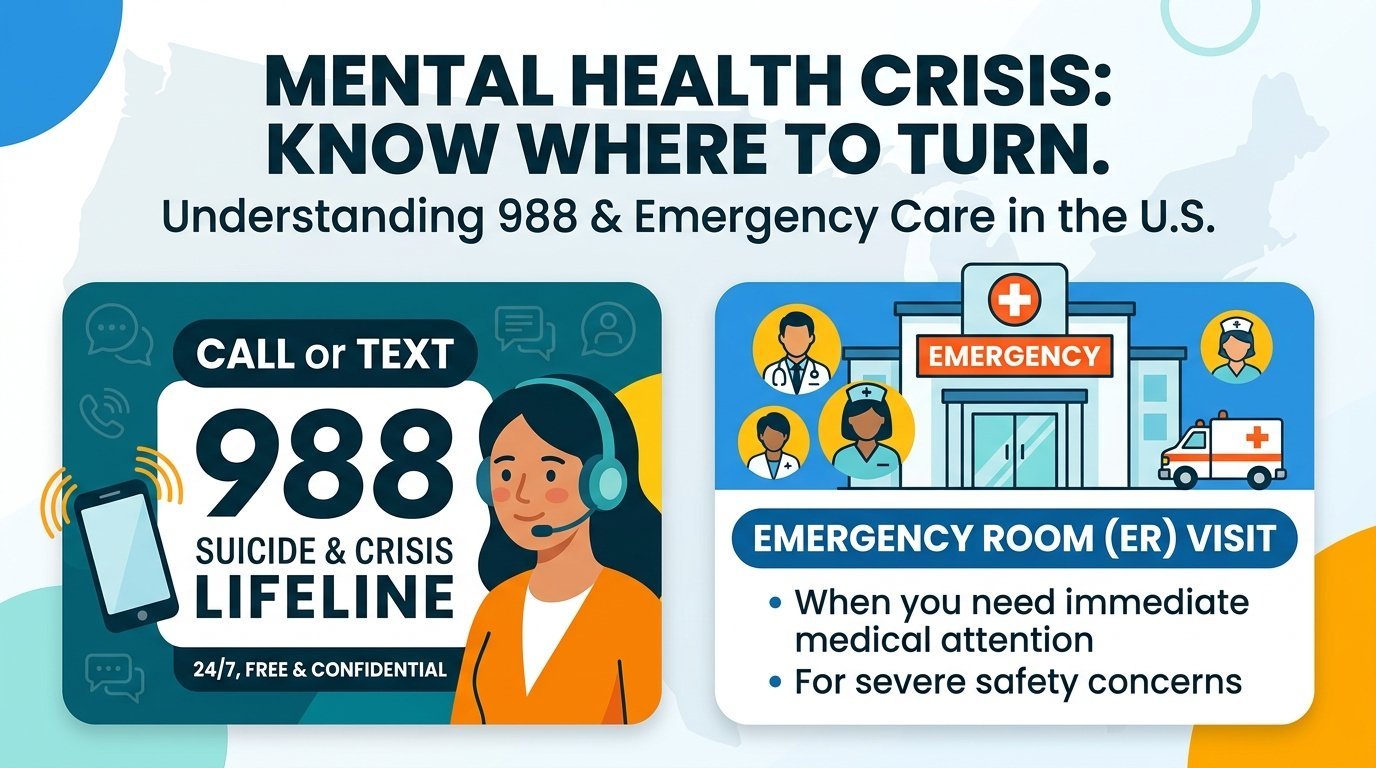
On July 16, 2022, the United States launched 988 as the new nationwide number for mental health crises. It is designed to work like 911 but specifically for mental health care. Understanding what 988 actually does can help you decide whether to call.
Who Answers the Phone
When you call 988, you are connected to a trained crisis counselor at one of over two hundred local crisis centers across the country. These counselors undergo specialized training that includes:
- De-escalation techniques for people in acute distress
- Active listening skills that validate rather than minimize
- Safety planning and lethal means counseling
- Referral to local mental health providers near me including mobile crisis teams and crisis stabilization units
The person who answers is not a therapist. They cannot provide ongoing mental health care. But they can help you get through the next hour and connect you to resources that will help beyond that.
When to Call 988
Call 988 if you or someone you care about is experiencing:
- Thoughts of suicide, even without a specific plan
- Overwhelming anxiety or panic that you cannot manage
- Severe depression that makes it hard to function
- Thoughts of harming someone else
- Hallucinations or delusions that are distressing
- Extreme agitation or rage that feels out of control
Call 988 even if you are not sure whether your situation qualifies. There is no penalty for calling when the situation is less severe than you thought. The counselors would rather talk to someone who is worried than miss someone who needs help.
What 988 Does Not Do
There are important limitations to understand:
988 does not send emergency services automatically. Unlike 911, calling 988 does not dispatch police or ambulances unless the counselor determines there is an immediate, imminent danger and you cannot keep yourself safe. Most 988 calls end with a safety plan and a referral, not a police visit.
988 counselors cannot prescribe medication or provide therapy. They are crisis intervention specialists, not clinicians. They can help you find mental health care for ongoing treatment, but the call itself is not treatment.
988 may not be able to help if you are currently in a medical emergency. If you have taken an overdose or are actively bleeding from self-harm, call 911 or go to the emergency room. 988 counselors will tell you the same thing.
Text and Chat Options
If you cannot or do not want to speak on the phone, 988 also offers text and chat. Text 988 from your mobile phone to connect with a crisis counselor via text message. Visit 988lifeline.org to use the chat feature. These options work the same way as phone calls, though response times may be slightly longer during high-volume periods.
Emergency Rooms and Psychiatric Care
For many people experiencing a severe mental health crisis, the emergency room becomes the entry point to care. Understanding what happens in the ER can reduce fear and help you prepare.
Why Go to the ER Instead of Calling 988
Call 988 first in most situations. But go directly to the ER or call 911 if:
- You have already taken an overdose or harmed yourself physically
- You have a specific plan to kill yourself and access to means
- You cannot keep yourself safe long enough for a 988 counselor to help
- You are hearing voices telling you to hurt yourself or others
- You are confused, disoriented, or unable to communicate clearly
The ER is also the right choice if the person in crisis is unwilling or unable to call 988 themselves. Emergency medical services can transport someone who is refusing care if they meet criteria for involuntary evaluation.
What Happens in the Psychiatric ER
Most emergency rooms have a designated area for psychiatric patients, though smaller hospitals may not. The process typically includes:
Medical clearance: Before any psychiatric evaluation, a doctor must rule out medical causes for your symptoms. A urinary tract infection in an older adult can cause confusion that looks like dementia. A thyroid disorder can cause anxiety or depression. Low blood sugar can cause agitation. The medical clearance includes blood work, vital signs, and a physical exam.
Psychiatric evaluation: A psychiatrist, psychiatric nurse practitioner, or licensed clinical social worker will interview you about your symptoms, history, current medications, and safety. This evaluation determines the appropriate level of care.
Disposition decision: Based on the evaluation, the provider will decide whether you can go home with a safety plan and follow-up appointment, need admission to a psychiatric unit, or need transfer to a different facility.
How Long the ER Visit Takes
Plan for a long wait. Psychiatric ER visits average six to twelve hours, sometimes longer. Some of this time is necessary for medical clearance. Much of it is waiting for a psychiatric bed if admission is recommended. There are far fewer psychiatric beds in the United States than needed, which means patients often wait in the ER for days.
What you can do to make the wait tolerable:
- Bring a phone charger and headphones
- Tell the triage nurse about any medical conditions or allergies
- Ask for updates every few hours if no one is communicating with you
- Bring a trusted person if allowed (policies vary)
Insurance Coverage for ER Psychiatric Care
Emergency psychiatric care is covered by insurance under the Mental Health Parity Act. However, coverage details matter.
| Insurance Type | ER Copay (Typical) | Coinsurance (Typical) |
|---|---|---|
| PPO | 150–500 | 10% – 20% after deductible |
| HMO (with prior authorization for admission) | 150–500 | 10% – 20% after deductible |
| Medicare Part B | 0–50 | 20% of approved amount |
| Medicaid | 0–25 | Varies by state |
Critical note: If you are admitted to the hospital from the ER, your ER copay is typically waived or reduced. The hospital admission benefits replace the ER copay. Ask the patient financial counselor about this if you receive a separate ER bill after admission.
When searching for UnitedHealthcare therapists or other in-network providers for follow-up care after an ER visit, ask specifically about “transitional care” or “post-discharge appointments.” Many practices prioritize patients who are being discharged from crisis care.
Mobile Crisis Teams: The Third Option
Between a phone call to 988 and an ER visit sits a third option: mobile crisis teams. These are teams of mental health professionals who come to you.
What Mobile Crisis Teams Do
A mobile crisis team typically includes a licensed clinician (social worker, psychologist, or psychiatric nurse) and sometimes a peer support specialist. They arrive at your home or wherever you are and provide:
- On-site psychiatric assessment
- Crisis de-escalation and stabilization
- Safety planning
- Connection to ongoing mental health care
- Transportation to a crisis stabilization unit or hospital if needed
Mobile crisis teams can often resolve a crisis without hospitalization. A person who is suicidal but willing to safety plan can stay home with follow-up appointments rather than spending days in a hospital.
Where Mobile Crisis Teams Exist
Mobile crisis services are not available everywhere. Coverage is best in urban and suburban areas. Rural counties often lack funding for mobile teams.
To find out if mobile crisis services exist in your area, call 988. The crisis counselor can tell you whether a mobile team is available and how to request one. You can also call your county behavioral health department directly.
How Much Mobile Crisis Costs
Mobile crisis services are typically free to the person in crisis. They are funded through a combination of state mental health dollars, county taxes, and grants. Insurance is not billed for most mobile crisis responses, though some programs bill Medicaid.
If you have private insurance including UnitedHealthcare, ask whether your plan covers mobile crisis services. Even if it does not, the service is usually provided at no cost. Do not let fear of a bill keep you from calling.
Crisis Stabilization Units: The Short-Term Alternative to Hospitalization
Crisis stabilization units (CSUs) are short-term residential facilities for people in acute mental health crisis. They offer an alternative to psychiatric hospitalization for people who need more than a phone call but less than a week of inpatient care.
What a CSU Looks Like
CSUs are small facilities, typically with eight to sixteen beds. Patients stay for three to seven days. Services include:
- Twenty-four-hour supervision by mental health staff
- Daily groups on coping skills and symptom management
- Individual check-ins with a clinician
- Medication management and administration
- Three meals daily
- Discharge planning and connection to ongoing care
CSUs are designed to feel less restrictive than hospitals. Patients typically keep their phones and wear their own clothes. The goal is stabilization in the least restrictive environment possible.
Who Belongs in a CSU
CSUs are appropriate for people who:
- Are at moderate risk of suicide but can safety plan
- Need medication adjustment or initiation
- Need a break from a stressful home environment
- Do not have a safe place to go for a few days
- Have acute symptoms that are not responding to outpatient care
CSUs are not appropriate for people who are actively homicidal, medically unstable, or require detoxification from severe substance withdrawal.
Accessing a CSU
You cannot directly admit yourself to most CSUs. The typical pathways are:
- Referral from 988
- Referral from a mobile crisis team
- Transfer from an emergency room
- Direct referral from a therapist or psychiatrist
Call 988 to explore CSU options in your area. If a CSU is available and appropriate, the crisis counselor can help facilitate the referral.
Creating a Crisis Plan Before You Need One
The worst time to figure out the mental health care system is when you are in crisis. Creating a crisis plan when you are well takes fifteen minutes and can save your life.
What to Put in Your Crisis Plan
Write down the following information and store it somewhere accessible (phone notes app, wallet card, shared with a trusted person):
Personal information:
- Your full name, date of birth, and address
- Emergency contact name and phone number
- Your diagnosis (if you have one)
- Current medications and dosages
- Medication allergies
- Your therapist’s name and phone number
- Your psychiatrist’s name and phone number
- Your insurance information including policy number
Early warning signs:
List the subtle changes that tell you a crisis might be coming. Examples: “Not sleeping for two nights in a row” or “Thinking about death more than once a day.”
Coping strategies:
List three to five things that have helped you in the past. Be specific. “Call my sister and tell her I am struggling” not just “reach out.”
Professional resources:
- 988 Suicide and Crisis Lifeline
- Your therapist’s after-hours number
- Your local mobile crisis team number (call 988 to get it)
- The nearest ER with psychiatric services
Logistical information:
- Who can pick up your children if you need to go to the hospital
- Who can feed your pets
- Who can notify your employer
- Where important documents are kept
Sharing Your Crisis Plan
A crisis plan does no good if no one knows it exists. Share a copy with:
- A trusted family member or friend
- Your therapist
- Your psychiatrist
- Any other providers on your mental health care team
Give these people permission to act on the plan if you cannot act for yourself. This permission is critical. Many people in crisis lose the ability to make good decisions or pick up the phone.
What to Do If You Are Worried About Someone Else
Watching someone you love struggle with their mental health is agonizing. You want to help. You are afraid of making things worse. Here is what actually works.
How to Start the Conversation
Do not wait for the perfect moment. There is no perfect moment. Say something like:
“I have noticed you have not seemed like yourself lately. I am not trying to tell you what to do, but I am worried about you. Can we talk about what is going on?”
If the person opens up, listen without interrupting. Do not offer solutions. Do not tell them to think positive. Just listen.
Asking the Direct Question About Suicide
Many people fear that asking about suicide will put the idea in someone’s head. Research shows the opposite. Asking directly reduces distress by giving the person permission to talk about what they are already thinking.
Ask: “Are you having thoughts of hurting yourself or ending your life?”
If the answer is yes, ask follow-up questions:
- Do you have a plan?
- Do you have access to what you would need to carry out that plan?
- What has stopped you from acting on these thoughts so far?
When to Call 988 for Someone Else
You can call 988 on behalf of someone else. The crisis counselor can help you:
- Assess the level of risk
- Develop a safety plan you can share with the person
- Identify local resources including mobile crisis teams
- Practice what to say when you talk to the person
Call 988 even if the person is not currently in crisis. Prevention is the goal.
When to Call 911 for Someone Else
Call 911 if:
- The person has already harmed themselves
- The person has a gun or other weapon and is threatening suicide
- You cannot keep the person safe and they are refusing help
- The person is so confused or disoriented that they are a danger to themselves
Tell the 911 dispatcher explicitly: “This is a mental health crisis. Please send crisis intervention trained officers if available.” Many departments now have Crisis Intervention Team (CIT) officers with specialized training in de-escalation.
After the Crisis: Transitioning Back to Ongoing Care
A crisis resolved is not the end. It is the beginning of the next phase of mental health care. The days and weeks after a crisis are when the risk of recurrence is highest.
The 72-Hour Window
The seventy-two hours after a crisis are critical. During this time:
- Attend all follow-up appointments, even if you feel fine
- Do not drink alcohol or use non-prescribed substances
- Remove access to lethal means from your home (firearms, unused medications, sharp objects)
- Stay connected to your support people
- Use your coping strategies even if you do not feel like it
Finding Ongoing Mental Health Providers Near Me After a Crisis
If you did not have a therapist or psychiatrist before the crisis, finding mental health providers near me becomes urgent after stabilization. Use these accelerated pathways:
Ask the ER or CSU for a warm handoff. Many psychiatric ERs have social workers who will call a clinic and make an appointment for you before you leave. Do not leave without a scheduled follow-up.
Call your insurance company. When you call for UnitedHealthcare therapists or other in-network providers, tell them you are being discharged from crisis care. Insurers often have expedited processes for post-crisis appointments.
Accept interim care. The first available therapist may not be your ideal fit. See them anyway while you continue searching for a long-term provider. Something is better than nothing during the post-crisis period.
Frequently Asked Questions About Mental Health Crisis Care
What is the difference between 988 and 911?
988 is for mental health crises where there is no immediate medical emergency. 911 is for medical emergencies, active violence, or situations where someone is imminently dangerous to themselves or others. When in doubt, call 988 first. They will tell you if you need 911 instead.
Can I call 988 for my child?
Yes. Parents can and should call 988 for children experiencing mental health crises. The crisis counselor will ask about the child’s age and developmental stage to provide age-appropriate support.
Will calling 988 put me on a government list?
No. 988 calls are confidential. The crisis center does not share your information with law enforcement, employers, or insurance companies unless there is an immediate, imminent danger that requires emergency response.
What if I have UnitedHealthcare and the crisis center is not in my network?
Crisis services including 988, mobile crisis teams, and emergency room psychiatric evaluations are covered under federal parity laws regardless of network status. Insurers cannot deny coverage for emergency mental health care because the provider is out-of-network. If you receive a bill, appeal.
How do I find mental health providers near me for follow-up care after a crisis?
Start with the discharge planner at the hospital or CSU. Then call your insurance company’s behavioral health line. Tell them you need a post-crisis appointment within seven days. Most insurers have protocols to expedite these appointments.
Final Thoughts: You Are Not Alone in the Crisis
The moment when you realize you need mental health care and cannot wait is terrifying. Your brain is not working the way it usually does. Your judgment is compromised. The simplest tasks feel impossible.
That is why the crisis system exists. Not because you failed at managing your mental health. Because crises are a normal part of living with a chronic condition, and you deserve a safety net when they happen.
The people on the other end of the 988 line have talked to thousands of people in the same situation you are in right now. They will not be shocked by anything you say. They will not judge you. They will not call the police unless you are about to die and there is no other way to save you.
All you have to do is pick up the phone.
If you are reading this because you are worried about someone else, all you have to do is start the conversation. Ask the question. Make the call. Your hesitation is understandable, but the cost of waiting could be everything.
The crisis system is not perfect. It is underfunded and overstretched. But it exists. And for millions of Americans, it has been the difference between life and death.
If you need it, use it. That is what it is there for.
Disclaimer: This article provides general educational information about mental health crisis services in the United States. It does not constitute medical advice or a substitute for professional clinical assessment. If you are in immediate danger of harming yourself or someone else, call 911 or go to the nearest emergency room. The 988 Suicide and Crisis Lifeline is available 24/7 for anyone experiencing a mental health crisis. You deserve help. You are not alone.