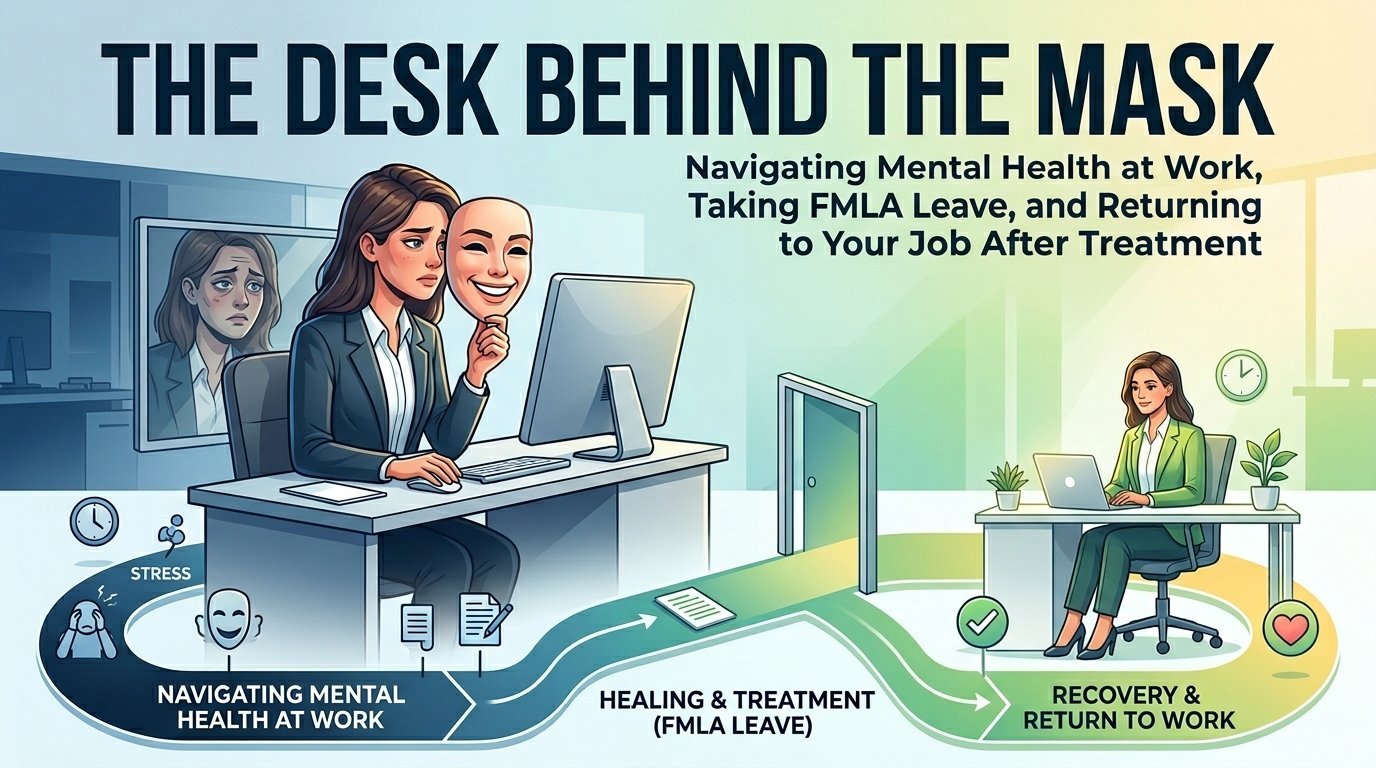
The Performance Nobody Sees
You sit down at your desk at 9:00 AM. You open your email. You join the Zoom meeting. You nod at the right moments. You laugh when your coworker makes a joke. You answer questions when asked. From the outside, you look like a perfectly functional employee.
What your colleagues do not see is what it costs you. The anxiety that spiked at 3:00 AM has not gone away. Your chest feels tight. Your thoughts are scattered. You read the same email three times and still do not know what it says. You are running on four hours of sleep because the depression will not let your brain shut off.
You are performing. Every day. Every meeting. Every email. The mask is exhausting. And underneath the mask, you are falling apart.
You have been searching for mental health providers near me at night, when everyone else has logged off. You have thought about taking leave but do not know how to ask. You are terrified that telling anyone at work about your mental health care needs will end your career.
This guide is for you.
You will learn how to request reasonable accommodations for mental health conditions under the Americans with Disabilities Act, how to take medical leave under the Family and Medical Leave Act (FMLA), what to say to your employer (and what not to say), how to protect your privacy, and how to return to work after intensive mental health care including inpatient hospitalization or intensive outpatient programs. You will also learn how UnitedHealthcare therapists and other providers can document your need for leave or accommodations.
No naive optimism about supportive workplaces. No fear-mongering about discrimination. Just practical, legal guidance for protecting your career while you protect your health.
Your Legal Rights: What the ADA and FMLA Actually Do for Mental Health
Two federal laws protect employees with mental health conditions. Understanding both is essential before you talk to anyone at work.
The Americans with Disabilities Act (ADA)
The ADA protects employees from discrimination based on disability. It also requires employers to provide reasonable accommodations to qualified employees with disabilities.
What counts as a disability under the ADA? A physical or mental impairment that substantially limits one or more major life activities. Major life activities include working, concentrating, thinking, communicating, sleeping, and interacting with others.
Depression, anxiety disorders, bipolar disorder, PTSD, OCD, and many other mental health conditions qualify as disabilities under the ADA if they substantially limit any of these activities.
Which employers are covered? Employers with fifteen or more employees. State and local governments. Employment agencies. Labor organizations.
What does the ADA require? Your employer cannot discriminate against you because of your mental health condition. This means:
- Cannot fire you because you have depression
- Cannot refuse to hire you because you have a history of mental health care
- Cannot deny you promotions or training opportunities based on your condition
- Cannot harass you because of your condition
The ADA also requires your employer to provide reasonable accommodations unless doing so would cause undue hardship.
The Family and Medical Leave Act (FMLA)
FMLA provides eligible employees with up to twelve weeks of unpaid, job-protected leave per year for serious health conditions, including mental health conditions.
Who is eligible? You must have worked for your employer for at least twelve months. You must have worked at least 1,250 hours in the past twelve months (about twenty-four hours per week). Your employer must have at least fifty employees within seventy-five miles.
What qualifies as a serious health condition for FMLA? Inpatient care (overnight stay in a hospital or residential treatment facility) OR continuing treatment by a healthcare provider. For mental health conditions, continuing treatment includes:
- Regular therapy appointments
- Medication management visits
- Intensive outpatient programs
- Partial hospitalization programs
- Time off for treatment-related appointments
What does FMLA provide? Up to twelve weeks of unpaid leave per twelve-month period. Your job (or an equivalent position) must be held for you while you are on leave. Your employer must continue your health insurance benefits under the same terms as if you were working.
Is FMLA leave paid? FMLA itself is unpaid. However, you may be able to use accrued paid time off (vacation days, sick days, personal days) during your FMLA leave. Some employers offer paid parental leave, but paid medical leave is less common. A few states (California, New York, New Jersey, Rhode Island, Massachusetts, Washington, Connecticut, Oregon, Colorado, Maryland, Delaware, and D.C.) have paid family and medical leave programs.
State Laws
Many states have additional protections. Some state laws cover smaller employers than the ADA or FMLA. Some provide paid leave where federal law does not. Check with your state department of labor.
Reasonable Accommodations for Mental Health Conditions
A reasonable accommodation is a change to your job, your work environment, or your schedule that allows you to perform the essential functions of your position despite your mental health condition.
Common Accommodations for Mental Health Conditions
Accommodations vary by job and by individual need. Examples that have been approved under the ADA include:
Schedule modifications:
- Flexible start and end times to accommodate therapy appointments
- Permission to take breaks for medication or to use coping strategies
- Reduced work schedule (e.g., four days per week instead of five)
- Permission to work from home on difficult days
- Time off for medical appointments without using PTO
Changes to the work environment:
- A quieter workspace or permission to use noise-canceling headphones
- Cubicle with higher walls or a private office
- Lighting adjustments (reducing fluorescent lights that trigger anxiety)
- Permission to work from home full-time or partially
Changes to how work is done:
- Written instructions in addition to verbal instructions for complex tasks
- Breaking large projects into smaller steps with interim deadlines
- Regular check-ins with a supervisor to stay on track
- Permission to record meetings for later review
- Extended time for certain tasks
Time off:
- Unpaid leave beyond what FMLA provides
- Intermittent leave for therapy appointments or bad days
- Short-term disability for extended treatment
How to Request an Accommodation
The ADA does not require magic words. You simply need to tell your employer that you need a change because of a medical condition.
Step One: Decide what to disclose. You do not need to give your diagnosis. You do not need to share medical records. You only need to say that you have a medical condition and that you need a specific accommodation.
Step Two: Make the request in writing. Email your supervisor or human resources department. This creates a paper trail. Write:
“I am writing to request a reasonable accommodation under the Americans with Disabilities Act. I have a medical condition that affects [specific job function, e.g., concentrating on written tasks]. I am requesting [specific accommodation, e.g., written instructions for complex assignments]. I am willing to provide documentation from my healthcare provider if needed. Please let me know what information you require to process this request.”
Step Three: Provide documentation if requested. Your employer may ask for a letter from your mental health care provider confirming that you have a condition requiring accommodation. The letter does not need to include your diagnosis. It can say:
“To whom it concerns: [Employee name] is under my care for a medical condition. Due to this condition, the following accommodations are recommended: [list accommodations]. This condition is expected to last [duration]. Please contact me with any questions.”
Your therapist, psychiatrist, or primary care doctor can write this letter.
Step Four: Engage in the interactive process. Your employer may propose alternative accommodations that also meet your needs. The law requires both sides to work together in good faith. If your employer denies your request without offering alternatives or without a legitimate reason, that may be discrimination.
What Is Not a Reasonable Accommodation?
Your employer does not have to provide accommodations that would cause “undue hardship” — significant difficulty or expense. The employer’s size, resources, and the nature of the accommodation all matter.
Your employer also does not have to eliminate essential job functions. If your job requires you to interact with customers, you cannot request an accommodation that eliminates all customer interaction. You can request a different way of interacting (e.g., email instead of phone) if that still meets the essential function.
Taking FMLA Leave for Mental Health Treatment
FMLA leave can be taken continuously (all twelve weeks at once) or intermittently (individual days or partial days). Both options are available for mental health conditions.
Intermittent FMLA Leave for Therapy Appointments
Many employees with mental health conditions use intermittent FMLA leave to attend weekly therapy appointments. Instead of using vacation days or sick days, you can take FMLA leave for the two hours you are at your therapist’s office.
How to request intermittent FMLA leave for therapy:
Step One: Get certification from your provider. Your employer will provide an FMLA certification form. Your mental health care provider fills out the form, confirming that you have a serious health condition and that intermittent leave is medically necessary.
Step Two: Submit the certification to HR. Certification is confidential. HR should not share your diagnosis with your supervisor.
Step Three: Track your leave. You are responsible for tracking the hours you take under FMLA. Some employers provide a system. If not, keep your own records.
Step Four: Recertification. Your employer can ask for recertification every thirty days for intermittent leave.
Continuous FMLA Leave for Intensive Treatment
If you need intensive outpatient programs (IOPs), partial hospitalization programs (PHPs), or inpatient psychiatric care, you may need continuous FMLA leave.
How long does continuous leave last? Up to twelve weeks per year. IOPs typically last six to twelve weeks. PHPs last one to four weeks. Inpatient stays last three to fourteen days. Most mental health treatment fits within twelve weeks.
What if you need more than twelve weeks? Some employers offer additional unpaid leave as an accommodation under the ADA. The ADA and FMLA run concurrently. Once FMLA is exhausted, you can request additional unpaid leave as a reasonable accommodation.
Short-Term and Long-Term Disability
Many employers offer short-term disability (STD) and long-term disability (LTD) insurance. These policies provide partial wage replacement when you cannot work due to a medical condition, including mental health conditions.
Short-Term Disability: Typically covers sixty to eighty percent of your salary for up to six months. Waiting period (elimination period) is usually seven to fourteen days.
Long-Term Disability: Begins after STD ends. May cover you for years or until retirement age, depending on the policy.
Mental health limitations: Some disability policies limit mental health coverage to twenty-four months. Check your policy.
To file for disability benefits, your mental health care provider must complete paperwork documenting that you cannot perform your job duties due to your condition.
What to Say (And What Not to Say) to Your Employer
The decision to disclose a mental health condition at work is deeply personal. There is no right answer that applies to everyone.
Factors to Consider Before Disclosing
- Is your condition visible or affecting your work performance already?
- Does your employer have a positive track record with accommodation requests?
- Do you need an accommodation that requires disclosure?
- Are you protected by the ADA (employer with fifteen or more employees)?
- Can you achieve what you need without disclosing a diagnosis?
The Minimal Disclosure Approach
You almost never need to share your specific diagnosis. You can say “a medical condition” or “a health condition.” You can request an accommodation or FMLA leave without naming depression, anxiety, bipolar disorder, or any other specific condition.
Example for accommodation request: “I have a medical condition that affects my concentration in noisy environments. I am requesting a quieter workspace or permission to use noise-canceling headphones.”
Example for FMLA leave: “I have a serious health condition that requires treatment. My provider has certified that I need intermittent leave for medical appointments.”
When You Might Need to Share More
In some situations, you may need to share more information:
- Your accommodation request is unusual and requires explanation
- You work in a safety-sensitive position (e.g., operating heavy machinery)
- You are seeking a specific accommodation that is clearly related to a specific condition
Even then, share only what is necessary. Your HR department is trained to handle confidential medical information. Your supervisor may not need to know anything beyond the accommodation you need.
What Your Employer Cannot Ask
Under the ADA, your employer cannot ask:
- Do you have a mental illness?
- What is your diagnosis?
- What medications are you taking?
- Are you in therapy or seeing a psychiatrist?
Your employer can ask for documentation of your need for accommodation or FMLA leave. They cannot ask for your medical records or a detailed treatment history.
Returning to Work After Mental Health Treatment
Coming back to work after an IOP, PHP, or hospitalization is hard. The transition requires planning.
The Return-to-Work Process
Step One: Before you return, your mental health care provider should complete a return-to-work letter. The letter should state that you are cleared to return and may include recommendations for accommodations or a phased return.
Step Two: Meet with HR before your first day back. Discuss any accommodations you need. Discuss any concerns you have about stigma or privacy.
Step Three: Plan a phased return if appropriate. Going from zero hours to forty hours is hard. Ask about:
- Returning for half days for the first week
- Working from home for the first week
- Reduced schedule for the first two to four weeks
- A temporary reassignment to lower-stress duties
Step Four: Identify a point person. Who at work can you talk to if you struggle after returning? This could be your supervisor, an HR representative, or a trusted colleague.
Step Five: Schedule follow-up appointments. Your first weeks back are high-risk for relapse. Keep therapy appointments. Keep medication management appointments. Do not cancel because you are “too busy” catching up at work.
Addressing the Gap in Your Resume
If your leave was longer than a few weeks, your absence will be visible to colleagues. You do not owe anyone an explanation. But you may want to have a brief script prepared.
Options for what to say:
- “I was out on medical leave. I’m back now and glad to be here.”
- “I was dealing with a health issue. I’m doing better now, thank you for asking.”
- “I appreciate your concern. I’d rather not discuss the details.”
You are not lying. You are protecting your privacy. That is your right.
When Your Employer Is Not Supportive
Unfortunately, not every employer follows the law. Discrimination happens. Retaliation happens.
Signs of Discrimination
- You request an accommodation and are suddenly placed on a performance improvement plan
- You are fired shortly after requesting FMLA leave
- Your workload increases dramatically after you disclose a mental health condition
- Coworkers or supervisors make jokes or comments about your condition
- You are denied a promotion for which you are qualified
What to Do If You Experience Discrimination
Document everything. Save emails. Write down dates, times, and what was said. Keep a log of any changes in how you are treated after disclosing or requesting leave.
Report internally. Most employers have a process for reporting discrimination. Start with HR. If HR is the problem, go to your manager or to the company’s ethics hotline.
File a complaint with the EEOC. The Equal Employment Opportunity Commission enforces the ADA. You have 180 days (300 days in some states) to file a charge of discrimination. The EEOC will investigate and may sue on your behalf or issue a “right to sue” letter that allows you to file a private lawsuit.
Consult an employment lawyer. Many employment lawyers offer free consultations. Bring your documentation.
Frequently Asked Questions About Mental Health at Work
Do I have to tell my employer that I am seeing a therapist?
No. You have no legal obligation to disclose that you are receiving mental health care. Your medical information is private.
Can my employer fire me for taking FMLA leave?
No. FMLA makes it illegal to fire someone for taking protected leave. If you are fired, you can sue for retaliation. Keep all documentation.
How do I find mental health providers near me who can complete FMLA paperwork?
Most therapists and psychiatrists are familiar with FMLA forms. When searching for mental health providers near me, ask: “Are you willing to complete FMLA certification forms?” Some providers charge a fee for paperwork. That is legal and common.
Can I use FMLA leave for my child’s mental health care?
Yes. FMLA covers leave to care for a spouse, child, or parent with a serious health condition, including mental health conditions. The same eligibility rules apply.
How do UnitedHealthcare therapists handle FMLA documentation?
Call your UnitedHealthcare therapists office and ask about their process for FMLA forms. They may have a standard form or may require an appointment to complete the certification. Ask about fees before you request the paperwork.
What if I need more than twelve weeks of leave?
Request additional unpaid leave as a reasonable accommodation under the ADA. Your employer may be required to grant it unless it causes undue hardship. Get documentation from your provider supporting the need for additional leave.
Final Thoughts: Your Health Comes Before Your Job
The fear is real. You have worked hard to build your career. You have bills to pay. You have people who depend on you. The idea of jeopardizing any of that by taking time off for mental health careis terrifying.
But here is the truth that the anxiety will not let you see: untreated mental health conditions eventually affect your work anyway. The missed days. The poor performance. The conflicts with coworkers. The burnout that leads to quitting or getting fired.
Taking leave to get treatment is not avoiding work. It is investing in your ability to work sustainably for years to come. The two weeks in an IOP or the few hours a week for therapy are not losses. They are the foundation of your future productivity.
And for those of you who manage people: The employee who seems distracted, irritable, or checked out may be struggling with something you cannot see. The ADA requires you to provide accommodations. But humanity requires more. Create a workplace where people can ask for help without fearing for their livelihoods. It is not just the law. It is the right thing to do.
If you are reading this at your desk, wearing the mask, wondering how much longer you can keep it up: stop wondering. Start planning. Look up mental health providers near me. Call your therapist. Talk to your doctor. Then talk to HR. You are protected. You are not alone. And you deserve to work without wearing a mask.
Disclaimer: This article provides general educational information about workplace mental health rights under federal law. It does not constitute legal advice. Laws vary by state, and individual circumstances differ. Consult with an employment lawyer or your state department of labor for advice specific to your situation. If you are experiencing a mental health emergency, call 988 or go to your nearest emergency room. Your life matters more than any job.