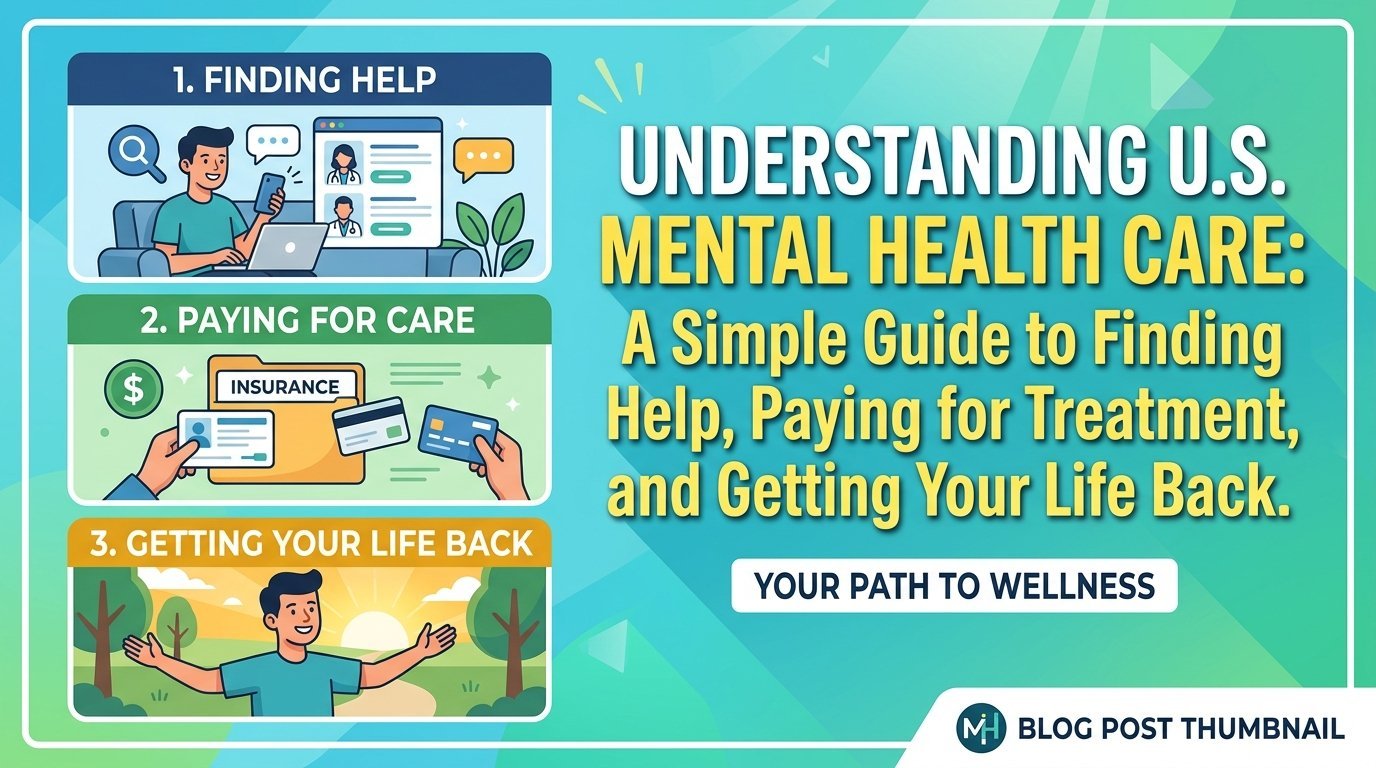
You Are Not Alone. Help Is Out There.
Feeling sad, anxious, or hopeless is not weakness. It is being human. But when those feelings do not go away, when they start affecting your work, your relationships, and your ability to get out of bed in the morning, it is time to get help.
Millions of Americans are in the same boat. According to the National Institute of Mental Health, nearly one in five adults in the United States lives with a mental illness. That is over fifty million people. Anxiety, depression, bipolar disorder, PTSD, OCD. These are not character flaws. They are medical conditions. And like any medical condition, they can be treated.
But finding mental health care in the United States can feel overwhelming. Where do you start? Do you need a therapist or a psychiatrist? How do you find someone who takes your insurance? How much will it cost? What if you cannot afford it? What if you need help right now?
This guide answers all those questions. You will learn about the different types of mental health providers, how to find mental health providers near me, how insurance works, what to expect in therapy, and how to pay for treatment even on a tight budget. No complicated medical jargon. Just simple, honest information to help you or someone you love get the care you deserve.
What Is Mental Health Care and Why Do You Need It?
Mental health care is the medical treatment of conditions that affect your mood, thinking, and behavior. These include depression, anxiety disorders, bipolar disorder, PTSD, OCD, eating disorders, addiction, and many others.
Just like you would see a doctor for a broken leg or high blood pressure, you see a mental health professional for a struggling mind. Therapy can teach you coping skills. Medication can balance brain chemistry. Both can help you feel like yourself again.
But here is the problem. Many people do not get help. They think they should be able to handle it on their own. They are ashamed. They are afraid of what others will think. They do not know where to start. Or they tried once and had a bad experience.
If any of this sounds like you, please keep reading. Getting help is not a sign of weakness. It is the bravest thing you can do.
Types of Mental Health Providers: Who Does What?
The world of mental health care has many different types of professionals. Each has different training and does different things. Knowing the difference helps you find the right person for your needs.
Psychiatrist (MD or DO)
A psychiatrist is a medical doctor who specializes in mental health. They went to medical school, then did four years of residency training in psychiatry. Some do additional training in child psychiatry, addiction psychiatry, or other specialties.
Psychiatrists are the only mental health professionals who can prescribe medication. They can also provide therapy, though many focus mainly on medication management. You might see a psychiatrist for fifteen to thirty minutes every few months to check on your medications.
When you need medication for depression, anxiety, bipolar disorder, or other conditions, a psychiatrist is the right choice.
Psychiatric Nurse Practitioner (PMHNP)
A psychiatric nurse practitioner is an advanced practice registered nurse with specialized training in mental health. They can also prescribe medication and provide therapy. In most states, they can practice independently without a doctor’s supervision.
PMHNPs often have shorter wait times than psychiatrists. Many people find them to be very thorough and compassionate.
Psychologist (PhD or PsyD)
A psychologist holds a doctoral degree in psychology. They cannot prescribe medication (except in a few states with additional training). Their main job is providing therapy and psychological testing.
Psychologists are experts in talk therapy. They use evidence-based treatments like Cognitive Behavioral Therapy (CBT), Dialectical Behavior Therapy (DBT), and others. If you want in-depth therapy to understand and change your patterns, a psychologist is a great choice.
Licensed Clinical Social Worker (LCSW) or Licensed Professional Counselor (LPC)
These are master’s-level clinicians. They have a master’s degree in social work, counseling, or a related field, plus thousands of hours of supervised clinical experience. They provide therapy and can diagnose mental health conditions.
Most talk therapy in America is provided by LCSWs and LPCs. They are highly trained, often more affordable than psychologists, and sometimes have shorter wait times.
Which One Is Right for You?
If you think you might need medication, start with a psychiatrist or PMHNP. They can prescribe and also provide therapy or refer you to a therapist.
If you want talk therapy only, start with a psychologist, LCSW, or LPC. They can help you work through your challenges without medication. If therapy alone is not enough, they can refer you to someone for medication.
How to Find Mental Health Providers Near Me
You have decided to get help. Now you need to find someone. Searching for mental health providers near me is the first step. Here is how to do it effectively.
Start with Your Insurance
If you have health insurance, log into your insurance company’s website. Look for the “find a doctor” or “behavioral health” section. You can search for therapists and psychiatrists in your network.
Why start here? Because in-network providers cost you much less money. Your copay might be twenty or thirty dollars per session instead of one hundred fifty dollars or more.
When you find a few names, call the office directly. Ask:
- Are you accepting new patients?
- Do you take my specific insurance plan?
- How soon can I get an appointment?
Insurance directories are often outdated. A provider listed as “accepting new patients” may not have openings. Always call and verify.
Use Online Directories
There are excellent free directories that help you find mental health providers. The most popular is Psychology Today. You can filter by location, insurance, specialty, gender, and therapeutic approach.
Other good directories include TherapyDen, Inclusive Therapists, and Open Path Collective. Open Path offers reduced-cost therapy for people without insurance.
Ask Your Primary Care Doctor
Your family doctor knows you. They can often recommend therapists or psychiatrists they trust. This is a great way to find someone good.
Ask Friends or Family
Many people find therapists through word of mouth. If you feel comfortable, ask people you trust if they know a good therapist. You might be surprised how many people you know have been in therapy.
Understanding Mental Health Insurance Coverage
Health insurance can be confusing. But understanding your mental health care coverage can save you a lot of money.
The Mental Health Parity Act
A federal law called the Mental Health Parity Act says that insurance plans must cover mental health care at the same level as medical care. That means your copay for therapy should be similar to your copay for a doctor’s visit. Your insurance cannot have stricter limits on mental health visits than on medical visits.
But that does not mean everything is covered. You still need to understand your specific plan.
Key Terms to Understand
Deductible: The amount you pay before insurance starts paying. If your deductible is 2,000,youpayfortherapyoutofpocketuntilyouhavespent2,000. Then insurance kicks in.
Copay: A fixed dollar amount per visit. Example: $30 for each therapy session.
Coinsurance: A percentage of the visit cost. Example: You pay 20%, insurance pays 80%.
Out-of-pocket maximum: The most you will pay in a year. After you hit this number, insurance pays 100%.
In-network: Providers who have a contract with your insurance company. You pay less.
Out-of-network: Providers without a contract. You pay more, but some plans offer partial reimbursement.
How to Check Your Benefits
Call the number on the back of your insurance card. Ask the customer service representative:
- Do I have mental health benefits?
- What is my copay or coinsurance for outpatient therapy?
- How much of my deductible has been met?
- Do I need a referral from my primary care doctor?
- Are there any session limits?
Write down the answers. Keep them in a safe place.
What If You Do Not Have Insurance?
Many people do not have health insurance. Or their insurance has very high deductibles. Or they cannot find an in-network therapist with openings. Do not give up. There are still options.
Community Mental Health Centers
Federally qualified health centers (FQHCs) and community mental health centers offer low-cost or free care based on your income. They accept Medicaid and Medicare. They also offer sliding scale fees. That means what you pay depends on how much money you make.
To find a community mental health center near you, search for “community mental health [your city]” or call 211.
Open Path Collective
Open Path is a nonprofit network of therapists who agree to charge between 40and70 per session for people without insurance or with high deductibles. You pay a one-time lifetime membership fee of $65 to join. Then you can search for therapists in your area.
This is an excellent option for people who cannot afford standard therapy rates.
University Training Clinics
Many universities with psychology, social work, or counseling programs have training clinics. Services are provided by graduate students under close supervision by licensed faculty. Sessions often cost 10to40.
The quality is usually very good because of the intense supervision. Search for “[university name] counseling training clinic” or “[university name] psychology clinic.”
Employee Assistance Programs (EAPs)
If you have a job, check if your employer offers an Employee Assistance Program. EAPs provide free, short-term counseling. Typical benefits are three to eight sessions per issue per year. The sessions are completely free and confidential. Your employer does not know who uses the EAP.
Support Groups
Support groups are free. They are not a replacement for therapy, but they can provide valuable connection and coping strategies. Organizations like NAMI (National Alliance on Mental Illness) and DBSA (Depression and Bipolar Support Alliance) offer free support groups in many communities and online.
What to Expect in Your First Therapy Session
You found a therapist. You booked an appointment. Now you are nervous. What will happen? What should you say? What if you do not like them?
Here is what to expect.
The First Session Is Different
The first therapy session is often longer than regular sessions, usually sixty to ninety minutes. It is mostly information gathering. Your therapist will ask you questions like:
- Why are you seeking therapy now?
- What are your symptoms?
- When did they start?
- Have you been in therapy before?
- Do you have any medical conditions?
- Are you taking any medications?
- Do you have thoughts of hurting yourself or others?
- What is your family like?
- What are your goals for therapy?
You do not need to share anything you are not ready to share. But remember, your therapist is there to help. They cannot help with what they do not know.
It Is Okay to Be Nervous
Everyone is nervous at first. Most therapists expect this. They will help you feel comfortable. You can even tell them, “I am really nervous right now.” That is totally fine.
You Do Not Have to Stick with the First Therapist
Therapy is a relationship. Sometimes it does not click. Maybe you do not feel understood. Maybe their style is not right for you. Maybe you just have a weird feeling.
That is okay. You can try someone else. Good therapists will not be offended. They want you to find the right fit.
Give It a Few Sessions
Unless there is a major problem, try to attend at least three or four sessions before deciding. The first session is awkward for everyone. It takes time to build trust and see how the therapist works.
Different Types of Therapy
Not all therapy is the same. Different problems need different approaches. Here are some common types of evidence-based therapy.
Cognitive Behavioral Therapy (CBT)
CBT is the most researched therapy for depression and anxiety. It focuses on the connection between your thoughts, feelings, and behaviors. You learn to identify negative thought patterns and replace them with more realistic ones. CBT is usually short-term, often twelve to twenty sessions.
Dialectical Behavior Therapy (DBT)
DBT was developed for people with extreme emotional dysregulation, often diagnosed with borderline personality disorder. It teaches skills for managing intense emotions, tolerating distress, and improving relationships. DBT usually includes both individual therapy and a skills group.
Exposure and Response Prevention (ERP)
ERP is the gold standard for OCD. You gradually expose yourself to the things that trigger your obsessions, and you practice not doing your compulsions. The anxiety decreases over time. ERP is highly effective.
Eye Movement Desensitization and Reprocessing (EMDR)
EMDR is used for trauma and PTSD. You recall traumatic memories while doing guided eye movements or other forms of bilateral stimulation. The memory becomes less distressing over time.
Interpersonal Therapy (IPT)
IPT focuses on problems in your relationships and life transitions. It is particularly effective for depression related to grief, role changes, or conflicts with others.
Which Therapy Is Best?
The best therapy is the one that works for you. A good therapist will explain their approach and why they think it will help. Do not be afraid to ask, “What type of therapy do you practice, and why is it a good fit for my situation?”
Medication for Mental Health: What to Know
For many people, therapy alone is not enough. Medication can help. There is no shame in taking medication for your mental health. It is no different than taking medication for diabetes or high blood pressure.
Common Types of Psychiatric Medication
SSRIs (selective serotonin reuptake inhibitors): These are the most common antidepressants. Examples include sertraline (Zoloft), fluoxetine (Prozac), and escitalopram (Lexapro). They are also used for anxiety, OCD, and PTSD.
SNRIs (serotonin-norepinephrine reuptake inhibitors): Examples include venlafaxine (Effexor) and duloxetine (Cymbalta). They work similarly to SSRIs.
Mood stabilizers: Used for bipolar disorder. Examples include lithium, valproate (Depakote), and lamotrigine (Lamictal).
Atypical antipsychotics: Used for bipolar disorder, schizophrenia, and sometimes as an add-on for depression. Examples include quetiapine (Seroquel), aripiprazole (Abilify), and olanzapine (Zyprexa).
Benzodiazepines: Used for anxiety or panic. Examples include alprazolam (Xanax), lorazepam (Ativan), and clonazepam (Klonopin). These are typically used short-term because of the risk of dependence.
How to Get Medication
You need a prescription from a psychiatrist, psychiatric nurse practitioner, or sometimes your primary care doctor. Your prescriber will ask about your symptoms, medical history, and any other medications you take.
Medication is not one-size-fits-all. You may need to try a few different ones to find what works. Be patient. Give each medication several weeks to work (unless side effects are severe). Always talk to your prescriber before stopping any medication.
What If You Need Help Right Now?
If you are in crisis, do not wait for a therapy appointment. Get help immediately.
Call 988
988 is the Suicide and Crisis Lifeline. It is free, confidential, and available 24/7. You can call or text. Trained crisis counselors will listen and help you get through the moment. They can also connect you to local resources.
Go to the Emergency Room
If you have taken an overdose, are actively bleeding from self-harm, or have a plan to kill yourself, go to the nearest emergency room or call 911. Tell them you are having a mental health crisis. They will keep you safe.
Call Your Therapist or Psychiatrist
If you already have a provider, call their office. Many have after-hours numbers for emergencies. They may be able to talk you through the crisis or advise you on what to do.
Paying for Mental Health Care: A Quick Summary
| Situation | Best Option |
|---|---|
| Have insurance with low deductible | Use in-network providers |
| Have insurance with high deductible | Consider Open Path or sliding scale providers |
| No insurance, low income | Community mental health center or Medicaid |
| No insurance, moderate income | Open Path or university training clinic |
| Employed | Check your EAP for free sessions |
| Veteran | VA health system (covers mental health) |
| Over 65 | Medicare (covers therapy and psychiatry) |
Frequently Asked Questions About Mental Health Care
How long does therapy take?
It depends on your goals. Some people feel better in six to twelve sessions. Others go for a year or more. Complex trauma or personality disorders often take longer. There is no right or wrong timeline.
Is therapy confidential?
Yes. With a few exceptions, what you say in therapy stays in therapy. The exceptions include if you are a danger to yourself or others, if you report abuse of a child or vulnerable adult, or if a court orders your records. Your therapist will explain confidentiality in your first session.
Can I see a therapist online?
Yes. Telehealth therapy is very common now. Many people prefer it because it is convenient and private. Research shows online therapy works as well as in-person therapy for most conditions.
What if I cannot afford any of these options?
Call 211. They can connect you to local resources, including free or low-cost services. Some communities have free support groups, sliding scale clinics, or charity care programs. Do not give up.
How do I find UnitedHealthcare therapists who accept my plan?
Log into your MyUHC account. Go to “Find a Doctor.” Filter by behavioral health and your location. Call each provider to verify they are accepting new patients and that your specific plan is accepted.
Final Thoughts: You Deserve to Feel Better
The hardest step is the first one. That phone call. That email. That moment when you admit to yourself that you need help. But once you take that step, the path gets easier.
You are not broken. You are not weak. You are a human being with a medical condition that deserves treatment. The same way you would go to a doctor for a broken leg, you can go to a therapist for a struggling mind.
Help is out there. Mental health providers near me are waiting for your call. Therapists want to help. Psychiatrists want to help. Support groups are filled with people who have been where you are.
You do not have to suffer alone. You do not have to figure everything out by yourself. You just have to take the first step.
Pick up the phone today. Make the call. Your future self will thank you.
Disclaimer: This article provides general information about mental health care in the United States. It does not constitute medical advice. Every person’s situation is different. Always consult with qualified medical professionals about your specific needs. If you are in crisis, call 988 immediately. You matter. Your life matters. Help is available.