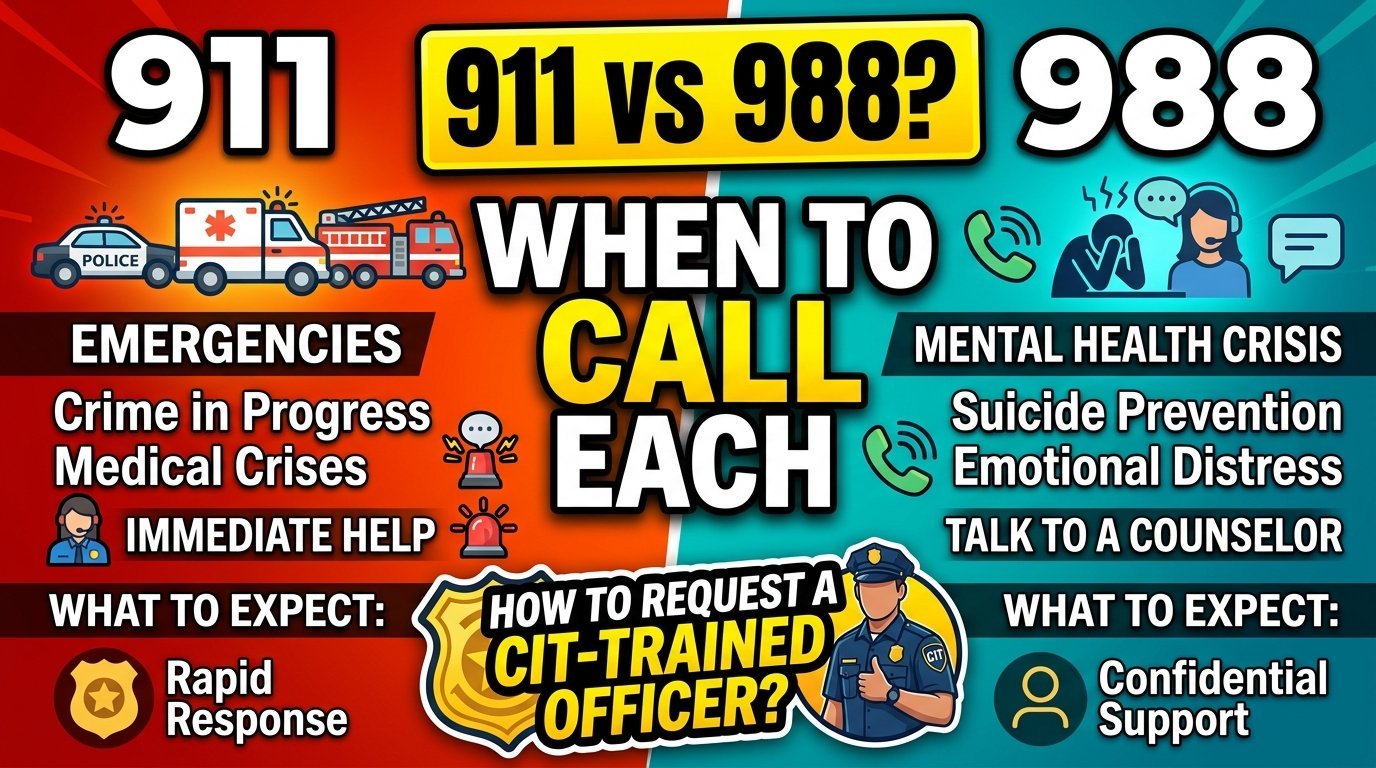
When someone you love is in mental health crisis—suicidal, psychotic, severely intoxicated, or threatening violence—the question of whether to call 911 or 988 is rarely obvious in the moment. Both are essential. Both can save lives. They do different things, and choosing well can mean the difference between a calming clinical response and an armed police encounter.
This guide explains exactly what happens when you call each number, how to request a Crisis Intervention Team (CIT) trained officer if you do need 911, what mobile crisis teams add to the picture, and how to plan ahead so the right system responds the first time.
What Happens When You Call 988
Launched nationwide in 2022, 988 is the Suicide and Crisis Lifeline. When you dial it, you reach a trained crisis counselor at one of more than 200 local centers. The call is free, confidential, and available 24/7 in English, Spanish, and (increasingly) other languages. Veterans can press 1, Spanish-speakers 2, and LGBTQ+ youth and young adults 3 to reach specialized counselors.
988 counselors are trained to:
- Talk through suicidal thoughts, panic, anxiety, depression, or general distress
- Help develop a safety plan
- Connect you with local mental health resources
- Dispatch a mobile crisis team in many cities
- Coordinate a warm handoff to a follow-up clinician
Roughly 98 percent of 988 calls are resolved without involving law enforcement. The system is designed for the emotional crisis to be handled by clinicians, not police.
When 988 Is the Right Call
- Suicidal thoughts without an active, in-progress attempt
- Severe anxiety, panic, or emotional crisis
- Concerns about a friend or family member who needs talking through
- Substance use crisis without immediate medical danger
- Worry about psychiatric medication, missed doses, or side effects
- Need for general support after a traumatic event
- Loneliness, grief, or hopelessness
When 911 Is the Right Call
Call 911 when there is an immediate medical emergency or imminent danger:
- Active suicide attempt in progress—overdose, lethal means already in use
- Serious self-injury requiring medical attention
- Loss of consciousness
- Severe bleeding or trauma
- Active violence or weapons involved
- Severe drug or alcohol overdose
- Child or vulnerable adult in immediate physical danger
If you are unsure whether 988 can handle the situation, calling 988 first is a safe default. The counselor can assess in real time and dispatch 911 (police, EMS, or fire) if the situation needs it.
If You Must Call 911: How to Reduce Police-Involvement Risk
When 911 is the right call, the following can shape the response in safer directions:
Request a CIT-Trained Officer
The Crisis Intervention Team (CIT) model, originally developed in Memphis in 1988, trains officers to recognize mental illness, de-escalate, and prefer connection to clinical care over arrest. Many U.S. police departments have CIT-trained officers, though availability varies. When you call 911, say:
“This is a mental health emergency, not a crime. Please send a CIT-trained officer if available, and a mental health co-responder or mobile crisis team if your jurisdiction has them.”
Ask for Co-Responder or Mobile Crisis Dispatch
Many cities now have co-responder programs where a clinician rides with police on mental health calls, or stand-alone mobile crisis teams that respond instead of police. Programs like CAHOOTS in Eugene, Oregon, STAR in Denver, and B-HEARD in New York City have shown that civilian crisis responders can safely handle a large majority of mental health calls.
Provide Clear, Calm Context
Tell the dispatcher:
- The person’s diagnosis, if known
- What medications they take
- Whether they are armed (be honest—omitting this puts everyone at greater risk)
- Whether they have any history of violence (yes or no)
- What has helped during past episodes
- Whether a Psychiatric Advance Directive exists
Plan the Scene
Lock away firearms and other weapons before officers arrive if it is safe to do so. Keep pets contained. Move bystanders to a separate room. The fewer triggers and surprises, the safer the encounter.
After the Crisis: What Comes Next
Whether the response was 988, mobile crisis, or 911, follow-up matters. Within 24 hours, your loved one should have:
- A scheduled outpatient psychiatry appointment, ideally within a week
- A safety plan reviewed with a clinician
- A medication review with the prescribing provider
- Connection to peer support, family education, or NAMI Family-to-Family programs
- If hospitalized, a discharge plan that includes step-down care like PHP or IOP
Special Situations
- Veterans—dial 988 then press 1 for the Veterans Crisis Line, available 24/7 with veteran-trained counselors
- LGBTQ+ youth and young adults—dial 988 then press 3, or call The Trevor Project at 1-866-488-7386
- Spanish speakers—press 2 on 988 for the Spanish-language line
- Deaf, hard of hearing, or speech-impaired—use 988 video relay or text 988
- Incarcerated individuals—jail mental health services or in-facility chaplains; 988 generally cannot intervene
Building a Family Crisis Plan
For families managing recurrent mental illness, plan in advance. Document on a one-page family crisis sheet:
- The person’s diagnoses, current medications, allergies
- Treating clinicians and their phone numbers
- Local 988, mobile crisis, and CIT-aware police non-emergency numbers
- Your nearest emergency department with a dedicated psychiatric ER
- The location of any Psychiatric Advance Directive
- Childcare and pet care arrangements during a hospitalization
A Final Note
The U.S. crisis-response system is in transition. 988 works far better than the old patchwork of crisis hotlines. Mobile crisis teams are expanding fast. CIT-trained officers and co-responder programs are increasingly the norm in major metro areas. The system is not perfect, but it is dramatically better than it was a decade ago—and using the right number, with the right context, gives your loved one the best possible chance at a safe, clinical, non-traumatic resolution.
This article is for informational purposes only and is not medical or legal advice. If you are in immediate danger, call 911 or 988 now.