The Conversation That Saves Lives
For most of the twentieth century, mainstream advice in mental health care cautioned against asking people directly about suicide. The unspoken theory was that direct questions would plant ideas, lead to action, or destabilise a fragile person. Decades of research have decisively reversed that view. Direct questions about suicide reduce risk rather than increase it. Patients who are asked feel seen rather than alarmed. Families who learn to ask save lives that quiet avoidance would have lost.
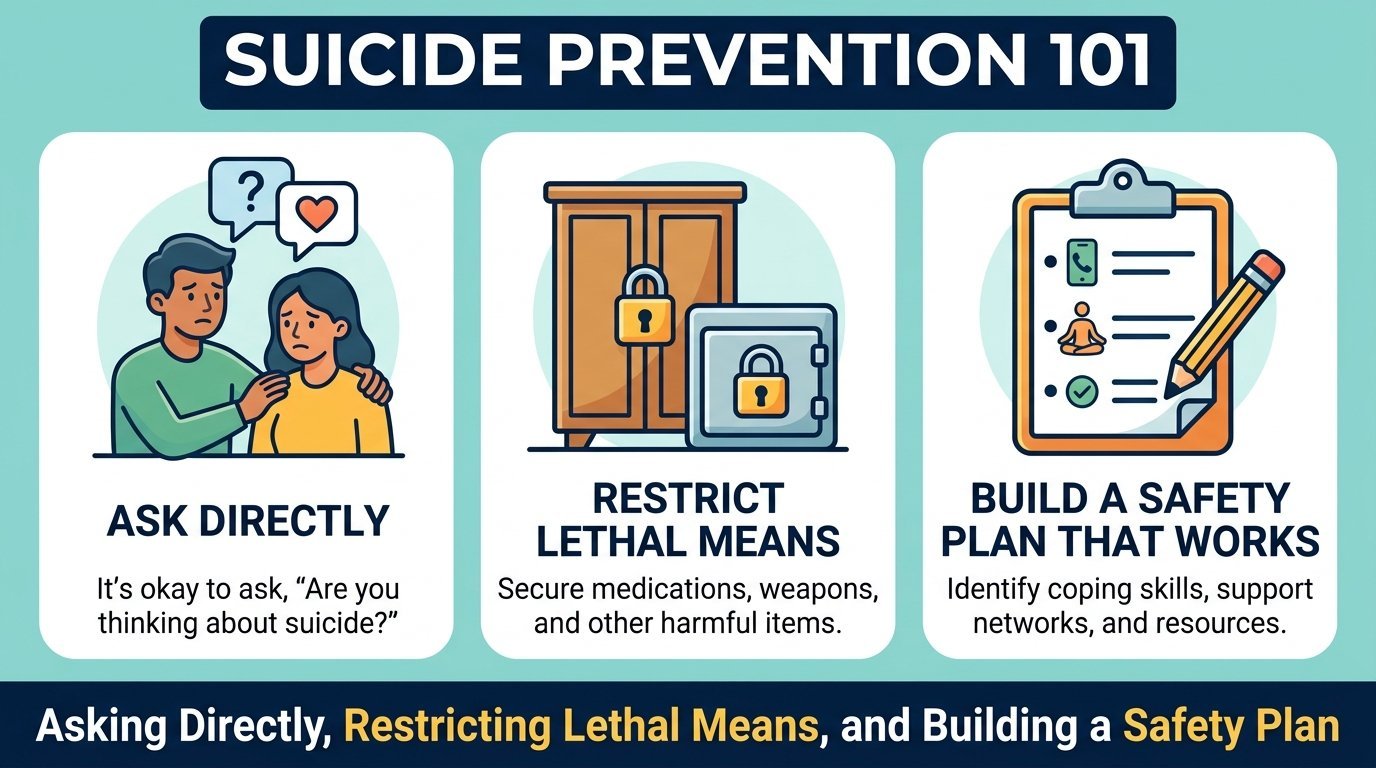
This guide describes the basics of suicide prevention as understood today, oriented around three core practices: asking the question, restricting access to means, and building a written safety plan. None of these require clinical training to use. All of them are most effective when known and applied by ordinary family members, friends, and coworkers in the moments where professional help is not yet involved.
Asking the Question
The first practice is asking directly. When a person you love seems to be struggling significantly, when warning signs are accumulating, or when something they have said is bothering you, ask the question explicitly. Not euphemistically. Not in a way that allows easy deflection. The phrasing taught by suicide prevention trainers is some version of: are you having thoughts of suicide. Are you thinking about ending your life. Are you thinking about killing yourself.
The directness is the point. Vague questions like “are you okay” or “are you having dark thoughts” produce ambiguous answers and let the person stay hidden. Direct questions create space for a direct answer. Most people who are having suicidal thoughts will tell you when asked plainly. Most will deny when asked vaguely.
If the answer is yes, do not panic. The right next step is to listen. Ask follow-up questions calmly. Have you thought about how. Do you have access to means. Do you have a specific time in mind. The questions are not investigative. They are gathering the information you need to assess severity and plan a response. They also signal to the person that you can hear what they are actually carrying, which itself reduces immediate risk.
Removing Means
The second practice is means restriction. The research on this point is among the most consistent in mental health care: making lethal means less accessible during a period of risk reduces deaths, even when underlying symptoms persist. The mechanism is that suicidal crises often pass within hours or days, and the impulse window during which most attempts are made is short. Removing or securing means buys time for the crisis to pass and for treatment to engage.
The most important category of means in the United States is firearms. More than half of suicide deaths in the country involve firearms, and firearm suicide attempts have a fatality rate exceeding ninety percent. Temporary off-site storage of firearms during a period of mental health crisis, whether at a relative’s home, a gun range, or a participating gun shop, is one of the highest-impact interventions a family can take. Many states have legal frameworks for voluntary or court-ordered temporary firearm storage during mental health crises.
The second category is medications. Securing prescription medications, particularly those with overdose potential, in a locked container or off-site reduces overdose attempts during the highest-risk windows. Pharmacies will often dispense limited quantities at one time when requested. The third category is alcohol, which can both lower inhibition and provide a rapid intoxicated state during which an attempt can occur. Reducing alcohol availability in the home during a crisis is another evidence-based step.
The Stanley-Brown Safety Plan
The third practice is the safety plan, a written document developed in collaboration with the person at risk that lists specific steps to take when warning signs appear. The most widely used format is the Stanley-Brown Safety Plan, a six-step structure that includes warning signs, internal coping strategies, social distractions, supportive people to contact, professional contacts, and means restriction commitments.
The plan is most useful when written collaboratively rather than handed to the person to fill out alone. A clinician, a trained peer, or a thoughtful family member can sit with the person and help them complete each section in their own words. The collaboration matters because the act of articulating the plan is itself part of the intervention. The plan also matters because it externalises decisions that otherwise have to be made in the middle of a crisis, when cognitive function is impaired and impulse control is reduced.
The plan should be visible. On the refrigerator. In a wallet. On the home screen of a phone. Many mental health providers near me use safety planning routinely as part of treatment, and patients who leave a hospitalisation or an ED visit with a written safety plan have measurably lower rates of future attempts than patients who leave with only verbal advice.
Using 988 and Mobile Crisis Teams
The 988 Suicide and Crisis Lifeline, available since 2022, has changed the practical landscape of suicide prevention in the United States. The three-digit number connects callers to trained counsellors who can de-escalate, assess, and arrange follow-up care. In many states, 988 can dispatch mobile crisis teams that come to the patient’s location for a clinical assessment, often without requiring transport to a hospital.
988 is appropriate for someone in distress who is not in immediate medical danger. For situations involving an active attempt, a medical emergency, or imminent danger to others, 911 remains the right call. The two systems are complementary, with 988 increasingly serving as the front door for behavioural health crises that do not require an emergency medical response.
Adding 988 to the safety plan, alongside the local mobile crisis line, the existing mental health care provider’s number, and the behavioural health crisis number on the back of an insurance card, ensures that multiple paths to help are documented when the person needs them most.
Connecting With Professional Care
Suicide prevention is most durable when it includes professional mental health care. After an initial conversation, after means restriction, and after safety planning, the next step is engaging the person with a therapist, psychiatrist, or treatment program who can address the underlying conditions driving the suicidal thoughts. The connection should be specific, not vague. A scheduled appointment within a week, with a named provider, with insurance verification completed, is dramatically more effective than a list of resources to investigate.
If the person is not currently in treatment, community mental health centres, IOPs, and PHPs all accept patients with current or recent suicidality and can provide intensive support during the highest-risk window. Insurance plans, including networks behind UnitedHealthcare therapists, Aetna therapists, Cigna therapists, and Blue Cross Blue Shield variants, cover these levels of care with prior authorisation handled by the program. The administrative friction is real but the path through it is well-worn.
After a Crisis Passes
The period after a suicide crisis passes is its own clinical window. Family members often relax, the patient often minimises what happened, and the connection to ongoing care often weakens. The data suggests that the weeks and months following a crisis remain elevated risk periods, particularly the first ninety days after a hospitalisation. Maintaining engagement during this window is one of the most useful preventive steps available.
This means continuing therapy, continuing medication if prescribed, attending follow-up appointments, and keeping means restriction in place even when the immediate crisis seems to have resolved. It also means having a low threshold for re-engaging crisis services if warning signs recur. The cost of an extra ED visit or mobile crisis dispatch during a vulnerable window is far lower than the cost of waiting too long.
A Word for Family Members and Friends
If you are reading this because someone you love is at risk, the work above is real labour. It is also possible. You do not need clinical training to ask the question, secure the firearms, write the plan, or call 988. You do need to act, and to keep acting, even when the person you love resists. The patients who survive serious suicide crises consistently report that someone in their life refused to look away. That someone can be you.
Take care of yourself in the process. Caregiver strain is real, and your own mental health care is part of the system that keeps the person you love alive. Therapy, support groups, and peer networks for family members of people at risk all reduce the long-term load and improve your capacity to keep showing up.
If you or someone you know is in crisis, call or text 988 in the United States to reach the Suicide and Crisis Lifeline twenty-four hours a day. For an active medical emergency, call 911.