Trent Hovenga had cancelled his gym membership three times in two years. The 34-year-old project manager from Boise, Idaho would sign up in January with all the optimism of a fresh start, attend twelve sessions in February, then watch his depression quietly drag him back to the couch by mid-March. He owned every excuse: too tired, too busy, too embarrassed about how out of shape he had gotten. What finally broke the cycle was not a better app or a smarter program. It was a coworker named Marcus who started texting him at 5:47 every morning with the same three words: “On my way.” Trent could not bear the thought of leaving Marcus standing alone in the parking lot of the 24 Hour Fitness on Vista Avenue. He showed up. Then he showed up again. Eight months later, his therapist noted that his PHQ-9 score had dropped from 18 to 6, and Trent told her something he had never said before: he was not exercising for himself. He was exercising because somebody was waiting for him, and that small fact had rewritten his entire week.

Workout buddy mental health benefits sit at the intersection of two well-documented forces: the antidepressant power of exercise and the protective effect of social connection. When you fold them together, you get something larger than either piece alone. The body of research on workout buddy mental health outcomes suggests that group exercisers stick with programs longer, push themselves harder, and report bigger reductions in anxiety and depressive symptoms than people who train alone. The accountability of a partner closes the gap between intention and behavior, which is exactly where most solo programs collapse. For people whose mood disorders make starting anything difficult, that gap is often the entire problem.
What the research says about social exercise versus solo exercise
A study published in the Journal of the American Osteopathic Association tracked medical students across a 12-week exercise program and found that those who trained in groups experienced a 26.2 percent reduction in perceived stress and meaningful improvements in mental, physical, and emotional quality of life. Solo exercisers, despite working out longer on average, saw no significant changes in stress or quality of life metrics. The mechanism is not mysterious. Group settings provide what researchers call “non-deliberative” social support, the background warmth of being seen and acknowledged that quietly recalibrates the nervous system without anyone having to discuss feelings. Most participants do not even register the support consciously, but their cortisol patterns notice.
Other trials have shown that participants in group exercise classes are roughly twice as likely to still be exercising six months later compared with people who started solo programs. Adherence is the hidden variable in nearly every exercise-and-mental-health study. The treatment only works if you take it, and a workout partner is one of the most reliable ways to ensure you take it. We covered the broader connection between movement and mood in our piece on exercise as antidepressant medication, and the social layer is where many readers discover the practice finally sticks.
The accountability factor and why it matters more than motivation
Motivation is a feeling, and feelings are the worst possible foundation for a behavior change program. Accountability is a structure, and structures hold up when feelings collapse. When Trent Hovenga described what made the difference, he did not mention discipline or willpower. He mentioned Marcus standing in a parking lot. The Centers for Disease Control and Prevention summarizes the broader picture in their guidance on physical activity and health, noting that social environments shape activity levels at least as strongly as individual intent.
Behavioral economists call this “commitment device” research. A commitment device is anything you set up in advance that makes it harder to flake later. Workout partners are commitment devices with a face. Telling a friend you will meet them at six creates a small social cost for not showing up that often exceeds the cost of pushing through the discomfort of getting out of bed. People with depression frequently report that this external pressure is the only thing strong enough to override anhedonia in the morning hours when symptoms are worst.
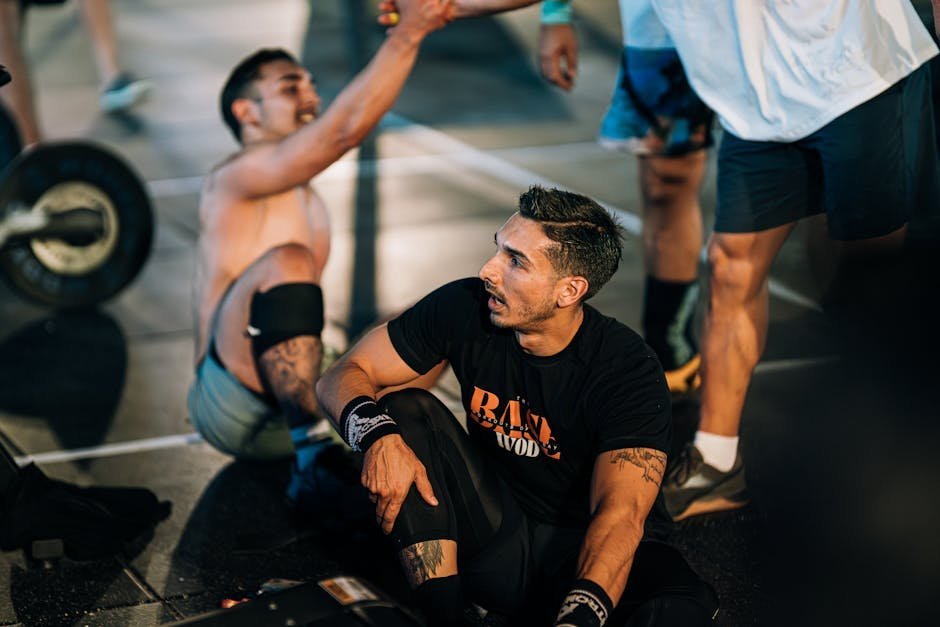
CrossFit, F45, and the cultural studies of group fitness mental health
Researchers studying CrossFit have repeatedly noted something that surprises outsiders: the affiliate gyms function less like fitness facilities and more like third places, in the sociologist Ray Oldenburg sense. Members know each other’s names, ask about kids and surgeries, and notice when somebody disappears for two weeks. A 2019 ethnography of CrossFit affiliates described the box culture as “muscular sociality,” a community built on shared physical struggle that rapidly produces friendships of unusual depth. Similar patterns show up in F45 studios, Orangetheory franchises, and Barry’s locations.
The mental health benefits of these communities are not just about the workout. They are about the unscripted ten minutes before class when somebody asks how your week has been, and the shared inside jokes, and the texts that go around when a regular member is going through chemo. For people who are isolated, transplanted, or recovering from a major life disruption like divorce or grief, a good box can become the most reliable source of human contact in their week.
Bumble BFF, Meetup, and Strava for finding workout partners
If you do not already have a friend who wants to train with you, the digital infrastructure for finding one has become surprisingly mature. Bumble BFF lets you filter for fitness interests and has been quietly responsible for thousands of running partnerships, climbing pairs, and yoga buddies in mid-sized American cities. Meetup remains the largest catalog of in-person fitness groups in the United States, with everything from sunrise hike clubs in Phoenix to women-only powerlifting collectives in Brooklyn.
- Strava clubs and segment leaderboards build virtual accountability for runners and cyclists
- Local Facebook groups remain a strong tool for run clubs and recreational sports leagues
- Apps like Atleto and Fitness Friend explicitly match people by training style and schedule
- Reddit’s r/CityName subs frequently host weekly workout buddy threads
- Many community centers and YMCAs run free “new member matching” programs for newcomers
Recreational sports leagues, run clubs, and ski clubs
For adults who want exercise to feel less like exercise, recreational leagues remain underrated. Kickball, softball, ultimate frisbee, and bocce leagues run in nearly every American city through organizations like Sport & Social and ZogSports. The training effect is modest, but the mental health effect is substantial because you have a fixed weekly social commitment with the same group of humans for an entire season. We have written before about team sports and adult friendship, and leagues are one of the few remaining venues where adults predictably make new close friends after age 30.
Run clubs serve a similar function with a different rhythm. Most cities have free weekly group runs hosted by local running stores or breweries, with paces ranging from 15-minute miles to sub-7. Ski clubs, often housed at universities or through organizations like the Eastern Ski Club Federation, package winter exercise inside friendship-rich weekend trips that can sustain mental health through the bleakest months of seasonal affective disorder.

Group fitness for autistic and ADHD adults
Group fitness can be unusually well-suited to neurodivergent adults, though the fit depends heavily on format. Many autistic adults report that structured class-based fitness, where the workout is dictated by a coach and conversation is optional, removes the social load that makes most group activities exhausting. ADHD adults frequently find that the external structure and novelty of varied class formats helps them sustain a routine where solo programs failed within weeks. The National Institutes of Health has summarized broader research on exercise and mental health outcomes across populations, and the patterns hold across neurotypes.
Sensory-friendly classes, which dim lights and lower music, have become more common in major metros, and many gyms now train staff in basic neurodivergent inclusion. Our guide to sensory-friendly mental health practices covers related considerations.
When group fitness backfires
Group fitness is not universally beneficial. For people prone to social comparison, classes that visibly rank performance can amplify the very anxieties they were meant to soothe. Perfectionists may train past the point of healthy fatigue because they cannot bear to scale a workout in front of others. Eating disorder histories frequently get triggered by gyms that emphasize body composition over capability. The signal that group fitness is helping is that you feel calmer and more connected; the signal that it is hurting is that you feel watched, judged, or compelled to keep up at any cost.
If a class culture is toxic, leaving it is not a failure of mental health but a protection of it. The right partner or community feels like a held door, not a judging eye.
Frequently asked questions
How often do I need to meet a workout buddy for the mental health benefit?
Even one or two predictable sessions per week tend to produce the accountability effect. The schedule matters more than the volume.
What if my workout buddy cancels often?
An unreliable partner can be worse than no partner because it teaches your brain that the appointment is optional. Either renegotiate the agreement or find a more committed person.
Should I tell my buddy about my mental health condition?
You do not have to. Many successful workout partnerships never discuss mental health directly; the support comes from the consistent showing up.
Are virtual workout buddies effective?
Texting before and after sessions, sharing Strava activities, or doing video workouts together produces measurable adherence benefits, though usually less than in-person partnerships.
Can a romantic partner serve as a workout buddy?
Sometimes yes, but couples often struggle with mismatched paces and the bleed of relationship dynamics into training. Many people find a non-romantic partner cleaner.
The bottom line
Exercise alone is one of the best-validated antidepressant interventions in the literature, and exercise with a partner is exercise that actually happens. If you have struggled to maintain a solo program, the missing ingredient is probably not a better plan but a better human. Find one person, set a fixed time, and let the small social cost of standing them up do the heavy lifting that motivation cannot.
If you are in crisis or thinking about suicide, please call or text 988 to reach the Suicide and Crisis Lifeline. Help is available 24 hours a day across the United States.
This article is for general informational purposes only and does not constitute medical advice, diagnosis, or treatment. Speak with a qualified mental health professional or physician about your specific situation.