The Three Habits Therapists Cannot Replace
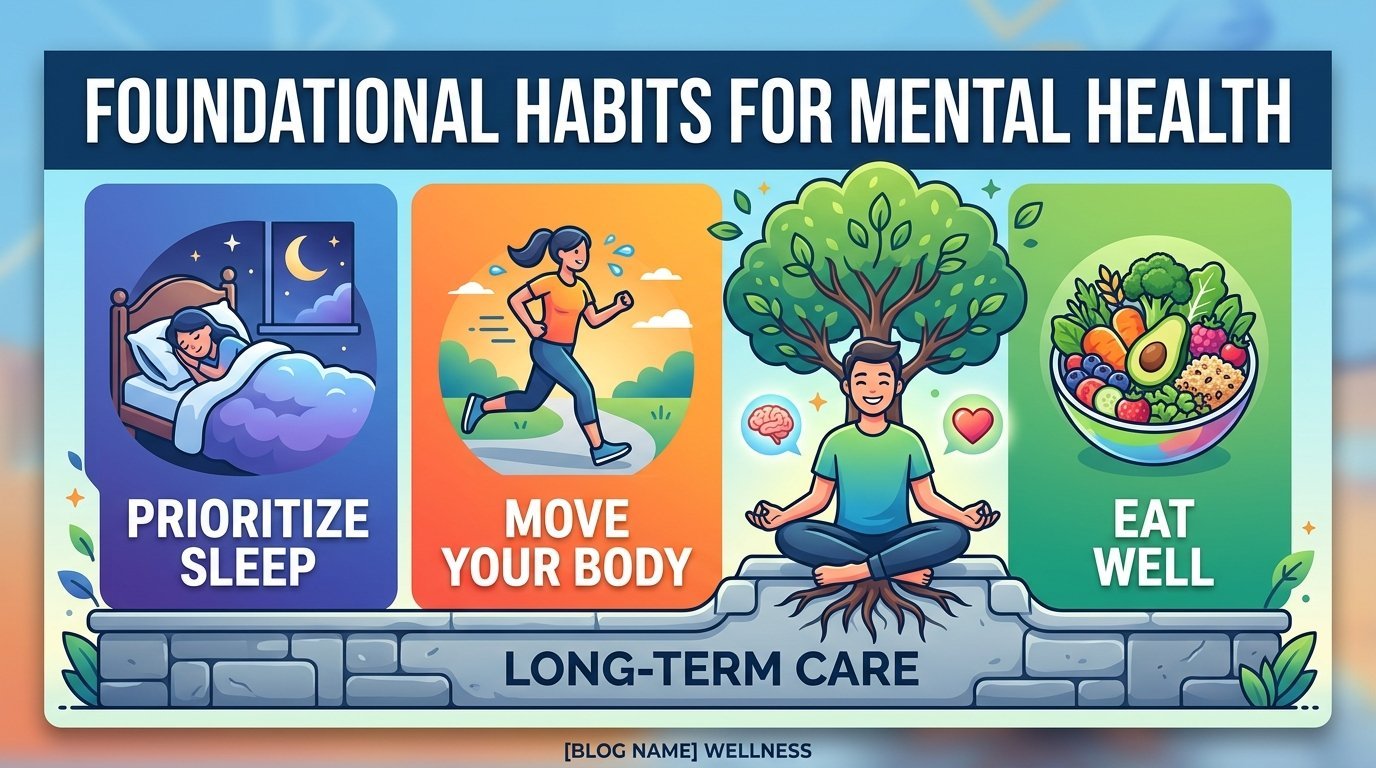
Talk therapy and psychiatric medication are powerful tools, but they operate on top of a biological foundation that most patients quietly neglect. Sleep, exercise, and nutrition are the three pillars of long-term mental health, and yet they receive almost no clinical attention in standard mental health care. Patients spend years and tens of thousands of dollars on therapy while sleeping six hours a night, eating ultra-processed food at most meals, and never moving their body. The therapy is not the problem. The unbalanced foundation is.
This guide describes what the research actually shows about the relationship between these three habits and mental health outcomes, and the small, sustainable changes that produce measurable improvement. The recommendations here are not heroic. They are the boring foundations on which therapy gains either compound or evaporate.
Sleep: The Most Underrated Mental Health Intervention
The relationship between sleep and mental health runs both directions. Mental health conditions disrupt sleep, and disrupted sleep worsens mental health conditions. Insomnia is both a symptom of depression and an independent driver of new depressive episodes. Disrupted sleep is among the strongest precipitants of bipolar mood episodes. Chronic sleep restriction increases anxiety, impairs emotional regulation, and reduces the effectiveness of therapy and medication.
The clinical target for adults is seven to eight hours of sleep per night on a consistent schedule, with similar wake times on weekdays and weekends. The single highest-impact intervention is a consistent wake time. The body’s circadian rhythm anchors to morning light exposure shortly after waking. A wake time that varies by more than an hour from day to day disrupts the rhythm and produces what researchers call social jet lag, a state of partial circadian misalignment that closely resembles the mental health effects of crossing time zones repeatedly.
Practical sleep hygiene includes keeping the bedroom cool and dark, restricting screens for the hour before bed, avoiding caffeine after noon, limiting alcohol, and reserving the bed for sleep rather than work or scrolling. For patients with persistent insomnia, cognitive behavioural therapy for insomnia, abbreviated CBT-I, is among the most effective interventions in mental health care. CBT-I is delivered through specialty clinics, certain therapists, and several validated apps. Insurance plans, including networks behind UnitedHealthcare therapists and other major carriers, increasingly cover CBT-I as a behavioural health benefit.
Exercise: A Dose-Response Relationship With Mood
The research on exercise and mental health has produced one of the strongest dose-response relationships in behavioural medicine. People who engage in moderate aerobic exercise three to five times per week show measurable reductions in depression and anxiety symptoms, often comparable in magnitude to a low-dose antidepressant. The effect is not merely psychological. Exercise produces neurochemical changes, including increased BDNF, serotonin, and endorphin levels, that affect mood independent of motivation or willpower.
The clinical target is one hundred fifty minutes of moderate-intensity activity per week, divided into thirty-minute sessions or shorter blocks. The form does not matter much. Walking briskly, cycling, swimming, dancing, gardening, and yoga all produce measurable benefits. The intensity matters more than the modality. Moderate intensity means the heart rate is elevated, conversation requires some effort, and a light sweat develops within ten minutes.
For patients in the middle of a depressive episode, the standard exercise prescription is often impossible to start. The most useful pivot is the smallest sustainable dose. A ten-minute walk five days per week is dramatically better than zero. Once the ten minutes becomes habitual, extending to fifteen, then twenty, then thirty is far easier than starting from zero. The goal in mental health care is to make exercise routine, not heroic.
Nutrition: A Subtler But Real Effect
The relationship between diet and mental health is real but more subtle than sleep or exercise. Strong evidence links Mediterranean-style eating patterns, characterised by vegetables, fruits, whole grains, fish, legumes, and olive oil, to reduced rates of depression and improved response to mental health treatment. Diets high in ultra-processed foods, refined sugars, and inflammatory ingredients show the opposite association.
The mechanism is partly through inflammation, partly through gut-brain axis effects on neurotransmitter production, and partly through stable blood sugar that prevents the energy and mood crashes that destabilise patients with anxiety and mood disorders. Specific micronutrient deficiencies, particularly vitamin D, omega-3 fatty acids, B vitamins, and iron, can mimic or worsen mental health symptoms. Routine screening for these deficiencies in patients with treatment-resistant symptoms is an underused intervention.
Practical changes are again the boring kind. Adding one serving of vegetables to lunch and dinner. Replacing one ultra-processed snack per day with a piece of fruit, nuts, or yogurt. Drinking water consistently. Reducing alcohol, which disrupts sleep and worsens mood for most patients with anxiety or depression. Eating regular meals rather than skipping and bingeing. None of these alone treat depression. Together, they create a stable substrate that allows therapy and medication to work.
The Combined Effect
The three pillars are independent in mechanism but synergistic in effect. A patient who improves all three habits modestly will often experience more meaningful symptom reduction than a patient who optimises only one. The combined effect of seven hours of sleep, three weekly exercise sessions, and a generally Mediterranean-style eating pattern is often equivalent to a low-dose pharmacological intervention, without the side effects.
This does not mean foundational habits replace therapy or medication for patients with significant mental health care needs. It does mean foundational habits are part of the treatment, not a separate self-improvement project. The patients who get the most out of professional treatment are usually the ones who also tend to the foundations. The patients who treat foundations as optional often plateau in therapy.
Asking Your Therapist About Foundations
If your current therapist has not asked about your sleep, exercise, and nutrition, raise the topic yourself. A skilled clinician will integrate these inputs into the treatment plan. The integration matters because foundational habits are themselves often shaped by mental health symptoms. A patient with severe depression cannot will themselves to exercise. A patient with anxiety may not be able to fall asleep without a sleep intervention. The therapist’s job is to address the symptom barriers to the foundations, not to lecture the patient about willpower.
Some mental health providers near me explicitly specialise in lifestyle psychiatry, an emerging field that integrates pharmacological treatment with structured attention to foundational habits. Lifestyle medicine boards now offer specialty certification, and the network of clinicians who practise this way is growing. For patients whose previous treatment has not produced enough improvement despite good adherence, switching to a lifestyle-oriented clinician can be a meaningful change.
A Realistic Closing Note
None of the recommendations here are revolutionary. They are the same advice physicians and therapists have given for decades, repeated more loudly. The reason they bear repeating is that the gap between knowing the recommendations and living them is the gap most patients never close. Closing it does not require willpower or discipline. It requires building specific habits, supporting them with environmental design, and allowing imperfection without abandoning the project.
The patients who close the gap report, almost without exception, that their mental health care works better. Therapy goes deeper. Medication has more effect with fewer side effects. Symptoms remit more quickly and stay remitted longer. The boring foundation, when laid, holds up the more dramatic interventions on top of it.
This article is for educational purposes and does not constitute personalised medical advice. If you or someone you know is in crisis, call or text 988 in the United States.