The Insurance Decision Many Self-Employed Americans Make Wrong
For the millions of Americans who do not get health insurance through an employer, the ACA marketplace is the primary path to coverage that includes mental health care. Self-employed workers, gig economy participants, early retirees, recent graduates, and people between jobs all rely on the marketplace, often without realising how much variation exists between plans for behavioural health benefits specifically. A plan that looks similar on premium and deductible can have dramatically different mental health coverage in practice.
This guide explains how ACA marketplace plans cover mental health care, what to look for during enrolment, and how to choose intelligently when therapy and psychiatry costs matter to your annual budget. The decision affects not just your premium but also your access to providers, your cost per session, and your ability to escalate care if needed.
What ACA Plans Are Required to Cover
The Affordable Care Act includes mental health care and substance use treatment as one of ten essential health benefits that all marketplace plans must cover. The federal mental health parity law applies, requiring plans to cover behavioural health at the same level as medical services. In theory, this produces broad and consistent coverage. In practice, the implementation varies significantly across plans, particularly in network adequacy, prior authorisation requirements, and out-of-network reimbursement rates.
Every marketplace plan must cover outpatient therapy with licensed providers, psychiatric medication management, prescription psychiatric medications, inpatient psychiatric hospitalisation, and substance use treatment including medication-assisted treatment. Most plans also cover intensive outpatient programs and partial hospitalisation programs, though prior authorisation is typically required. Telehealth therapy is universally covered, often at the same cost-share as in-person sessions.
Plan Tiers and What They Mean for Mental Health
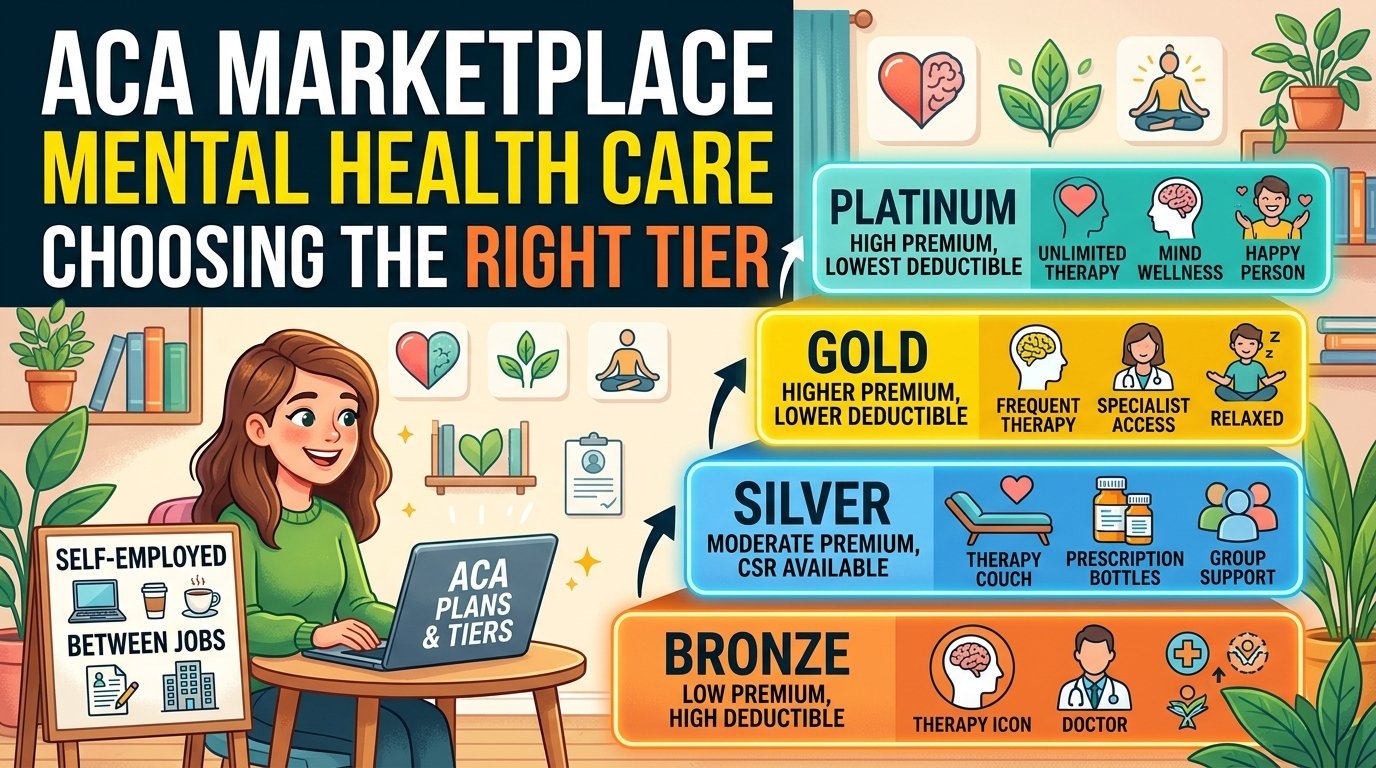
Marketplace plans are organised into four tiers: Bronze, Silver, Gold, and Platinum. The tiers describe how the cost of care is split between the patient and the insurer. Bronze plans have the lowest premiums but the highest cost-sharing, with deductibles often exceeding seven thousand dollars before most coverage kicks in. Platinum plans have the highest premiums but the lowest cost-sharing, often covering most care after a small copay.
For patients who use significant mental health care, the tier choice matters more than for patients who use only routine medical services. Weekly therapy at one hundred fifty dollars per session, plus monthly psychiatry at two hundred dollars, plus medications, can produce annual mental health spending in the low five figures. Under a Bronze plan, almost all of that spending is out of pocket until the deductible is met. Under a Gold or Platinum plan, much of it is paid by the insurer after a copay or co-insurance.
The math frequently favours the higher-tier plan for high-utilisation patients, even when the premium is higher. The savings on therapy copays alone can exceed the additional premium cost. Calculate your expected annual mental health spending and compare the two scenarios explicitly. The intuition that lower premium is always better often misleads patients who use significant mental health care insurance.
Network Adequacy: The Hidden Variable
Within any given tier, plans differ in network breadth. Some plans offer broad networks with thousands of in-network mental health providers near me, while others offer narrow networks built around specific health systems. The premium difference between broad and narrow networks can be twenty to thirty percent. The clinical difference can be the ability to see your existing therapist or psychiatrist versus starting over with a new provider you have not chosen.
Before choosing a plan, search the plan’s behavioural health provider directory for a sample of clinicians you would consider seeing. If your current therapist is in network, that argues for the plan. If the directory is thin in your specialty area or geography, that is a signal to choose a broader network. Many marketplace shoppers skip this step and end up locked into a plan whose network does not include accessible providers.
Premium Subsidies and the Income Cliff
Most marketplace shoppers qualify for premium subsidies based on household income. The subsidies are substantial: many self-employed workers earning between twenty and seventy thousand dollars find their net premium reduced by hundreds of dollars per month. The subsidies make Gold and Platinum plans affordable for patients whose income would otherwise have pushed them toward Bronze. The cost-sharing reduction subsidies, which apply only to Silver plans for patients below certain income thresholds, can make Silver plans behave like Platinum in terms of out-of-pocket costs.
The interaction between income, subsidy, plan tier, and mental health utilisation is complex. The most reliable approach is to model two or three plan scenarios for your specific income and expected utilisation, using the marketplace’s plan comparison tool. The investment of an hour during open enrolment can save thousands of dollars over the year.
HSA-Eligible Plans and Self-Employment Tax Strategy
Self-employed marketplace shoppers have particular reason to consider HSA-eligible plans. The combination of self-employment income, the deductibility of health insurance premiums for self-employed taxpayers, and the triple tax advantage of an HSA can produce substantial tax savings. A self-employed therapy patient who chooses a Bronze HSA-eligible plan, contributes the maximum to the HSA, and pays therapy from HSA dollars often pays effectively less for mental health care than the same patient on a higher-tier plan, when total tax savings are accounted for.
The math is sensitive to income, marginal tax rate, and utilisation level. For self-employed patients in higher tax brackets, the HSA strategy is often the most tax-efficient way to fund mental health spending. For patients in lower brackets or with very high utilisation that would exceed the HSA contribution limit, a higher-tier plan with lower out-of-pocket costs may be better. A consultation with an accountant familiar with self-employed health benefits is often worth the fee.
Special Enrollment Periods
Most marketplace enrolment happens during the annual open enrolment period, which runs from November to mid-January in most states. Patients who experience qualifying life events, including job loss, marriage, divorce, the birth of a child, moving to a new state, and several other categories, can enroll during a special enrolment period at any time of year. If you are between jobs and lost employer coverage, do not wait for open enrolment. The special enrolment period exists for exactly this scenario.
For patients who experience a mental health crisis between open enrolment periods and find that their coverage is inadequate, the available options are typically limited to switching to a different plan within the same tier, adding a supplemental product, or in extreme cases moving to Medicaid if income drops. Planning the right plan during open enrolment matters because correcting later is harder.
A Practical Decision Framework
The right marketplace plan for mental health care depends on three things: how much therapy and psychiatry you expect to use, how much you can afford to pay in premium versus out-of-pocket, and how much you value access to specific providers. Patients with high utilisation, moderate premium budget, and a preference for specific providers often choose Gold or Platinum plans with broader networks. Patients with low utilisation, tight premium budget, and flexibility on providers often choose Bronze plans, sometimes paired with an HSA for tax efficiency.
The decision is not casual. Spend the time during open enrolment to model your options. Use the marketplace’s plan comparison tool, the carrier’s behavioural health provider directories, and an honest projection of your annual mental health care needs. The plan you choose shapes the next twelve months of access, cost, and continuity in your treatment.
This article is informational and does not constitute tax or legal advice. For specific marketplace questions, contact HealthCare.gov or your state-based marketplace. If you or someone you know is in crisis, call or text 988 in the United States.