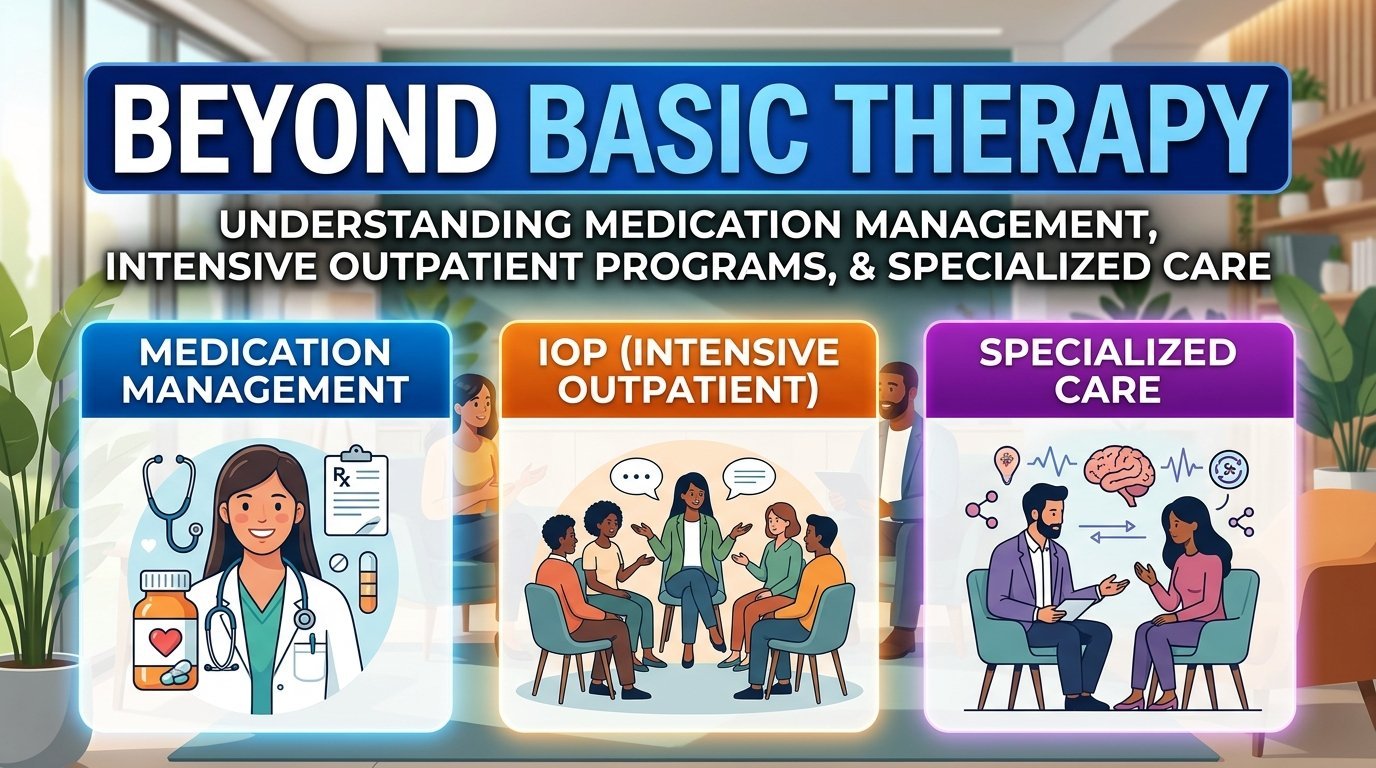
When Weekly Therapy Is Not Enough
You have been seeing a therapist for several months. The first few sessions felt productive. You appreciated having a neutral person to talk to. But somewhere along the way, the progress stalled.
The anxiety still spikes without warning. The depression still makes getting out of bed a negotiation every morning. You are doing the worksheets. You are practicing the breathing exercises. And yet something essential is not shifting.
This is not a sign that you are failing at therapy. It is a sign that your current level of mental health care may not match the intensity or complexity of your condition. Just as a primary care doctor treats routine infections but refers complex cases to specialists, basic outpatient therapy helps many people but leaves others needing more.
This guide explores the full range of specialized mental health care available in the United States. You will learn when medication management becomes appropriate, what intensive outpatient programs actually involve, how to find UnitedHealthcare therapists and other providers who specialize in specific diagnoses, and how to determine whether your current treatment plan needs escalation. No generic advice. No pretending that one approach works for everyone.
Recognizing When Basic Outpatient Care Is Not Sufficient
Before discussing specialized options, it helps to identify the signs that standard weekly therapy may not be enough for your situation.
The Plateau That Does Not Break
Most people in therapy experience periods where progress feels slow. This is normal. But a plateau lasting more than six to eight weeks despite consistent attendance and genuine effort suggests that the current approach may need adjustment.
Ask yourself honestly: Compared to three months ago, are your symptoms noticeably better? Not completely resolved, but meaningfully improved. If the answer is no, your current level of care may be insufficient.
Functional Impairment That Persists
The purpose of mental health care is not just to feel better. It is to function better. If you are still missing work, withdrawing from relationships, neglecting basic self-care, or avoiding activities you used to enjoy despite weekly therapy, something needs to change.
Symptoms That Require Medical Intervention
Some conditions respond poorly to talk therapy alone. Severe depression often requires medication to create enough stability for therapy to work. Panic disorder with frequent attacks may need medication to reduce the baseline anxiety before cognitive techniques become learnable. Bipolar disorder, psychosis, and severe obsessive-compulsive disorder almost always require psychiatric medical management.
Knowing when to escalate is not giving up on therapy. It is matching the right tool to the problem.
Medication Management: What Psychiatrists and Psychiatric Nurse Practitioners Actually Do
Medication management is one of the most misunderstood components of mental health care. Many patients assume that seeing a psychiatrist means giving up on therapy or that medication will change their personality.
The Role of the Prescriber
Psychiatrists (MD or DO) and psychiatric nurse practitioners (PMHNP) are medical professionals who prescribe and monitor psychiatric medications. Their job includes:
- Conducting diagnostic evaluations to determine whether medication is appropriate
- Prescribing initial medications at safe starting doses
- Monitoring for side effects and adjusting doses accordingly
- Changing medications when first-line options do not work
- Managing medication during pregnancy, breastfeeding, or with other medical conditions
- Coordinating care with your therapist and primary care doctor
Most prescribers do not provide weekly talk therapy. Their visits are shorter, typically fifteen to thirty minutes, focused on medication effectiveness and side effects.
When Medication Management Is Appropriate
Medication is not a sign of weakness or a moral failure. It is appropriate for:
- Moderate to severe major depressive disorder
- Generalized anxiety disorder with physical symptoms
- Panic disorder
- Bipolar spectrum disorders
- Obsessive-compulsive disorder
- Post-traumatic stress disorder with severe hyperarousal
- Psychotic disorders including schizophrenia
For these conditions, delaying medication while hoping therapy alone will work often prolongs suffering unnecessarily.
What to Expect in a Medication Management Visit
Your first visit with a prescriber is longer, typically sixty to ninety minutes. The psychiatrist or PMHNP will ask about:
- Your current symptoms and their severity
- When symptoms began and what triggers them
- Past treatments including medications and therapy
- Your medical history including other conditions
- Medications you currently take
- Family history of mental health conditions
- Substance use including alcohol, cannabis, and other drugs
This information helps determine which medication class is safest and most likely to work for your specific situation.
Follow-up visits are shorter. The prescriber will ask about side effects, symptom changes, and any new concerns. Adjustments happen gradually. Most psychiatric medications take four to six weeks at a therapeutic dose to show full effects.
Finding Prescribers Who Accept Insurance
Searching for mental health providers near me who can prescribe medication requires filtering specifically for psychiatrists or psychiatric nurse practitioners. When using insurance portals including the UnitedHealthcare therapists directory (which also includes prescribers), select “psychiatry” or “medication management” as the specialty.
Wait times for psychiatrists are often longer than for therapists, sometimes three to four months. Psychiatric nurse practitioners frequently have shorter wait times and provide equally good care for common conditions.
The Cost of Medication Management
| Provider Type | In-Network Copay (after deductible) | Private Pay Cost |
|---|---|---|
| Psychiatrist (initial eval) | 40−80 | 300−500 |
| Psychiatrist (follow-up, 15-30 min) | 20−40 | 150−250 |
| Psychiatric NP (initial eval) | 30−60 | 200−350 |
| Psychiatric NP (follow-up) | 20−30 | 100−200 |
Many patients see a prescriber every one to three months once stable. The monthly cost of medication itself varies widely. Generic antidepressants cost 10to30 per month. Newer or brand-name medications can cost hundreds. GoodRx and manufacturer assistance programs help reduce costs.
Intensive Outpatient Programs: When Weekly Therapy Is Not Enough but Hospitalization Is Too Much
Intensive outpatient programs (IOPs) occupy the middle ground on the spectrum of mental health care. They provide more support than weekly therapy without requiring you to live at a facility.
What an IOP Actually Looks Like
No two IOPs are identical, but most share common features:
- Nine to fifteen hours of treatment per week
- Three to five days of programming weekly
- Morning or evening schedules (many offer both to accommodate work)
- Group therapy as the primary treatment modality
- One individual therapy session weekly
- Weekly medication management with a psychiatrist or NP
- Skills training in distress tolerance, emotion regulation, and interpersonal effectiveness
- Homework and practice assignments between sessions
Patients return home each evening. IOPs typically last six to twelve weeks, though some patients need longer.
Who Belongs in an IOP
IOPs are appropriate for:
- Patients who have tried standard outpatient therapy without sufficient improvement
- Those stepping down from inpatient or partial hospitalization
- People with moderate suicidal ideation but no active plan or intent
- Patients whose symptoms significantly impair daily functioning
- Those with co-occurring mental health and substance use disorders
- People needing more structure than weekly sessions can provide
IOPs are not appropriate for active crisis requiring 24-hour monitoring or for patients who cannot safely return home each evening.
What Insurance Covers for IOPs
Most PPO plans and many HMOs cover IOPs when medically necessary. Prior authorization is required. Your outpatient therapist or psychiatrist must submit documentation showing that standard outpatient care has been insufficient.
Typical IOP coverage includes:
| Insurance Type | Typical Daily Copay | Prior Authorization Required? |
|---|---|---|
| PPO (after deductible) | 50−150 | Yes |
| HMO (with referral) | 30−100 | Yes |
| Medicare | 20% coinsurance | Yes |
| Medicaid | 0−25 | Varies by state |
Without insurance, IOPs cost 300to500 per day, making them inaccessible to most patients without coverage.
Finding IOPs Near You
Search for mental health providers near me that offer IOPs. Most hospital systems have IOPs. Freestanding psychiatric hospitals also offer them. When searching insurance portals, look for “intensive outpatient program” or “partial hospitalization” (PHP is a higher level of care).
Call the IOP directly and ask:
- Do you accept my specific insurance plan?
- What is the typical wait time for admission?
- Do you offer evening schedules for people who work?
- What is the expected duration of the program?
- Do you provide transportation assistance?
Partial Hospitalization Programs: The Step Below Inpatient Care
Partial hospitalization programs (PHPs) provide more intensive care than IOPs but still allow patients to return home or to transitional housing each evening.
What a PHP Looks Like
PHPs typically include:
- Twenty to thirty hours of treatment weekly
- Five to six hours per day, five days per week
- Breakfast and lunch often provided
- Multiple therapy groups daily
- Daily individual check-ins with a primary therapist
- Daily medication management
- Case management for housing, employment, or benefits
- Family therapy sessions as appropriate
PHPs usually last one to four weeks, with patients stepping down to IOPs or standard outpatient care afterward.
Who Belongs in a PHP
PHPs are appropriate for:
- Patients discharged from inpatient psychiatric hospitalization
- Those with active suicidal ideation but no plan or intent
- People unable to work or attend school due to symptoms
- Patients needing daily structure to maintain safety
- Those who have failed IOP-level care
Insurance Coverage for PHPs
PHP coverage mirrors IOP coverage but daily copays are typically higher given the increased service intensity. Prior authorization is always required. Most patients access PHPs through a referral from an emergency room or inpatient psychiatric unit.
Specialized Therapy for Specific Diagnoses
Not all therapy is the same. For certain diagnoses, general talk therapy is significantly less effective than specialized, evidence-based protocols.
Cognitive Behavioral Therapy for Anxiety and Depression
CBT is the most researched therapy for anxiety and depression. It focuses on identifying and changing thought patterns that drive emotional distress. Unlike open-ended talk therapy, CBT is typically time-limited (twelve to twenty sessions) and structured.
When searching for mental health providers near me who offer CBT, ask specifically about their training. Many therapists claim to practice CBT but only use its surface elements. True CBT includes between-session homework, structured agendas, and measurable progress tracking.
Dialectical Behavior Therapy for Borderline Personality Disorder and Chronic Suicidality
DBT was developed specifically for borderline personality disorder but is now used for any condition involving emotional dysregulation. Comprehensive DBT includes four components:
- Weekly individual therapy
- Weekly skills training group
- Between-session phone coaching for crises
- A consultation team for the therapist
Partial DBT (individual therapy only or group only) is significantly less effective. When searching for mental health providers near me who offer DBT, ask whether they provide the full four-component model.
DBT is intensive and expensive. Comprehensive DBT costs 300to600 per week. Most insurance plans cover it with prior authorization, though some limit the number of group sessions.
Prolonged Exposure and EMDR for PTSD
Post-traumatic stress disorder requires trauma-focused treatment. General talk therapy can actually worsen PTSD by allowing patients to avoid traumatic material without processing it.
Prolonged Exposure (PE) and Eye Movement Desensitization and Reprocessing (EMDR) are the most researched trauma treatments. Both involve approaching traumatic memories in structured ways under therapist guidance. Treatment typically lasts eight to fifteen sessions.
When looking for UnitedHealthcare therapists or other in-network providers for PTSD, filter by trauma specialty and ask whether they are trained in PE, EMDR, or Cognitive Processing Therapy (CPT).
Coordinating Care Between Multiple Providers
Many patients receiving specialized mental health care see multiple providers simultaneously: a therapist for weekly sessions, a psychiatrist for medication management, and possibly a group therapist for IOP or DBT skills group.
The Importance of Release of Information
Your providers cannot talk to each other without your written permission. Sign release of information forms allowing your psychiatrist and therapist to communicate. This prevents dangerous situations like your psychiatrist prescribing a medication your therapist does not know you are allergic to.
Who Should Be the Lead Clinician
For most patients, one provider should serve as the lead clinician coordinating care. In IOPs and PHPs, the program director fills this role. For standard outpatient care with separate therapist and psychiatrist, your therapist typically serves as lead, but this should be explicit.
Ask: “Who is responsible for communicating with my other providers if something urgent comes up?”
Handling Conflicting Advice
Sometimes providers disagree. Your therapist might recommend a medication change you do not want. Your psychiatrist might think you are ready to reduce therapy frequency when you do not feel ready.
When conflicts arise, schedule a joint session with both providers. Most will agree to this. Hearing everyone in the same room resolves confusion faster than relaying messages back and forth.
When Hospitalization Is Necessary: What to Expect
Inpatient psychiatric hospitalization is the highest level of mental health care. It is not something to fear, but it is something to understand before you need it.
Reasons for Hospitalization
Inpatient care is appropriate when:
- You are an immediate danger to yourself (active suicidal intent and plan)
- You are an immediate danger to someone else
- You cannot care for basic needs (eating, drinking, bathing, taking medications)
- You are experiencing psychosis with dangerous disorganization
- You need medical detoxification from substances with dangerous withdrawal
Hospitalization is not appropriate for non-emergency conditions. Most stays last three to seven days, focused on stabilization rather than long-term treatment.
What Happens in the Hospital
Inpatient psychiatric units vary widely, but most include:
- A private or semi-private room
- Three meals daily
- Daily psychiatrist visits
- Group therapy sessions
- Medication administration
- Discharge planning with a social worker
You may not have access to your phone or computer depending on hospital policies. Visitors are typically limited to specific hours.
Insurance Coverage for Hospitalization
Inpatient psychiatric care is covered by most insurance plans under the Mental Health Parity Act. Coverage mirrors medical hospitalization:
- Daily copay or coinsurance after deductible
- Prior authorization required for planned admissions
- Emergency admissions are covered pending authorization
Medicare covers up to 190 days of inpatient psychiatric care in a lifetime. Medicaid coverage varies by state.
Frequently Asked Questions About Specialized Mental Health Care
How do I know if I need medication or just more therapy?
Ask your therapist directly. If they are unsure, request a psychiatric evaluation. A psychiatrist or psychiatric nurse practitioner can assess whether medication is likely to help your specific symptom pattern.
Can I do an IOP while working?
Many IOPs offer evening schedules specifically for employed patients. Evening IOPs typically run 5:30 PM to 8:30 PM, three to five evenings per week. Some employers allow schedule adjustments or FMLA leave for IOP attendance.
What if my UnitedHealthcare therapists directory shows no specialized providers near me?
Look for telehealth options. Specialized providers including DBT therapists and trauma specialists increasingly offer virtual services. Expand your search to statewide or national directories and filter for telehealth.
How long does medication management take to work?
Most antidepressants and anti-anxiety medications take four to six weeks at a therapeutic dose to show full effects. Do not stop a medication because you feel no change after one week. Give it time unless side effects are intolerable.
What if I cannot afford specialized care even with insurance?
Community mental health centers offer sliding-scale specialized services including medication management and IOPs. Wait times are longer, but care exists. Call your county behavioral health department for referrals.
Final Thoughts: Matching Care to Need
The goal of mental health care is not to be in the highest level of care possible. It is to be in the right level of care for your current needs. That level will change over time.
What starts as an IOP may step down to weekly therapy. What starts as weekly therapy may escalate to an IOP during a difficult period. What starts with a therapist alone may add medication management. These changes are not failures. They are signs that you and your providers are paying attention to what works and adjusting accordingly.
If you have been in weekly therapy for months without meaningful improvement, do not quietly quit. Do not assume you are the problem. Have an honest conversation with your therapist about whether your current level of care matches your needs. Ask about medication evaluation. Ask about IOPs. Ask about specialized protocols for your specific symptoms.
The right level of care for you exists. Your job is not to know what it is automatically. Your job is to keep asking until you find it.
Disclaimer: This article provides general educational information about specialized mental health care options in the United States. It does not constitute medical advice or a substitute for professional clinical assessment. Treatment decisions should be made with qualified health professionals who know your specific situation. If you are experiencing a mental health emergency, including active suicidal thoughts with intent, call 988 or go to your nearest emergency room immediately.