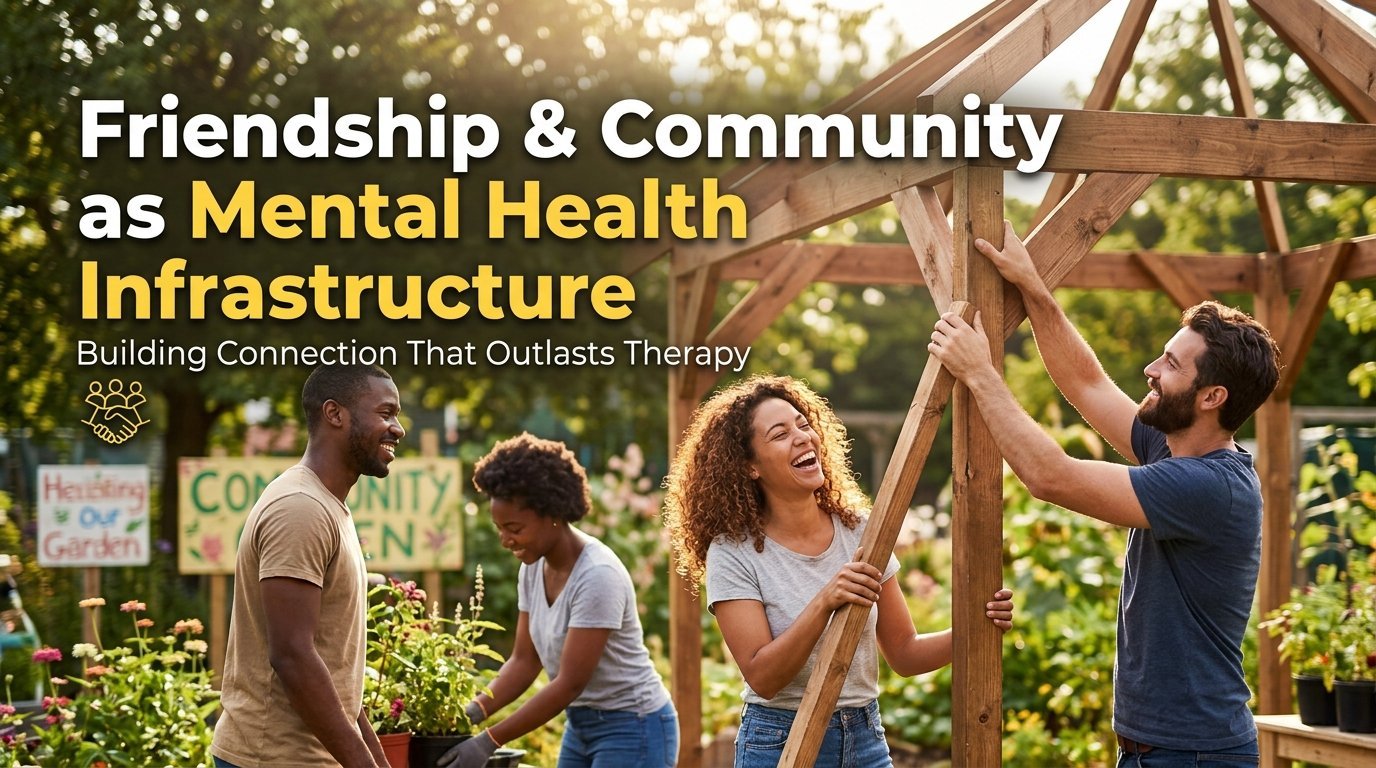
The Mental Health Infrastructure That Costs Nothing and Predicts the Most
The longest-running study of human flourishing in history, the Harvard Study of Adult Development, has tracked hundreds of men over more than eight decades. The single most consistent finding from the study is that the quality of close relationships, more than wealth, fame, intelligence, or genes, predicts long-term mental and physical health. The result has been replicated and extended across many other studies. Whatever else makes up a good life, the people in it are at the centre.
For modern Americans navigating mental health care, this finding has practical consequences. The friendships you maintain, the communities you belong to, and the casual social texture of your daily life are not lifestyle accessories. They are mental health infrastructure. Investing in them produces measurable benefits for depression, anxiety, cognitive decline, and overall life satisfaction. Neglecting them produces predictable costs that no amount of therapy or medication fully offsets.
The Specific Mechanisms
The connection between social relationships and mental health operates through several distinct mechanisms. Social contact reduces baseline cortisol and inflammation, both of which contribute to depression and anxiety when chronically elevated. Conversation activates brain regions associated with emotional regulation, which over time strengthens the regulatory capacity itself. Sharing experiences with others reduces the cognitive load of managing distress alone, since externalising a problem in conversation often reframes it.
Beyond the moment-to-moment effects, social relationships provide a backstop during difficult periods. People with strong social networks recover faster from depressive episodes, are less likely to become suicidal during crises, and report better outcomes from formal mental health care. The relationships are not a replacement for professional treatment when needed. They are part of the substrate that makes treatment work and that prevents some treatments from being needed in the first place.
The Adult Friendship Problem
Most adults in the United States report fewer close friends than they had in earlier life stages. The reasons are well-documented: career intensity, parenting demands, relocation, the geographic dispersion of college friends, the effort required to maintain friendships without the structural scaffolding of school or shared workplaces. The result is that adult friendship is something most people experience as a slow loss, with limited tools for reversal.
The reversal is possible but requires deliberate work. Adult friendships do not form passively the way they did in childhood. They form when people share repeated, low-stakes contact over time, with explicit invitations to deepen the relationship as it progresses. The structures that support this kind of contact, including hobby groups, regular social rituals, professional communities, faith communities, and parents-of-the-same-age cohorts, do not emerge automatically. They have to be sought.
Practical Steps for Building Adult Connection
The most useful single step for most adults is to commit to a recurring weekly or biweekly activity that involves the same people. The recurring nature is more important than the activity itself. A weekly running group, a biweekly book club, a monthly board game night, a weekly community garden volunteer slot, a weekly faith community gathering. The repetition produces the conditions for friendship to develop, which a series of one-time events does not.
The second step is to convert acquaintances into friends through deliberate invitation. Most adults have multiple acquaintances who could become friends with a few invitations. The barrier is the awkwardness of the first invitation. The friction is real but manageable. A specific invitation, like “would you want to grab coffee Saturday morning,” produces a meaningful step forward. Vague invitations, like “we should hang out sometime,” rarely do.
The third step is to maintain existing relationships against the natural drift of adult life. A weekly call with a college friend who lives in another city. A monthly dinner with a long-standing local friend. A birthday text. A periodic check-in. The maintenance is unglamorous and requires deliberate scheduling. The relationships that survive adulthood are the ones whose participants do this work, not the ones whose participants assume the relationships will sustain themselves.
Community as a Different Layer
Beyond individual friendships, communities provide a different kind of mental health infrastructure. Religious congregations, neighbourhood associations, civic organisations, recovery groups, hobby clubs, and other communal structures offer what individual friendships often cannot: a sense of belonging to something larger, a network of weak ties that can be activated in crisis, and a shared identity that anchors the self during difficult periods.
The decline of community participation across American adulthood is well-documented. The reversal, like the reversal of friendship decline, is possible but requires deliberate engagement. Showing up regularly to a community matters more than what is done at the meetings. Becoming known by others in the community produces a different kind of social capital than the strongest individual friendship can provide.
For patients with significant mental health care needs, communities specifically organised around recovery, such as twelve-step groups, NAMI peer support groups, recovery community organisations, and DBSA chapters, offer the dual benefit of community and shared experience. The peer support component is itself evidence-based and has been incorporated into many formal treatment models.
Loneliness as a Clinical Risk Factor
The U.S. Surgeon General declared loneliness a public health crisis in recent years, citing evidence that the mortality risk of chronic loneliness exceeds the mortality risk of smoking fifteen cigarettes per day. The clinical implications for mental health care are significant. Patients presenting with depression and anxiety who also report chronic loneliness benefit from interventions that address loneliness directly, not just from interventions that address symptoms.
Some clinicians now explicitly screen for loneliness and incorporate connection-building into treatment plans. The interventions are sometimes simple, including encouraging patients to commit to a recurring social structure, helping patients identify and overcome the barriers to connection, and treating loneliness as a symptom worth addressing in its own right rather than as a downstream effect of depression that will resolve when the depression resolves.
Online Versus In-Person Connection
The role of online connection in mental health is nuanced. Online interactions with established close friends and family members appear to be neutral or beneficial, supporting relationships that would otherwise drift. Online interactions with strangers, particularly through algorithmic social media feeds, tend to be neutral or harmful for mental health, with several large studies showing increased rates of depression and anxiety associated with heavy social media use.
The practical implication is that online connection is most useful when it supports specific people you actually know, and least useful when it consists of scrolling content from people you do not. Replacing one hour of social media scrolling per day with one hour of focused contact with a specific friend, even by phone or video, often produces measurable improvements in mood and reduces self-reported loneliness.
A Long-Term Investment
Building friendship and community as mental health infrastructure is a long-term project. The investments rarely produce immediate dividends. The recurring activity attended for the first three weeks may not produce friendship until the third month. The acquaintance invited for coffee may not become a real friend until the fifth or sixth invitation. The community joined may not feel like home until the second year.
The gradual nature is the point. Relationships that develop quickly often dissolve quickly. Relationships that develop through repeated low-stakes contact tend to last. The patience required to build them is the same patience required to maintain them, and the patients who develop this patience are the ones who report the strongest social support over decades.
For patients receiving formal mental health care, the work of building social infrastructure is part of the treatment. The therapist or psychiatrist alone cannot provide what a network of relationships provides. Both are needed, and the gains compound. The hours invested in friendship and community are among the highest-return hours in long-term mental health.
This article is for educational purposes and does not constitute personalised medical advice. If you or someone you know is in crisis, call or text 988 in the United States.