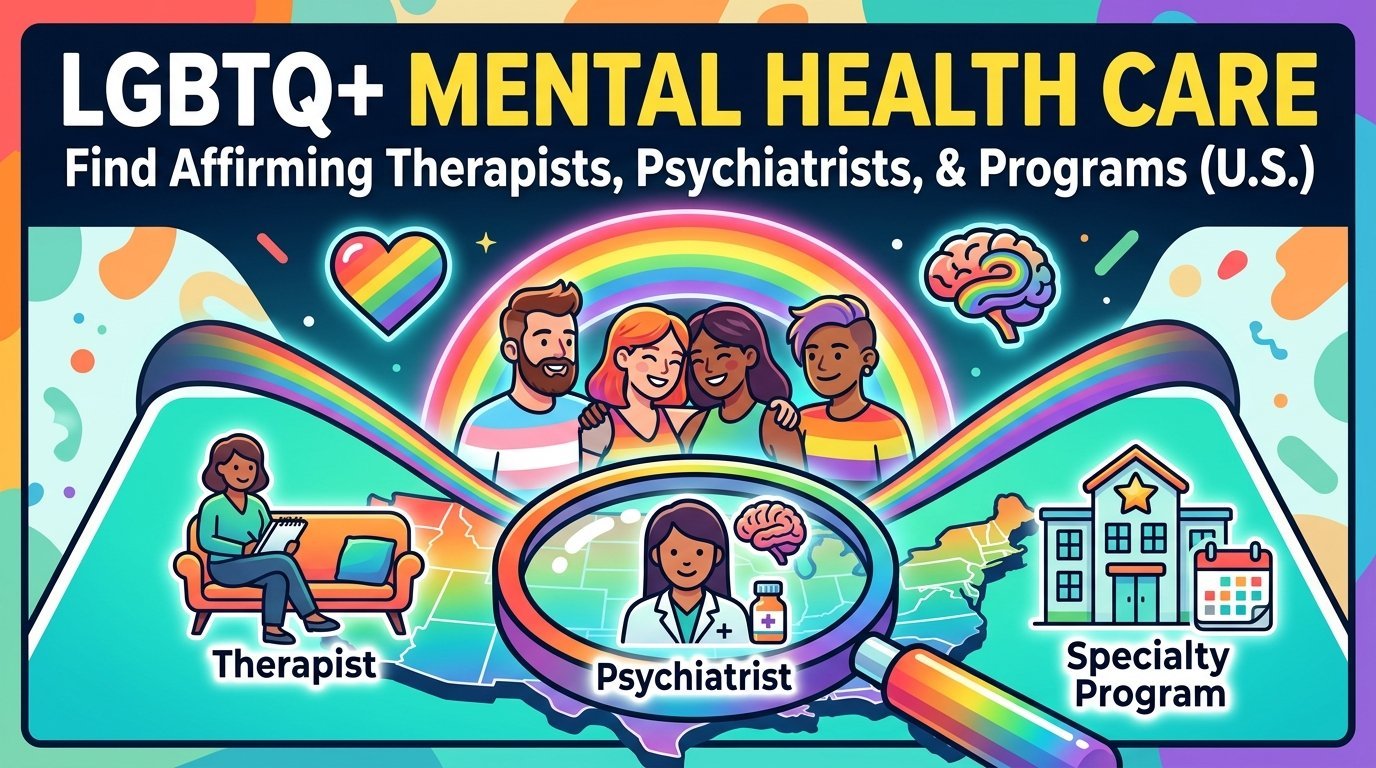
Lesbian, gay, bisexual, transgender, and queer Americans experience higher rates of depression, anxiety, suicidality, and substance use than the general population—not because of intrinsic vulnerability, but because of the cumulative weight of minority stress: discrimination, family rejection, healthcare bias, and identity invalidation. LGBTQ+ affirming mental health care recognizes these realities, treats identity as a strength rather than a pathology, and adapts standard evidence-based therapies to the specific lives of queer and trans patients.
This guide explains what affirming care actually means, how to find clinicians who provide it, what insurance is required to cover, and how to evaluate a therapist before the first session.
What “Affirming” Means
An affirming mental health provider:
- Recognizes LGBTQ+ identities as healthy and natural variations of human experience, not symptoms or disorders
- Does not promote, suggest, or accept conversion practices—these are now banned in roughly 27 U.S. states for minors and discredited universally by major mental health organizations
- Has training and lived familiarity with the specific stressors of LGBTQ+ life, including family of origin issues, internalized stigma, religious trauma, healthcare discrimination, and minority stress
- Understands gender-affirming care, the WPATH Standards of Care, the role of letters of support for hormones or surgery, and the lived realities of transition
- Adapts standard evidence-based therapies (CBT, DBT, ACT, EMDR, IFS) to the patient’s identity context
- Uses correct names and pronouns consistently
- Recognizes intersectional identities—Black, Latina, Asian, Indigenous, and disabled LGBTQ+ patients face overlapping systems of stress that affirming care must address
Common Mental Health Concerns the Field Treats
- Depression and suicidal ideation, especially in adolescents and young adults
- Generalized and social anxiety
- PTSD related to family rejection, religious trauma, anti-LGBTQ+ violence, or medical trauma
- Substance use disorders, which are elevated in LGBTQ+ populations
- Eating disorders, with particularly high rates in trans and non-binary individuals
- Coming out, identity exploration, and disclosure
- Gender dysphoria and gender-affirming care planning
- Relationship issues, including non-monogamy, polyamory, and queer relationship structures
- HIV-related mental health, sero-discordant couples, and chronic illness adjustment
- Family of origin estrangement, chosen family, and parenting
How to Find Affirming Providers
Reliable starting points include:
- Psychology Today and Inclusive Therapists directories with LGBTQ+ filter
- Therapy for Black Girls, Therapy for Latinx, Asian Mental Health Collective, and Asians for Mental Health for intersectional matches
- WPATH provider directory for clinicians experienced in gender-affirming care
- National Queer and Trans Therapists of Color Network
- LGBTQ+ community health centers like Fenway Health (Boston), Howard Brown (Chicago), Whitman-Walker (DC), Callen-Lorde (NYC), Mazzoni Center (Philadelphia), Lyon-Martin (San Francisco)
- Local LGBTQ+ centers, which usually maintain referral lists
- The Trevor Project and Trans Lifeline for crisis-line support and referrals
- Insurance directory search filtered by behavioral health and LGBTQ+ specialty (note: filter accuracy varies)
Vetting a Therapist: Questions to Ask Before the First Session
- What is your training and experience working with LGBTQ+ clients specifically?
- How do you address identity in therapy when it is part of the presenting concern?
- If I am trans or non-binary, are you familiar with WPATH, hormone-readiness letters, and the specific medical and social aspects of transition?
- How do you handle situations where my identity intersects with my faith background, family of origin, or culture?
- What is your stance on conversion practices?
- Do you offer telehealth across state lines if I move?
- How do you bill insurance for couples or polyamorous structures, and do you provide superbills if needed?
Strong affirming clinicians answer these questions with confidence and specifics. If a therapist becomes defensive or vague, that itself is a useful data point.
Insurance and Cost
Standard mental health benefits cover therapy and psychiatric medication for LGBTQ+ patients just as they do for any patient. Federal mental health parity rules apply. Coverage is increasingly comprehensive for gender-affirming care, including hormone therapy and surgery, in most ACA-compliant plans, Medicaid (in expansion states), and major employer plans. Some employer plans still impose specific exclusions; the Department of Labor has clarified that many such exclusions violate the ACA’s sex-discrimination protections under Section 1557.
Many LGBTQ+ community health centers operate on a sliding scale, accept Medicaid, and dramatically reduce out-of-pocket costs for patients without strong insurance. Federally Qualified Health Centers (FQHCs) similarly use sliding-scale fees based on income.
Telehealth Therapy for LGBTQ+ Patients
Telehealth has dramatically expanded access for LGBTQ+ patients in rural areas, conservative regions, or homes where in-person therapy would not be safe. Telehealth platforms specifically focused on LGBTQ+ care include Folx, Plume (for trans patients), and various queer-led private practices that operate across multiple state licenses. Verify state licensure—a therapist generally needs to be licensed in the state where you are physically located when you have a session.
For Family Members and Allies
Parents and family members of LGBTQ+ youth can dramatically reduce mental health risk through acceptance and affirmation. Family acceptance research from the Family Acceptance Project shows that affirming behaviors (using correct name and pronouns, advocating for the child at school, connecting with LGBTQ+ adults) substantially reduce suicide risk and depression. PFLAG offers in-person and virtual support groups for parents working through their own learning curves.
Crisis Resources
- 988 Suicide and Crisis Lifeline—press 3 for the LGBTQI+ Youth and Young Adult specialty service
- The Trevor Project—1-866-488-7386, available 24/7 for LGBTQ+ youth under 25
- Trans Lifeline—1-877-565-8860, peer support staffed by trans-identified individuals
- The LGBT National Hotline—1-888-843-4564 for general LGBTQ+ support
A Final Note
LGBTQ+ affirming mental health care is no longer a niche specialty. The evidence base is robust, the provider pool is growing, and most insurance plans cover it. Finding the right clinician matters: identity-aware therapy is faster, less retraumatizing, and more effective than care that treats your identity as something to manage around. The first session is the highest-stakes one. Use the questions above, trust your gut, and switch providers without guilt if the fit is wrong.
This article is for informational purposes only and is not medical advice. If you are in crisis, contact 988 or another crisis line listed above.