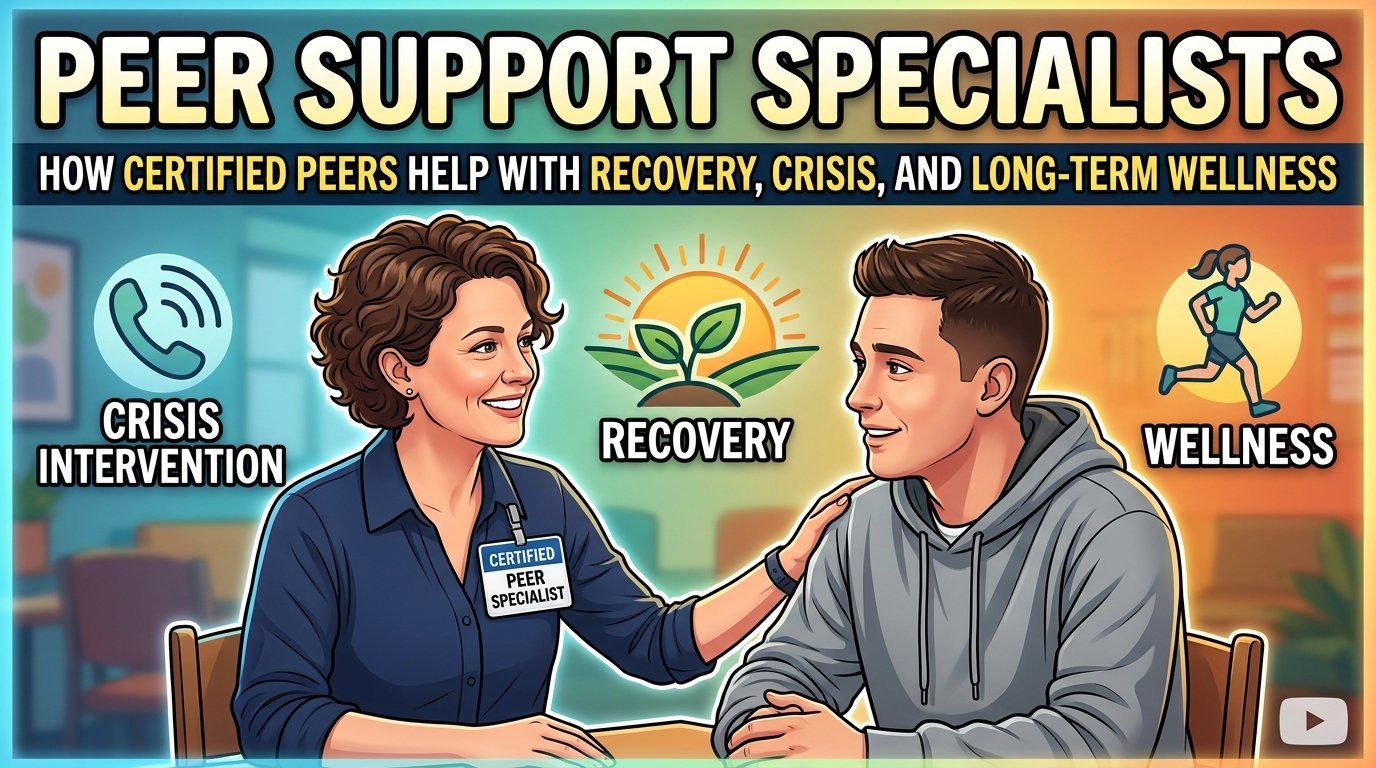
Some of the most useful conversations a person can have during recovery are not with a licensed clinician at all—they are with someone who has been where they are. Peer support specialists are trained, often-credentialed members of the mental health and addiction recovery workforce who use their own lived experience of mental illness or substance use to support others. The role is now embedded in hospitals, community mental health centers, recovery community organizations, crisis lines, and even traditional clinical practices.
This guide explains what peer support specialists do, how they differ from sponsors and therapists, where to find one, and what insurance is required to cover.
What a Peer Support Specialist Does
A peer support specialist:
- Listens, validates, and shares from their own recovery experience
- Helps with goal-setting, navigating the mental health system, and building self-advocacy
- Connects clients to housing, food, employment, transportation, and benefits
- Accompanies clients to appointments, court, or social services
- Models hope—the most powerful intervention in early recovery for someone who feels nothing will ever change
- Supports family members and care partners of people in recovery
- Often serves on crisis teams, mobile crisis units, and certified community behavioral health clinics
What peer specialists do not do: diagnose, prescribe, conduct therapy in the clinical sense, or provide care that requires licensure. They are part of a treatment team, not a replacement for therapy or psychiatry.
Peer Support vs. Sponsors vs. Therapists
- 12-step sponsors are unpaid volunteers within a specific recovery program (AA, NA, etc.) who guide a sponsee through the steps. They are not regulated, not paid, and not part of any medical system
- Peer support specialists are trained, often state-certified, paid professionals who can be employed in clinical and community settings. Their work is guided by ethical codes and supervision
- Therapists and counselors are licensed mental health clinicians providing diagnosis and treatment. Their training and scope are very different
The roles are complementary. Many people in recovery have all three at different points and benefit from each.
Certification and Training
Most U.S. states have a peer support certification process. Common paths include:
- Certified Peer Specialist (CPS) or state-equivalent for mental health peer support
- Certified Recovery Specialist (CRS), Peer Recovery Specialist, or CPRS for substance use recovery
- Certified Family Peer Specialist for parents and caregivers of children with mental illness
- Certified Forensic Peer Specialist for justice-involved populations
Training typically requires a minimum amount of personal recovery time (often 12 to 24 months), 40 to 80 hours of training, supervised work hours, and a state exam. Certified peers receive ongoing supervision and continuing education.
Where Peer Support Lives
- Recovery Community Organizations (RCOs)—independent nonprofits offering peer-led support, typically free
- Community Mental Health Centers and CCBHCs—peer specialists are increasingly standard staff
- Hospitals and emergency departments—many have peer recovery coaches who meet patients within hours of an overdose or psychiatric crisis
- Mobile crisis teams—peers ride alongside clinicians on crisis calls
- 988 Suicide and Crisis Lifeline call centers—some peer specialists work alongside clinical counselors
- Inpatient psychiatric units and detox facilities—peer presence eases admission and discharge
- Veterans organizations—the VA peer specialist program is one of the largest and longest-running
- Drug courts and reentry programs—peers often play key roles for justice-involved individuals
Insurance and Cost
Peer support is increasingly billable to Medicaid, Medicare, and many commercial insurance plans. Most states allow Medicaid reimbursement for certified peer support services, often under H0038 (mental health) and H0046 or H2017 (substance use). Medicare covers peer support through its Behavioral Health Integration codes when delivered as part of a clinical team.
For patients, peer services through community organizations are typically free. Hospital-based peer recovery support is generally bundled into the inpatient or ED bill at no additional charge. Within outpatient treatment teams, peer support is part of the program and rarely a separate copay.
How to Find a Peer Specialist
- SAMHSA National Helpline—1-800-662-HELP, can refer to local recovery community organizations
- Faces & Voices of Recovery—national directory of recovery community organizations at facesandvoicesofrecovery.org
- Mental Health America (MHA)—listings of state peer-run organizations
- NAMI—family support and certified family peer specialists
- Your state mental health authority—most maintain registries of certified peer specialists
- Your treatment team—ask whether peer support is available within the practice or through partner agencies
Peer Support for Families
Family peer specialists support parents, partners, and adult children of people with mental illness or substance use disorders. They have lived experience as a family member and can help navigate the emotional toll, system frustrations, and care planning challenges. NAMI Family-to-Family is a free 12-session education program led by trained family peers and is available in most U.S. cities.
When Peer Support Is Particularly Powerful
- Immediately after a psychiatric hospitalization or ER visit—peer presence dramatically reduces 30-day readmission
- After a non-fatal overdose—peers can engage individuals who refuse traditional treatment
- During the early weeks of recovery—when isolation and hopelessness are most dangerous
- For people who have lost trust in clinical systems—peers often serve as a bridge back into care
- For underserved populations—Black, Indigenous, immigrant, and LGBTQ+ peers can build trust faster than clinicians from outside the community
- For long-term wellness—peer connections sustain recovery in ways clinical relationships often cannot
A Final Note
The U.S. mental health workforce shortage is real, and clinical care is rationed by insurance, geography, and waitlists. Peer support specialists are not a substitute for therapists or psychiatrists, but they fill gaps that clinical providers cannot—and they offer something no clinician can: the simple, profound experience of talking to someone who has come through what you are facing. For many people in recovery, that is the relationship that changes everything.
This article is for informational purposes only and is not medical advice. Peer support is most effective when integrated with appropriate clinical care.