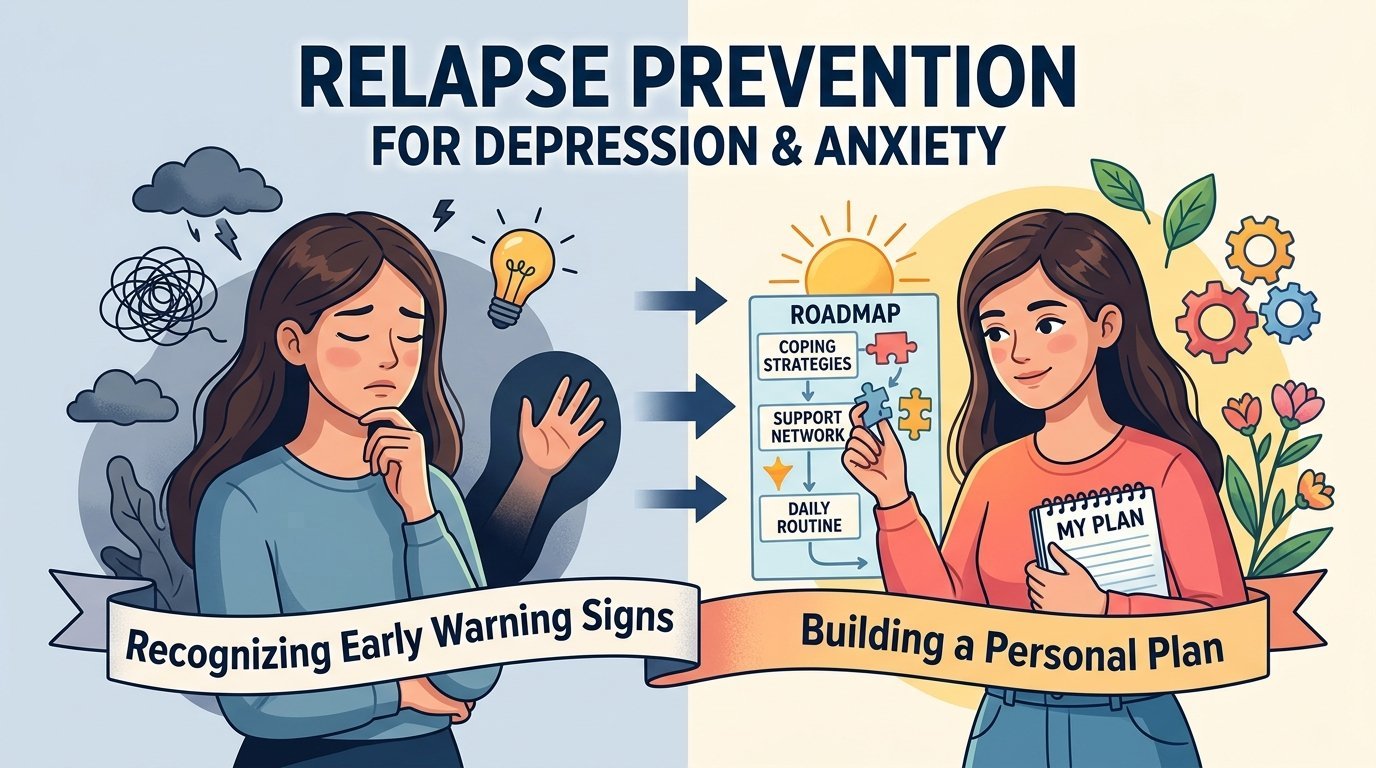
Why Relapse Plans Are the Quietly Important Part of Therapy
Most patients who recover from depression or anxiety experience at least one period of recurrence in their lifetime. The numbers depend on the condition and the population, but for major depressive disorder, the chance of a second episode within five years of the first is roughly fifty percent, and the chance of a third episode rises to around seventy percent. For anxiety disorders, persistence and recurrence are similarly common. The implication is that effective mental health care is not finished when symptoms remit. The next phase of work is preventing the next episode.
Relapse prevention is a structured discipline within mental health treatment, with specific tools, frameworks, and skills that have been refined over decades of research. Most patients never receive explicit relapse prevention training, even when their treatment was otherwise excellent. This guide describes what relapse prevention actually looks like, how to build a personal plan, and how to recognise the early signs of recurrence in time to intervene before a full episode develops.
The Anatomy of a Relapse
Relapses do not arrive suddenly. They develop in stages, often over weeks. The first stage is usually a subtle return of subclinical symptoms, what clinicians call prodromal signs. Sleep starts to slip. Energy decreases. The familiar patterns of self-talk start to resurface. The person notices a slight increase in anxiety in social situations, a slight loss of interest in activities, a slight irritability with family members. None of these alone is alarming. Together, over a few weeks, they constitute the early phase of an episode.
The second stage is when symptoms reach the threshold for clinical recognition. Sleep is consistently disrupted. Mood is consistently low or anxious. Functional impairment becomes noticeable: missing work, withdrawing from social engagements, neglecting routines that had been stable. Most patients seek mental health care at this stage, often after a prompt from a family member or a self-recognition that something is wrong.
The third stage is full episode recurrence, with significant symptoms across multiple domains, often including suicidal thoughts in depression or panic attacks in anxiety. The intervention required at this stage is more intensive than what would have been needed in the prodromal phase. Catching the relapse early changes both the duration and the severity of the episode.
Building a Personal Relapse Plan
An effective relapse plan is a written document with five components. The first is a description of yourself when you are well, including your sleep, energy, mood, social engagement, productivity, and self-care patterns. This baseline is the reference point against which deviations are measured.
The second is a list of personal warning signs. These are the specific changes that have appeared in your previous episodes, often in a recognisable order. For depression, the order might be: sleep changes, then loss of interest, then increasing self-criticism, then social withdrawal. For anxiety, the order might be: increased physical symptoms, then avoidance behaviours, then panic attacks. The list is most useful when it is specific to your own pattern, not a generic checklist.
The third component is a tiered list of interventions. Mild prodromal symptoms might respond to extra attention to sleep, exercise, and a brief check-in with a therapist. Moderate symptoms might require resuming weekly therapy, considering medication adjustment, and engaging family support. Severe symptoms require intensive mental health care at IOP or higher levels. Each tier has specific actions and specific contacts to reach out to.
The People Who Help You Notice
The fourth component is a list of trusted observers, people who know you well enough to notice changes you cannot see in yourself. Spouses, close friends, parents, siblings, and sometimes therapists or psychiatrists fill this role. The relapse plan includes explicit permission for these people to point out changes they observe, even when you are dismissive or defensive in the moment.
The arrangement matters because relapses often produce a specific cognitive distortion that resists self-recognition. Patients in early depression frequently experience their declining mood as a permanent reflection of reality rather than as a recurrence of an illness. Patients in early anxiety often interpret their increasing physical symptoms as evidence of medical danger rather than as the familiar pattern. Trusted observers can name what is happening before the patient can.
Maintenance Treatment as Prevention
Many patients with recurrent depression or anxiety benefit from maintenance treatment that continues after symptoms remit. Maintenance can take the form of continued antidepressant medication, periodic booster sessions of cognitive behavioural therapy, or scheduled follow-ups with a psychiatrist or therapist on a less frequent cadence. The evidence on maintenance treatment in mental health care is robust: continued treatment substantially reduces the rate of recurrence compared with full discontinuation.
The decision about maintenance treatment is individualised. Patients with a history of multiple episodes, severe past episodes, or strong family history of mood disorders generally benefit from longer maintenance. Patients with a single episode in response to a clear stressor and full recovery may be appropriate for tapering off treatment after a year or two. The conversation with a prescriber and therapist should happen explicitly, with the relapse history as the central data point.
Lifestyle and the Substrate of Stability
The fifth component of a relapse plan is the lifestyle commitments that maintain your stability over time. These include consistent sleep schedules, regular exercise, stable nutrition, low to moderate alcohol use, and active maintenance of social connections. The commitments are not a separate self-improvement project. They are part of the treatment, and the patients who maintain them tend to have longer remission periods than the patients who do not.
The commitments do not have to be perfect. Patients who maintain them imperfectly still benefit. The key is to notice when multiple commitments slip simultaneously, since simultaneous slippage often precedes prodromal symptoms. A patient who has stopped sleeping well, stopped exercising, and started drinking more in the same two-week window is in a vulnerable state, regardless of how good they currently feel.
When to Re-Engage Professional Care
The threshold for re-engaging mental health care during early relapse should be set in advance, not improvised in the moment. Many patients delay too long, partly because of the cognitive distortion noted earlier and partly because re-engaging feels like an admission of failure. It is not a failure. It is the appropriate use of a tool you built for exactly this situation.
A reasonable threshold for re-engaging therapy is two weeks of consistent prodromal symptoms, or any single episode of suicidal ideation, panic attacks, or significant functional impairment. The same threshold can be communicated to a primary care physician, who can adjust medications if needed and refer back to the prior psychiatrist or therapist. Most plans, including networks behind UnitedHealthcare therapists, Aetna therapists, and Cigna therapists, will cover a return to treatment quickly under existing benefits, particularly if the patient has been seen recently within the past year.
The Long View on Recurrent Conditions
Living with a recurrent mental health condition over a lifetime is a different project than recovering from a single episode. The framing matters. Patients who treat each remission as a return to normal that should never need attention again tend to be repeatedly disrupted by recurrences. Patients who treat their condition as a chronic vulnerability that requires ongoing maintenance, with periods of higher and lower activity, tend to have steadier trajectories over decades.
The chronic-vulnerability framing is not pessimistic. It is realistic, and it leads to better outcomes than the alternative. The patients who do best with recurrent depression or anxiety are not the ones who manage to never relapse. They are the ones who relapse less often, recover more quickly, and live full lives in between because they have built systems that support stability. The relapse plan is a central piece of that system.
This article is for educational purposes and does not constitute personalised medical advice. If you or someone you know is in crisis, call or text 988 in the United States.