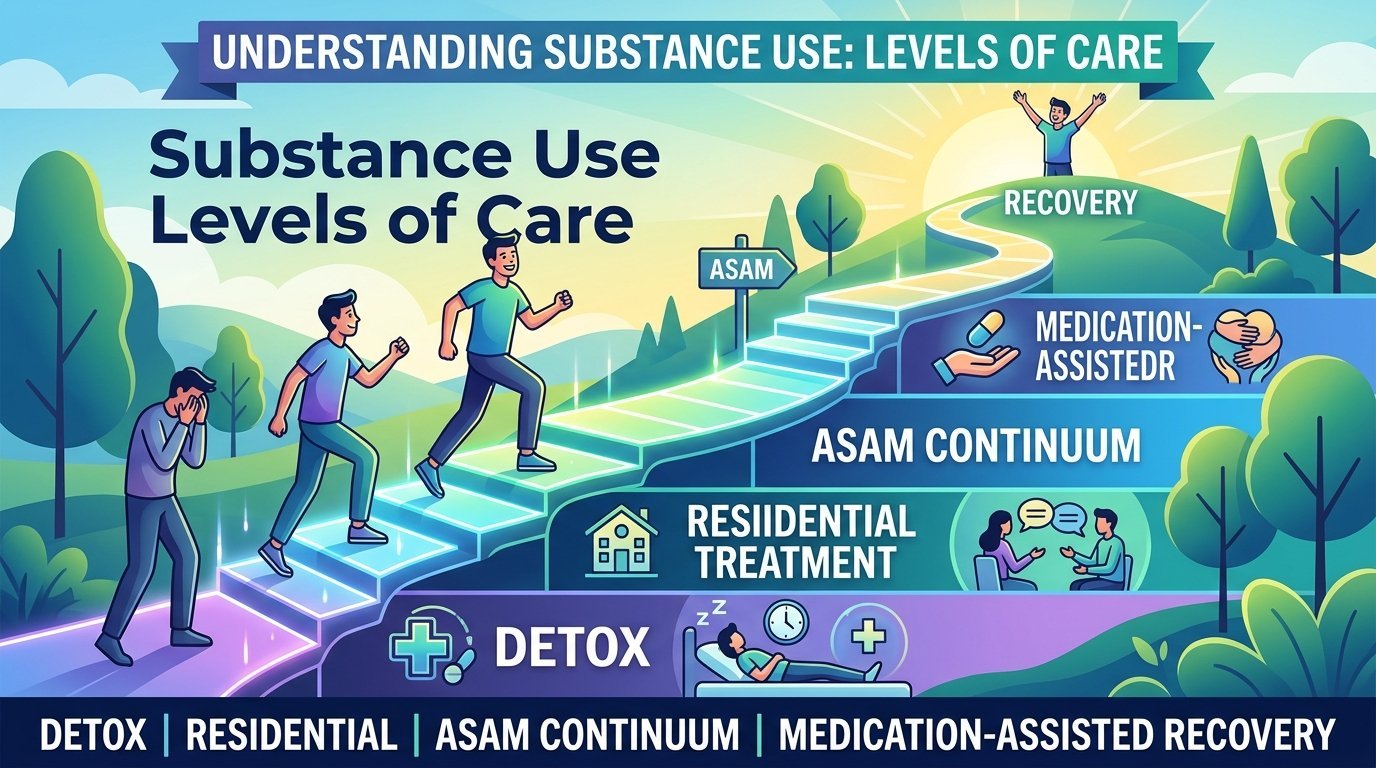
Why Substance Use Has Its Own Levels of Care
The continuum of mental health care has a parallel continuum specifically for substance use disorders, with its own terminology, its own clinical structures, and its own evidence base. The American Society of Addiction Medicine, often called ASAM, has codified this continuum into a set of levels that providers, insurers, and treatment programs use as a common language. Patients and families navigating addiction treatment benefit enormously from understanding the ASAM framework before making decisions about where to start.
This guide describes the major ASAM levels for substance use treatment, from outpatient through detox and residential care, including how each level works, who it serves, what insurance typically covers, and how patients access the right level. The framework applies to alcohol use disorder, opioid use disorder, stimulant use disorder, and most other substance use conditions, with some variation based on the specific substance and individual circumstances.
Level One: Outpatient Services
ASAM Level 1 corresponds to standard outpatient substance use treatment, typically meaning weekly individual therapy with an addiction-trained clinician, sometimes supplemented by group therapy and medication management. Patients at this level have moderate substance use concerns, intact functional capacity, and stable home environments that support recovery. They continue working, parenting, and engaging in normal life with treatment as a weekly addition.
For alcohol use disorder, Level 1 often combines therapy with medication-assisted treatment using naltrexone, acamprosate, or disulfiram. For opioid use disorder, Level 1 frequently combines therapy with buprenorphine or methadone maintenance, the gold standard medication treatments. The integration of medication and therapy at the outpatient level is one of the strongest predictors of long-term recovery and is now standard at most mental health providers near me who specialise in addiction treatment.
Level Two: Intensive Outpatient and Partial Hospitalisation
ASAM Level 2.1 is intensive outpatient treatment, with nine or more hours of structured care per week, often delivered in three-hour blocks three days per week. Level 2.5 is partial hospitalisation, with twenty or more hours per week, often six hours per day five days per week. Both levels target patients whose substance use disorder is more severe than Level 1 can manage but whose home environment is stable enough to allow them to sleep at home each night.
The treatment at Levels 2.1 and 2.5 includes group therapy, individual therapy, family work, twelve-step facilitation, motivational enhancement, cognitive behavioural therapy techniques specifically adapted for addiction, and medication management when appropriate. The cohort model is central. Patients move through the program with a small group of peers, and the shared experience is part of the therapeutic mechanism.
Insurance coverage at these levels is broad. Networks behind UnitedHealthcare therapists, Optum behavioural health, Aetna therapists, Cigna therapists, and Blue Cross Blue Shield variants typically cover both IOP and PHP for substance use treatment with prior authorisation. Medicaid coverage is similarly comprehensive in most states. Out-of-pocket costs depend on plan design, with copays per program day in the range of zero to seventy-five dollars after deductible.
Level Three: Residential Treatment
ASAM Level 3 is residential or inpatient services, with multiple subdivisions based on intensity. Level 3.1 is clinically managed low-intensity residential, sometimes called sober living plus structured programming. Level 3.5 is clinically managed medium-intensity residential, the most common form of substance use residential treatment. Level 3.7 is medically monitored intensive inpatient, used for patients with significant medical complications. Level 4 is medically managed intensive inpatient, the most acute level used for severe withdrawal complications.
For most patients with substance use disorders requiring residential care, Level 3.5 is the typical entry point. Stays last twenty-eight to ninety days, with structured days that combine group therapy, individual therapy, family programming, twelve-step participation, recreational activities, and medication management. The environment is removed from the patient’s home community to interrupt patterns and reduce access to substances during early recovery.
Cost and insurance coverage for residential treatment vary dramatically. In-network residential programs covered by major plans often produce out-of-pocket costs in the low thousands of dollars for a thirty-day stay. Out-of-network residential treatment can produce surprise bills in the tens of thousands. Always obtain written preauthorisation before admission, and confirm in writing whether the program is in-network or out-of-network for your specific plan.
Detoxification: A Specific Medical Need
Detoxification, often called detox, is a separate clinical service focused on the medical management of withdrawal during the first days after a patient stops using a substance. Detox is not a complete substance use treatment. It addresses the physiological aspects of stopping use, but the underlying disorder requires further treatment afterwards. Patients who complete detox without continuing into a higher level of substance use treatment have very high relapse rates.
Detox can be provided as an outpatient service, an intensive outpatient component, or an inpatient service, depending on the substance and the patient’s medical risk. Alcohol withdrawal in heavy drinkers, benzodiazepine withdrawal in long-term users, and opioid withdrawal in some patients with significant medical complications often require inpatient or medically monitored detox. Most other substance withdrawals can be managed in outpatient or partial settings with appropriate clinical oversight.
Medication-Assisted Treatment Across Levels
The role of medication in substance use treatment has expanded dramatically over the past decade. For opioid use disorder, buprenorphine and methadone are standard of care, with substantial evidence showing reductions in mortality, overdose, and continued use compared with non-medicated treatment. Extended-release naltrexone provides a non-opioid alternative for some patients. For alcohol use disorder, naltrexone, acamprosate, and disulfiram are FDA-approved with meaningful effect sizes.
Medication can and should be combined with treatment at every ASAM level. The integration is not always automatic. Some residential programs and some treatment providers historically resisted medication, particularly for opioid use disorder, based on outdated frameworks that have since been disconfirmed by the evidence. Modern mental health care for substance use disorders treats medication as an essential tool rather than as a compromise. Patients and families should ask explicitly about medication options at any level of treatment they consider.
Choosing the Right Level
The ASAM continuum is designed for matching, not for assuming a single best level. The right level depends on six dimensions ASAM uses for assessment: acute intoxication and withdrawal potential, biomedical conditions, emotional and behavioural conditions, readiness to change, relapse potential, and recovery environment. A skilled addiction clinician will assess across these dimensions and recommend a level that matches the patient’s actual needs.
For patients new to addiction treatment, an assessment with an ASAM-trained clinician is the right starting point, not a self-directed decision about where to go. The assessment can occur at a community mental health centre, a private addiction practice, a primary care setting with addiction specialty, or a treatment program’s intake process. The recommendation will guide the level of care that gives the patient the best chance of recovery.
Aftercare and the Long Arc
Substance use disorder is a chronic condition for many patients. The treatment arc usually extends well beyond the initial intensive treatment, with continued outpatient mental health care, peer support participation, family involvement, and lifestyle commitments. Patients who continue engagement with some form of recovery support for several years after the initial treatment have substantially better outcomes than patients who treat the initial treatment as a one-time event.
The right framing is not whether the substance use disorder will ever be treated. It is how the patient will manage the condition over a lifetime. The ASAM levels provide the technical structure for the most intensive phases. The longer arc is built on the connections, skills, and commitments that emerge from those phases. Treating both as parts of the same project produces the strongest long-term outcomes.
This article is for educational purposes and does not replace personalised guidance from a licensed clinician. If you or someone you know is in crisis, call or text 988 in the United States. SAMHSA’s National Helpline at 1-800-662-HELP provides free, confidential treatment referrals twenty-four hours a day.