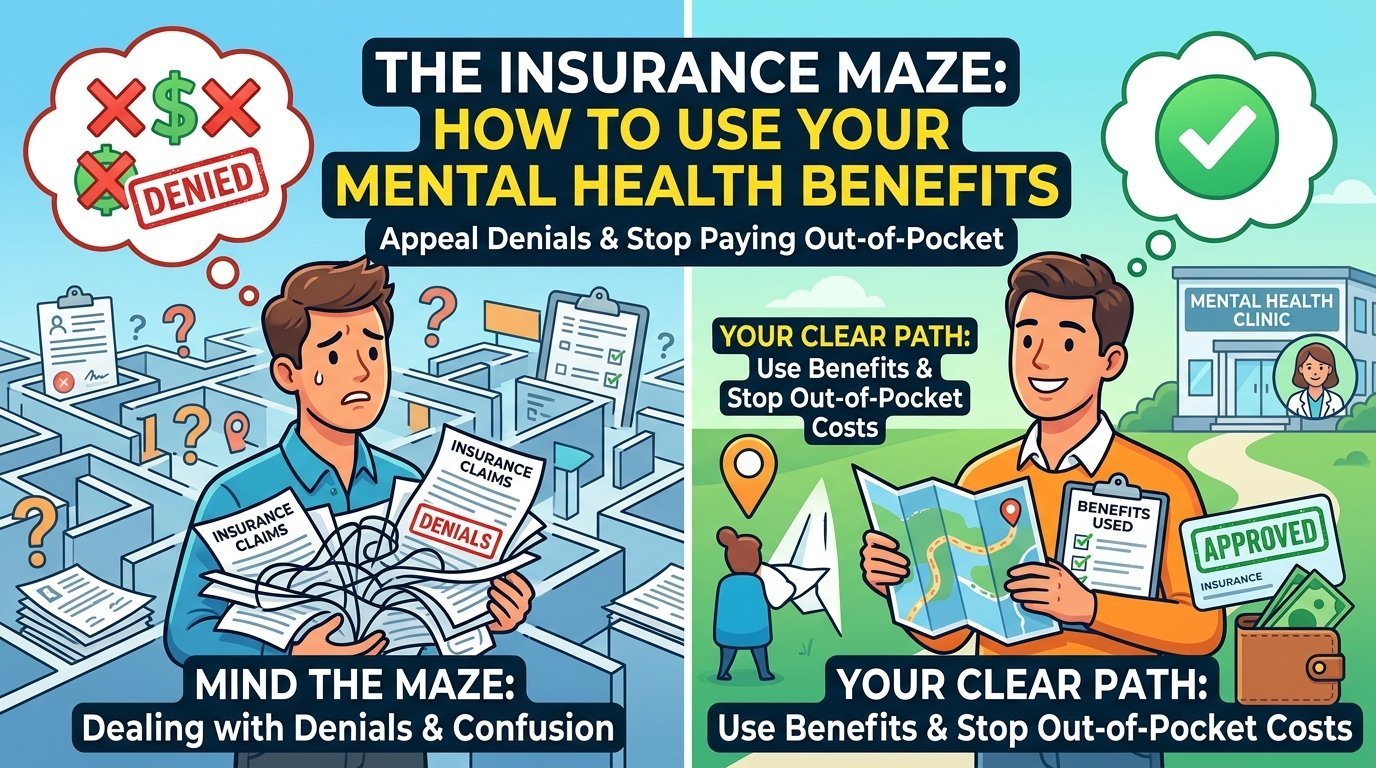
The Bill That Should Never Have Arrived
You found a therapist. You verified that they accepted your insurance. You attended sessions for two months. You were finally making progress. Then the bill came.
Not the usual 30copayyouexpected.Abillfor1,200. The insurance company denied every single claim. The reason code on the explanation of benefits read: “Service not medically necessary.”
Or maybe you have a different problem. You found an amazing therapist who does not accept any insurance at all. You have been paying $200 per session out of pocket, telling yourself it is worth it. But you have a PPO plan with out-of-network benefits. Some of that money could be coming back to you. You just do not know how to file the claim.
Or perhaps you live in an area where the only therapist with expertise in your condition is out-of-network. Your insurance company says you can only see in-network providers. You know there are no in-network specialists within a hundred miles. You just do not know how to ask for an exception.
This guide solves all three problems. You will learn exactly how to verify your mental health carebenefits before you owe a dime, how to file out-of-network claims and get reimbursed, how to request a single-case agreement when no in-network specialist exists, and how to appeal denied claims when insurance says no to mental health providers near me that you know you need.
No insurance jargon without explanation. No assuming you already understand your plan. Just step-by-step instructions for getting your insurance to pay what it owes.
Understanding Your Mental Health Benefits: The Basics Most People Miss
Before you can fight a denial or file an out-of-network claim, you have to understand what your plan actually covers. Most people never read their Summary Plan Description. That document holds the answers.
Where to Find Your Mental Health Benefits Information
Your mental health care benefits are described in several documents:
Summary of Benefits and Coverage (SBC): A standardized, easy-to-read document that every plan must provide. It includes a section on mental health services. Look for the rows labeled “Mental/Behavioral Health Outpatient Services” and “Mental/Behavioral Health Inpatient Services.”
Summary Plan Description (SPD): A longer, more detailed document. Required for employer-sponsored plans. The mental health section will specify copays, coinsurance, deductibles, session limits, and prior authorization requirements.
Provider Directory: The list of in-network mental health providers near me. Always verify directly with the provider before assuming the directory is accurate.
Evidence of Coverage (EOC): For individual plans purchased on the marketplace. Similar to the SPD.
If you cannot find these documents, call the customer service number on your insurance card and ask: “Can you send me the Summary of Benefits and Coverage and the behavioral health section of my plan documents?”
The Five Numbers That Determine Your Out-of-Pocket Cost
Every insurance plan defines mental health care costs using five numbers:
1. Deductible: The amount you pay before insurance starts paying. If your deductible is 2,000,youpaythefullnegotiatedratefortherapysessionsuntilyouhavespent2,000. After that, you pay only your copay or coinsurance.
2. Copay: A fixed dollar amount per visit. Typical mental health copays are 20to40 for in-network therapy.
3. Coinsurance: A percentage of the visit cost. 20% coinsurance means you pay 20% of the negotiated rate and insurance pays 80%.
4. Out-of-Pocket Maximum: The most you will pay in a year. After you hit this number, insurance pays 100% of covered services.
5. Visit Limits: Some plans still limit the number of therapy sessions per year. The Mental Health Parity Act prohibits limits that are stricter than medical visit limits, but plans can still use “medical necessity” reviews after a certain number of sessions.
Write these five numbers down before you call any provider. You cannot verify your benefits if you do not know your own plan.
The Parity Act: Your Legal Protection
The Mental Health Parity and Addiction Equity Act of 2008 requires large-group health plans to cover mental health services at levels comparable to medical and surgical services. This means:
- Your plan cannot charge higher copays for therapy than for primary care
- Your plan cannot impose stricter session limits on therapy than on physical therapy
- Your plan cannot require prior authorization for therapy if it does not require prior authorization for similar medical services
If your plan violates parity, you can file a complaint with your state insurance commissioner or the Department of Labor.
Verifying Your Benefits Before Your First Session
The single biggest mistake people make is trusting what the therapist’s receptionist says without verifying with the insurance company directly.
The Two-Step Verification Process
Step One: Call Your Insurance Company
Call the behavioral health or mental health number on your insurance card. Ask:
- “Is [Provider Name] with NPI number [number] in-network for my specific plan? My plan ID is [number].”
- “What is my copay or coinsurance for outpatient therapy using CPT codes 90834 (45 minutes) or 90837 (60 minutes)?”
- “How much of my deductible has been satisfied this year?”
- “Is there a separate deductible for mental health services?”
- “Do I need prior authorization before starting therapy? If so, what is the process?”
- “Are there any session limits or medical necessity reviews I should know about?”
Write down the representative’s name, the date, the time, and a reference number for the call.
Step Two: Call the Provider’s Billing Office
After verifying with insurance, call the provider. Ask:
- “Have you successfully billed my specific insurance plan for other patients recently?”
- “What is your billing policy if insurance denies a claim? Will you bill me or write it off?”
- “Do you offer a cash discount if I choose not to use insurance?”
- “Will you provide a superbill if I need to file out-of-network claims myself?”
If the provider hesitates or gives vague answers, consider this a red flag.
What Is a Superbill?
A superbill is a detailed receipt that includes everything your insurance company needs to process an out-of-network claim:
- Provider’s name, address, NPI number, and tax ID
- Your name and date of birth
- Date of service
- CPT code (procedure code, e.g., 90837 for 60-minute therapy)
- Diagnosis code (ICD-10 code)
- Amount charged
- Amount paid
Ask your provider for a superbill after each session or at the end of each month. You will need it to file out-of-network claims.
Out-of-Network Mental Health Care: Getting Reimbursed for Private Pay Therapy
Many excellent therapists do not accept insurance. This does not mean you cannot get partial reimbursement. If you have a PPO plan with out-of-network benefits, you can file claims and get money back.
How Out-of-Network Reimbursement Works
The process has five steps:
1. Pay the therapist upfront. You pay the full session fee at the time of service.
2. Get a superbill. The therapist provides a detailed receipt.
3. File a claim. You submit the superbill to your insurance company.
4. Insurance processes the claim. They apply your out-of-network deductible and coinsurance.
5. You receive reimbursement. Insurance sends you a check or direct deposit.
What You Actually Get Back
Here is a realistic example:
- Your therapist charges $200 per session
- Your plan’s “reasonable and customary” fee for therapy in your area is $150
- Your out-of-network coinsurance is 70% (insurance pays 70% of the reasonable fee, you pay 30%)
- Your out-of-network deductible is $1,000 and you have not met it yet
Before meeting deductible: You pay 200persession.Nothingcomesbackuntilyouhavepaid1,000 toward the reasonable fee. After that…
After meeting deductible: Insurance pays 70% of 150=105. You pay 45ofthereasonablefeeplusthe50 difference between the actual fee and the reasonable fee = $95 total out of pocket.
Over ten sessions, out-of-network benefits save you more than 1,000comparedtopaying200 each time.
How to File an Out-of-Network Claim
Most insurers allow you to file claims online, by mail, or through their mobile app.
Online: Log into your insurance portal. Look for “Submit a Claim” or “Out-of-Network Claim.” Upload the superbill. Enter the dates of service and procedure codes.
By Mail: Download a claim form from your insurer’s website. Attach the superbill. Mail to the address on the form. Keep copies of everything.
Through the App: Some insurers including UnitedHealthcare allow claim submission through their mobile app. Take photos of the superbill and upload.
Claims typically process in four to six weeks. You will receive an Explanation of Benefits (EOB) showing how the claim was processed, then a separate check or direct deposit.
Finding UnitedHealthcare Therapists Who Are Out-of-Network
Even if a therapist does not accept UHC insurance, you can still see them and file out-of-network claims. When searching for UnitedHealthcare therapists in the provider directory, you will only see in-network providers. For out-of-network care, use general directories like Psychology Today, then check whether your plan offers out-of-network benefits.
Call UHC and ask: “What is my out-of-network deductible? What is my out-of-network coinsurance for outpatient therapy? How do I file an out-of-network claim?”
Single-Case Agreements: When No In-Network Specialist Exists
A single-case agreement (SCA) is a contract between your insurance company and an out-of-network provider to treat you at in-network rates. SCAs are powerful tools that few patients know exist.
When to Request a Single-Case Agreement
Request an SCA when:
- No in-network provider has expertise in your specific condition
- All in-network mental health providers near me have waitlists longer than six weeks
- You have an established relationship with an out-of-network provider and moving would disrupt your care
- You live in a rural area with no in-network specialists within a reasonable distance
How to Request a Single-Case Agreement
Step One: Document the Network Gap
Call your insurer and ask for a list of in-network providers who treat your specific condition. If they give you names, call each one. Document:
- Date of call
- Name of person you spoke with
- Whether they are accepting new patients
- Wait time for first appointment
- Whether they have expertise in your specific condition
If no one on the list has openings or expertise, you have documented evidence of a network gap.
Step Two: Request the SCA in Writing
Send a written request to your insurer’s behavioral health department. Include:
- Your name, policy number, and contact information
- The name and NPI of the out-of-network provider you want to see
- Documentation of the network gap (the list of providers you called and their responses)
- A letter from the out-of-network provider confirming they are willing to accept in-network rates
- A statement of medical necessity from your current provider or the out-of-network provider
Step Three: Escalate If Denied
If your initial request is denied, escalate to a supervisor. Cite the Mental Health Parity Act and any applicable state laws requiring adequate networks. If still denied, file a complaint with your state insurance commissioner.
How Therapists Can Help With SCAs
Not every out-of-network therapist is willing to sign a single-case agreement. The process requires paperwork and negotiating rates. Ask your provider: “Would you be willing to sign a single-case agreement with my insurance company? I will do all the administrative work.”
Some therapists say yes. Many say no. Neither answer is wrong. But you need to know before you invest time in the request.
Appealing Denied Claims: When Insurance Says No
Insurance companies deny mental health care claims for many reasons. Some denials are legitimate. Many are not. Knowing how to appeal can turn a denial into payment.
Common Reasons for Denial
“Service not medically necessary”: The most common and most frustrating denial. Insurers hire reviewers who have never met you to decide whether your therapy is necessary. This denial is often reversible with a letter from your therapist.
“Out-of-network provider”: You saw an out-of-network provider but did not have out-of-network benefits, or you did not file the claim correctly. Check your plan documents before appealing.
“Missing prior authorization”: Your plan required prior authorization for therapy and you did not obtain it. Some plans offer retroactive authorization for emergencies.
“Exceeded session limit”: Your plan limits the number of therapy sessions per year. The Parity Act may help you challenge this if medical services have no similar limits.
“Coding error”: The provider used the wrong CPT code or diagnosis code. This is usually an easy fix. The provider can submit a corrected claim.
The Three Levels of Appeal
Almost all insurance plans offer multiple appeal levels.
Level One: Internal Appeal
You ask the insurance company to review its own decision. Submit:
- A written request for appeal (use the form on your EOB)
- A letter from your therapist explaining why the service was medically necessary
- Any relevant medical records
- The original claim and denial notice
Deadline: Usually 180 days from the date of denial. Response time: Usually 30 to 60 days.
Level Two: Second Internal Appeal
If the first appeal is denied, you can request a second internal review. The insurer assigns different reviewers. The process is similar to Level One.
Level Three: External Review
If internal appeals fail, you can request an external review by an independent organization not affiliated with your insurance company. Federal law requires external review options for most plans.
To request an external review, contact your state insurance commissioner or the federal Employee Benefits Security Administration (EBSA). The denial notice should include instructions for external review.
Writing an Effective Appeal Letter
Your appeal letter should include:
- Your name, policy number, and claim number
- The date of the denial
- A clear statement: “I am appealing the denial of coverage for [service] on [date]”
- Why the denial is wrong (citing your plan documents and the Parity Act)
- Evidence supporting your appeal (a letter from your therapist)
- Your signature and date
Keep a copy of everything. Send the appeal by certified mail or upload through the insurer’s portal and save the confirmation.
Using Employee Assistance Programs (EAPs) for Free Mental Health Care
Many Americans have access to free mental health care through their employer and do not know it.
What EAPs Offer
Employee Assistance Programs typically include:
- Three to eight free counseling sessions per issue per year
- 24/7 crisis phone lines
- Referrals to network providers
- Legal and financial consultations
- Work-life services (childcare referrals, elder care resources)
EAP sessions are completely free. Copays do not apply. Deductibles do not apply. The sessions do not count toward your insurance benefits.
Confidentiality of EAPs
Many people avoid EAPs because they fear their employer will find out. Federal law prohibits EAPs from sharing identifying information with employers. Your employer receives only aggregate data (e.g., “twelve employees used the EAP this month”). They do not receive names, diagnoses, or any details about what was discussed.
How to Access Your EAP
Check your employee handbook or ask HR: “What is the phone number for our Employee Assistance Program?” Call that number. Tell the intake coordinator you want to use your EAP benefit for counseling. They will connect you with a therapist in your area who accepts the EAP.
EAP therapists are often the same mental health providers near me you would find through your insurance. The difference is that the first several sessions are free.
Frequently Asked Questions About Insurance and Mental Health Care
How do I find out if my plan covers telehealth therapy?
Call the behavioral health number on your insurance card. Ask: “Are telehealth visits covered at the same rate as in-person visits? Do I need to use a specific platform?” Most plans now cover telehealth at parity.
What if the provider directory shows in-network providers but they are all not accepting new patients?
Document this. Call each provider and write down the date and the response. Then call your insurer and ask for help finding an in-network provider with openings. If they cannot find one, request a single-case agreement with an out-of-network provider.
Can I use my HSA or FSA to pay for mental health care?
Yes. Health Savings Accounts (HSAs) and Flexible Spending Accounts (FSAs) cover therapy, psychiatry, and even telehealth platform fees. Keep your receipts in case of an audit.
How do I find UnitedHealthcare therapists who are accepting new patients?
Call the UHC behavioral health number. Ask them to search for in-network providers with current openings. UHC care navigators can do this search for you. It saves hours of calling offices yourself.
What if my appeal is denied at all levels?
You have the right to sue your insurance company under ERISA (for employer-sponsored plans) or state law (for individual plans). Most people do not need to go this far. But if the amount at stake is large enough, consult an attorney who specializes in insurance denials.
Final Thoughts: You Paid for These Benefits. Use Them.
Health insurance in the United States is expensive. The average annual premium for employer-sponsored family coverage now exceeds $23,000. You pay a significant portion of that. The benefits belong to you.
When an insurance company denies mental health care that you need and that your plan covers, they are not protecting the system from fraud. They are betting that you will give up rather than fight. Most people do give up. The appeals process is designed to be confusing and time-consuming. That is not an accident.
But you do not have to be most people.
The steps in this guide take time. They require patience and organization. They are also completely doable. Thousands of people successfully appeal denials, file out-of-network claims, and secure single-case agreements every year. You can be one of them.
Start with one call. Verify your benefits. Write down the numbers. Then, if you need to fight, fight. The money that comes back to you is money you already paid for care you already received. It is not a gift from the insurance company. It is what they owe you.
And if you are reading this because you have been paying out of pocket for months or years without filing claims, stop. Get the superbills from your provider. File the claims. Get your money back.
You deserve mental health care. And you deserve to have that care covered by the insurance you pay for every single month.
Disclaimer: This article provides general educational information about insurance coverage for mental health care in the United States. It does not constitute legal advice or insurance advice. Insurance plans vary significantly. Always verify coverage directly with your insurer. If you need legal assistance with an insurance denial, consult an attorney or contact your state insurance commissioner. If you are experiencing a mental health emergency, call 988 or go to your nearest emergency room.