
Devon, a 34-year-old software engineer in Austin, had tried every productivity system in the world. Bullet journals. Notion. Todoist. The Eisenhower Matrix laminated on his desk. Each one worked for about three weeks, then collapsed in a heap of guilt and unfinished checklists. He thought he was lazy. His wife thought he had a problem. His doctor thought he might have ADHD. The diagnosis came at 33, and the relief was real but short-lived because the productivity advice he found online was almost all written for neurotypical brains. The Pomodoro technique made him panic. Time-blocking made him freeze. He worked with an ADHD coach for six months, threw out almost everything he had been told, and slowly built a system that actually fit how his brain worked. He still misses things. He still has bad weeks. But he no longer hates himself for it, and his work has gotten more consistent than it ever was when he was running on shame. His story is the story of a generation of late-diagnosed adults trying to manage time with brains that experience time differently.

Effective time management ADHD strategies start from a different premise than mainstream productivity advice. They assume that your brain has trouble seeing time the way clocks see time, that motivation is interest-based rather than priority-based, and that anxiety often shows up as a passenger or a driver. Research from Russell Barkley, the leading clinical psychologist on adult ADHD, frames this as time blindness, the difficulty perceiving and tracking time intervals. This guide will walk through evidence-grounded strategies, the apps that actually help, the systems that quietly make ADHD worse, and how to build something sustainable. Mastering time management ADHD tools is less about willpower and more about building external scaffolding for an internal system that works differently.
The Time Blindness Problem and Why Standard Productivity Advice Fails
Time blindness is not a metaphor. It is a measurable difference in how the ADHD brain perceives the passage of time. Studies by Barkley and colleagues, including a frequently cited 2008 review in the Journal of Clinical Psychiatry, show that adults with ADHD consistently under- or over-estimate time intervals, struggle to anticipate future consequences with the same emotional weight as immediate ones, and have particular difficulty with tasks that have no clear external time pressure. This is why deadlines a week away feel identical to deadlines four months away until they are 36 hours from due.
Standard productivity advice was largely written by and for people without ADHD. It assumes you can choose to do the most important task, that delaying gratification is a matter of discipline, and that breaking a task into steps is sufficient to start it. None of those assumptions hold reliably for ADHD brains. The result is shame spirals when generic systems fail, which then make the underlying executive function challenges worse. Anxiety often grows in this gap, and distinguishing ADHD time problems from anxiety time problems matters because the treatments differ. For background on the lifestyle side of adult ADHD, see our piece on adult ADHD lifestyle changes.
Time-Tracking and Visualization Apps That Work for ADHD Brains
Making time visible is one of the most consistently helpful interventions. The principle is simple: if your brain has trouble feeling time pass, show it. Several tools have earned a reputation among ADHD specialists.
- Toggl Track: a friction-light time-tracking app with a one-click timer. Users start the timer, label the task, and stop when they switch. Reviewing the day shows where time actually went, which is often shocking and useful.
- Sunsama: a daily planner that forces realistic time estimates by displaying a calendar block for every task. Trying to schedule 12 hours of work into an 8-hour day becomes immediately visible.
- Time Tree: a shared calendar app that helps families coordinate, reducing the cognitive load of remembering everyone’s schedule.
- Tiimo and Routinery: visual schedule apps designed specifically for neurodivergent users, with timers, transitions, and pictograms.
- Focusmate: virtual coworking sessions with a real human on video, using body doubling principles.
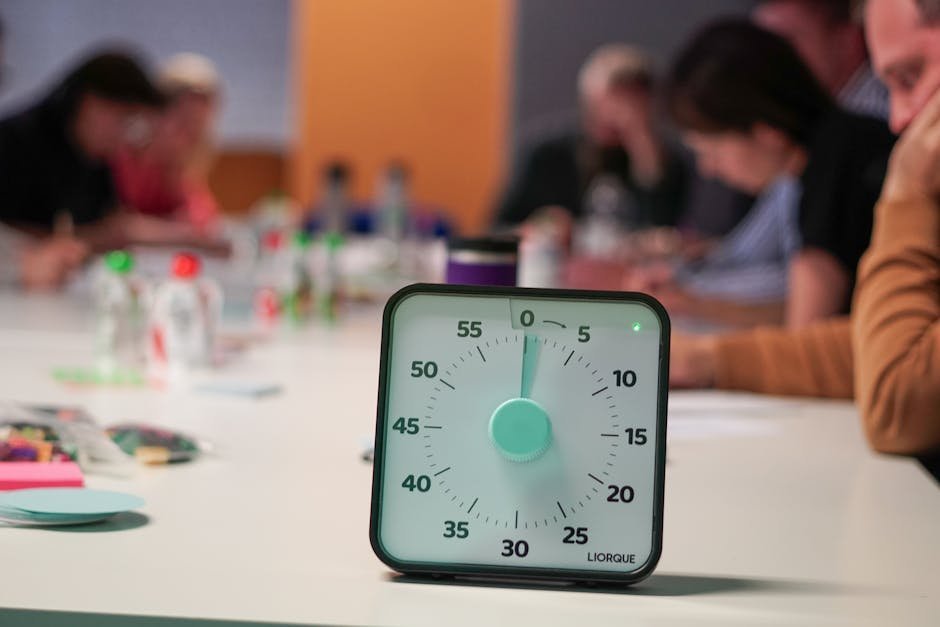
- Visual Timer apps (such as the Time Timer): show time draining as a red disk, making abstract minutes concrete.
None of these tools fixes ADHD. They make time visible enough that your brain can engage with it. Many ADHD coaches recommend rotating tools every six to twelve months because novelty itself is part of what keeps these systems working.
Modifying the Pomodoro Technique for ADHD
The standard Pomodoro technique (25 minutes of work, 5 minutes off) was designed by Francesco Cirillo in the late 1980s and works well for many people. For ADHD brains, it often fails because 25 minutes is either too short to enter hyperfocus or far too long for low-interest tasks. Modifications make it more usable.
For low-interest tasks like admin or email, try 10-minute sprints with 2-minute breaks. The reduced commitment lowers the activation barrier. For deep work in a state of interest, extend to 50 or 90 minutes with longer breaks, but use a timer that interrupts gently rather than alarms loudly. Body doubling apps like Focusmate provide the structural pressure of working alongside someone else, which compensates for the executive function load of self-starting. Caroline Maguire, an ADHD coach and author, calls this “borrowing someone else’s prefrontal cortex,” and the evidence base from coworking studies supports its effectiveness.
Why the Eisenhower Matrix Often Fails ADHD Users
The Eisenhower Matrix sorts tasks into four quadrants based on urgency and importance. For neurotypical brains it works well. For ADHD brains it often fails because the system assumes that knowing a task is important is sufficient to get the brain to engage with it. ADHD motivation is interest-based, not importance-based. A task that is critical to your career but boring may sit in the urgent-important quadrant for weeks while you complete a dozen low-priority tasks that happen to feel interesting.
A modified version, sometimes called the “ADHD-friendly priority list,” sorts tasks by interest level alongside importance, then deliberately stacks low-interest tasks behind high-interest ones as rewards. Body doubling, a clear next-action description (David Allen’s Getting Things Done methodology adapted for ADHD), and immediate consequence creation (telling a colleague you will send something by 3 p.m.) all help bridge the gap between knowing and doing. Implementation intentions, a research-backed strategy from psychologist Peter Gollwitzer, also help: rather than “I will work on the report,” use “When I finish lunch on Tuesday, I will open the report file and read the first paragraph.” The specificity offloads decision-making.
Distinguishing ADHD Time Problems from Anxiety Time Problems
Anxiety and ADHD often coexist; roughly 30 to 50 percent of adults with ADHD also meet criteria for an anxiety disorder, according to data summarized at nimh.nih.gov. The two can produce similar surface behaviors (procrastination, avoidance, missed deadlines) for very different underlying reasons. ADHD procrastination is often about activation: the task is boring or unclear and the brain cannot generate the dopamine to start. Anxiety procrastination is often about avoidance: the task triggers fear of failure or judgment.
The interventions differ. ADHD-driven procrastination responds to body doubling, immediate consequences, novelty, and stimulant medication. Anxiety-driven procrastination responds to cognitive behavioral therapy, exposure-based work, and sometimes SSRIs. Trying to apply ADHD techniques to an anxiety problem (or vice versa) often makes things worse. Many adults benefit from working with a clinician who can sort the two, and information on the link between anxiety and ADHD is available at cdc.gov. Our piece on finding an ADHD specialist covers what to look for in a clinician.
When Productivity Systems Make ADHD Worse
Some signs that your productivity system has become part of the problem rather than the solution include: spending more time maintaining the system than doing the work; feeling intense shame when you fall behind on the system; abandoning the system after every minor disruption; using the act of system-building as a way to avoid the actual tasks. ADHD brains are particularly prone to “productivity porn,” the consumption of productivity content as a substitute for productivity itself.
The fix is usually to simplify radically. A pen, a small notebook, and three priorities for the day can outperform an elaborate digital system that you maintain perfectly for two weeks before collapsing. Behavioral activation, an evidence-based strategy from depression treatment that has been adapted for ADHD, encourages starting with the smallest possible action: not “write the report” but “open the document.” The principle is that action precedes motivation, not the other way around. Behavioral activation has solid research support and is particularly useful for the ADHD-anxiety overlap.

Workplace Accommodations and Returning to Structure
Under the Americans with Disabilities Act, ADHD can qualify as a disability and trigger reasonable accommodations at work. These can include written instructions for tasks normally given verbally, flexible schedules around peak focus hours, noise-canceling headphones, a quieter workspace, breaks structured for medication timing, and explicit deadline check-ins from a manager. Requesting accommodations involves disclosure, which is a personal decision with implications, but the process is straightforward through HR or, in some cases, an external advocate.
For people returning to work after time away, whether for treatment, parental leave, or burnout, the gradual ramp matters. Trying to perform at pre-leave levels in week one is a recipe for collapse. Our coverage of return to work after mental health leave covers the broader strategy, which applies cleanly to ADHD-specific reentry. Job and Career Accommodation Network (JAN), a free service from the U.S. Department of Labor, provides individualized accommodation guidance.
Building a System That Lasts More Than a Month
The mark of a sustainable ADHD time management system is not perfection. It is recoverability. Bad days are inevitable. Bad weeks happen. The system has to allow for them without collapsing. Building in deliberate flexibility (a single weekly planning session, a Friday review, a weekly catch-up day) gives the system room to absorb chaos without forcing you to rebuild from scratch every Monday.
Devon’s current system is embarrassingly simple. He has a paper notebook with three priorities each morning. He uses Toggl for the work hours. He has Focusmate sessions four mornings a week. He puts his phone in another room during deep work. He takes his medication. He sees his ADHD coach monthly. He has not “optimized” his system in two years, and that is what is making it work.
Frequently Asked Questions
Will medication fix my time management problems?
Stimulant medication often helps with activation, sustained attention, and task initiation, but it does not teach skills. Most clinicians recommend medication plus coaching, therapy, or skill-building because the underlying patterns remain even with medication on board.
Is it normal to abandon productivity systems?
For ADHD, yes. The novelty of a new system often provides motivation that fades within weeks. Rotating systems, simplifying ruthlessly, and not interpreting abandonment as personal failure are all part of the approach.
What if I cannot afford an ADHD coach?
Free and low-cost options exist. Group coaching is cheaper than individual. CHADD, the national ADHD nonprofit, offers free resources and support groups. Some employers cover ADHD coaching through EAPs. Body doubling apps like Focusmate are free for several sessions per week.
Should I disclose ADHD to my employer?
Disclosure is personal. It is required only if you are formally requesting accommodations. Some people benefit from disclosure because it produces understanding from managers; others find it produces stigma. The Job Accommodation Network can help think through the decision.
Why does my brain hyperfocus on the wrong things?
Hyperfocus is interest-driven attention without choice. The ADHD brain locks onto stimulating content (often games, videos, side projects) because the dopamine reward is high. Working with this rather than against it (using interesting tasks as rewards, capturing hyperfocus for high-value work when it appears) is more sustainable than fighting it.
The Bottom Line
ADHD time management is not a willpower problem. It is a wiring difference that requires external scaffolding to function in a world built around clocks and calendars designed for different brains. The right tools, modifications, and accommodations can make the difference between a career that feels like sustained drowning and one that feels challenging but sustainable. Start small. Make time visible. Borrow other people’s prefrontal cortexes through body doubling. Distinguish ADHD struggles from anxiety struggles. Forgive yourself when systems collapse, then rebuild simpler.
If you or someone you love is in crisis, call or text 988 to reach the Suicide and Crisis Lifeline, available 24/7 across the United States.
This article is for educational purposes only and does not constitute medical, psychological, or therapeutic advice. Please consult a licensed mental health professional for guidance specific to your situation.