Therapy Across Years, Not Months
The cultural script around therapy treats it as an episode. The patient enters with a problem, works on the problem, and exits when the problem is resolved. The reality for many people who use mental health care over a lifetime is different. Therapy is a relationship that can span decades, with periods of intensive work, periods of pause, and periods of low-intensity maintenance. Managing this longer arc thoughtfully produces better outcomes than treating each engagement as a discrete event.
This guide describes how to maintain a therapeutic relationship across years, including how to pace sessions, when to pause, when to return, how to handle major life events, and how to know when the long-term relationship has run its useful course. The audience is patients who have already experienced the value of therapy and want to think strategically about how to use it across the rest of their life.
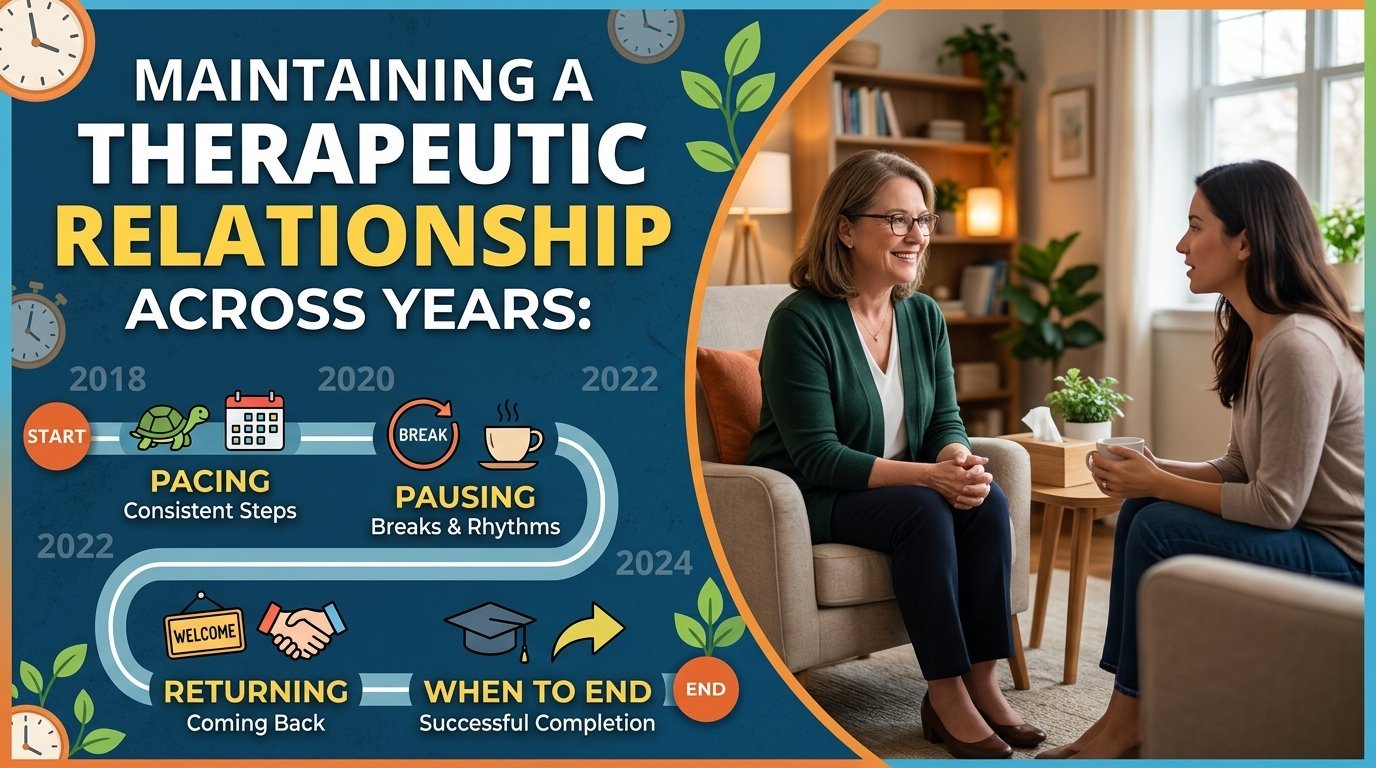
The Pacing Question
The default cadence for active therapy is weekly. The cadence works during periods of acute work, when the material is dense and the contact is needed for momentum. Outside of acute periods, weekly therapy can become a routine that produces less value than its cost would suggest. Patients who continue weekly therapy through quiet seasons sometimes feel a decline in the work, where sessions become check-ins rather than productive engagements.
The conversation about pacing should be explicit. Most therapists welcome a patient who initiates a discussion about cadence. Moving from weekly to biweekly during a calmer phase often preserves the relationship while allowing the work to mature. Moving to monthly maintenance, with the option to step back up to weekly when needed, is appropriate for many long-term patients. The flexibility is part of the design of mature mental health care.
The pacing question also has financial implications. Weekly therapy at standard fees can cost five to ten thousand dollars per year. Reducing to biweekly halves the cost. Reducing to monthly cuts it by seventy-five percent. For patients sustaining long-term work, the ability to adjust pacing without losing the relationship makes the long arc affordable in a way that constant weekly therapy might not be.
The Pause Question
Many long-term patients pause therapy for stretches of months or years. The pauses are sometimes due to financial pressure, sometimes due to life transitions, sometimes due to a sense that the work has reached a stable plateau. Done well, pauses do not damage the relationship. Done poorly, they leave loose ends that complicate the eventual return.
A well-done pause is explicit. The patient and therapist agree on the pause, discuss what would prompt a return, and leave the door open. The relationship is not abandoned. The patient might send a check-in email every six months, or schedule a single annual session as a maintenance touch point. Therapists generally welcome these arrangements because they preserve the working relationship without requiring the structure of regular sessions.
A poorly done pause is silent. The patient stops scheduling, does not respond to the therapist’s outreach, and disappears. Returning later is harder than it would have been. The relationship has cooled. The clinical context that the therapist held in their working memory has faded. The next engagement requires more rebuilding than necessary. The cost of an explicit pause conversation is fifteen minutes. The cost of a silent disappearance is months of friction at the eventual return.
Returning After a Pause
Returning to a previous therapist after a pause is usually possible and usually valuable. The clinical history is already in their notes. The relational rapport is already established. The work can pick up at a deeper level than starting fresh with a new clinician. Most therapists hold a few openings for returning patients, particularly former long-term patients whose work was meaningful.
If the previous therapist is no longer available, the relationship can sometimes be transferred to a colleague the original clinician trusts. The therapist’s referral comes with context that a cold search cannot provide. Patients who reach out to a former mental health care provider for a referral often find that the referral lands them with a clinician who is already prepared for the kind of work the patient needs.
Major Life Events as Therapy Moments
Long-term patients often use therapy as a resource during major life transitions: marriage, parenting, divorce, career change, relocation, illness, loss. The transitions sometimes prompt a step-up to more frequent sessions for a defined window. Therapists generally accommodate these intensifications, particularly for patients with whom they have a long-term relationship.
Naming the intensification explicitly produces better work. A patient who says “I am about to go through a divorce and would like to move to weekly sessions for the next six months” gives the therapist a clear container. Both can plan accordingly. The intensification is bounded, and the eventual return to lower-intensity work is part of the agreement.
Insurance coverage usually accommodates these intensifications under standard outpatient benefits. Networks behind UnitedHealthcare therapists, Aetna therapists, Cigna therapists, and Blue Cross Blue Shield variants generally do not require additional preauthorisation for moving from biweekly to weekly therapy. The change is a clinical decision between patient and provider.
When the Long-Term Relationship Has Run Its Course
Some long-term therapy relationships eventually reach a point where the work has matured and the patient has substantially internalised what the relationship offered. The therapist’s role has become smaller, the patient’s autonomy has grown, and the sessions feel like maintenance more than active work. This is not a failure. It is the intended outcome of long-term mental health care done well.
Recognising when the relationship has run its course is itself a clinical task. Talk about it explicitly with the therapist. Many therapists welcome the conversation and can offer their own observations about the trajectory. The decision to end a long-term relationship is mutual and ideally involves a structured wind-down: a few sessions specifically focused on the ending, an explicit discussion of what the work meant, and a clear understanding of how to return if needed.
The ending of a long-term therapy relationship is often itself therapeutic. The capacity to end something good without rupture, to grieve the loss while honouring the gain, is a skill that many patients develop in this final phase. The skill carries forward into other endings in the patient’s life.
Multiple Therapists Across a Lifetime
Most long-term patients work with several different therapists across a lifetime. Each clinician brings different expertise, and different phases of life often benefit from different orientations. A trauma-focused therapist for a specific window. A relational therapist for a relationship-focused decade. A psychodynamic clinician for an existential phase. The shifts are not failures of any individual therapist. They are appropriate matches between the patient’s evolving needs and the strengths of available clinicians.
The accumulated experience of working with multiple therapists over years also teaches patients what to look for, what fits, and what does not. Patients who have done significant mental health care become discerning consumers, capable of recognising fit quickly and switching when needed. The discernment is itself a long-term outcome of the work.
A Lifelong Tool
Treating therapy as a lifelong tool, rather than a single intervention, produces a different relationship with the field. The patient becomes someone who knows how to use therapy, when to engage with it, when to pause, when to return, and when to end. The skill set is unusual in American culture but increasingly common as more people experience long-term mental health care and develop comfort with it.
The investment compounds. Each engagement adds to a deepening capacity for self-reflection, for relational repair, and for the kind of psychological maintenance that supports a long, full life. The work is real. The continuity matters. The skill of using therapy across decades is among the most useful skills a patient can develop.
This article is for educational purposes and does not constitute personalised medical advice. If you or someone you know is in crisis, call or text 988 in the United States.