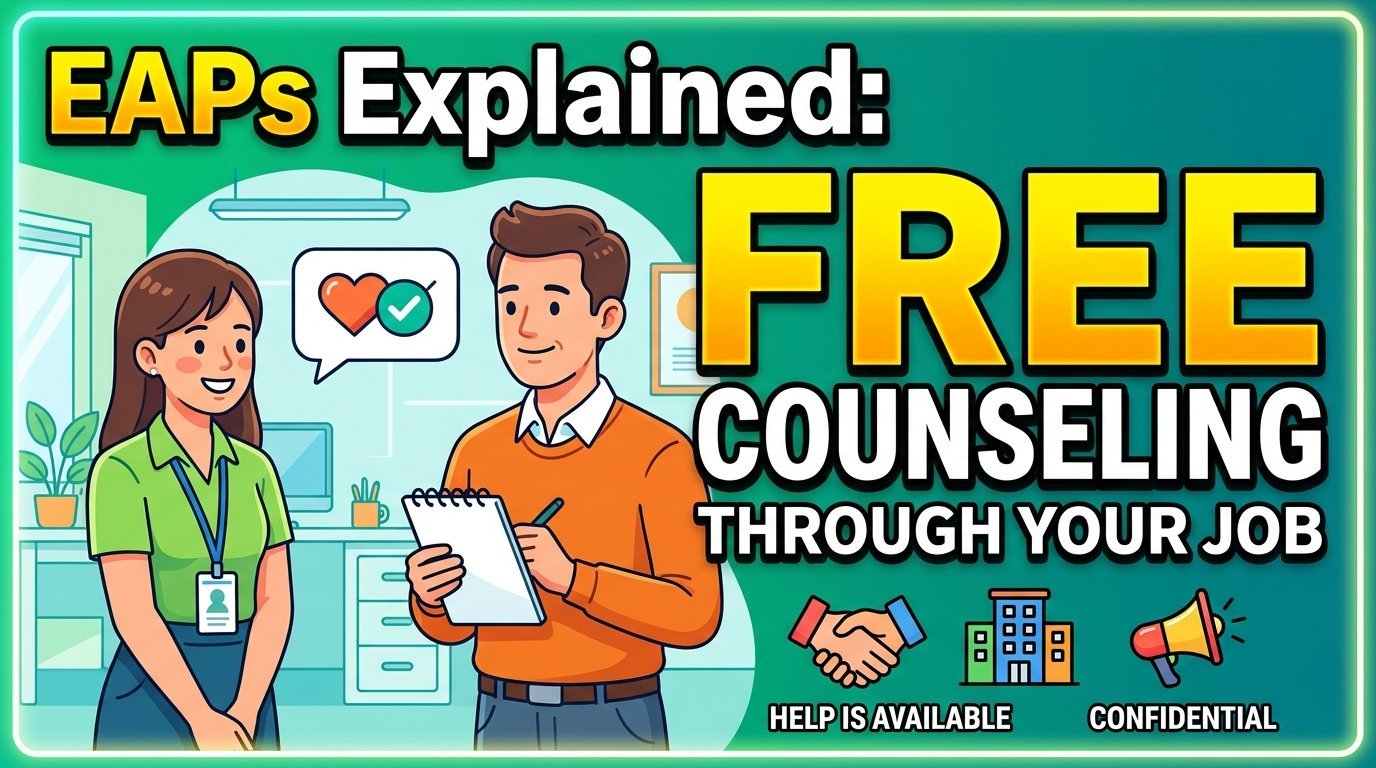
If you work for an employer with more than fifty employees, there is a strong chance your benefits package includes an Employee Assistance Program (EAP)—and an even stronger chance you have never used it. EAPs offer free, confidential counseling sessions, financial coaching, legal consultation, and behavioral health referrals to employees and their household members. Yet utilization rates remain stubbornly low at around 5 percent of eligible workers, often because employees do not know the benefit exists, fear their employer will find out, or assume the counselors are not as qualified as private therapists.
This guide explains how EAPs actually work in 2026, what they do and do not cover, how privacy is protected, and how to use yours without feeling like your job is watching.
What an EAP Is—and What It Is Not
An Employee Assistance Program is a benefit your employer purchases from a third-party vendor. The vendor employs or contracts with licensed counselors, financial advisors, lawyers, and care navigators. When you call or log in, you reach the vendor—not your HR department.
EAPs are designed for short-term, solution-focused support—typically three to eight sessions per issue per year. They are not a replacement for ongoing psychotherapy, psychiatric medication management, intensive outpatient programs, or any kind of long-term mental health care. The counseling provided is usually short-term solution-focused therapy aimed at stabilizing a situation and connecting you with longer-term resources if needed.
What EAPs Typically Cover
Modern EAPs are surprisingly broad. Common benefits include:
- Free short-term counseling for stress, anxiety, depression, grief, relationship issues, and substance use concerns
- Crisis support with 24/7 phone access to licensed clinicians
- Financial coaching—debt management, budgeting, credit repair, retirement planning
- Legal consultation—30-minute attorney consultations on family law, estate planning, traffic citations, and consumer issues, with discounted hourly rates if you retain
- Work-life referrals—child care, elder care, adoption, pet care, tutoring
- Substance use assessments and referrals to treatment programs
- Mediation and conflict resolution for workplace and personal disputes
- Manager consultation—your supervisor can call for advice without naming the employee involved
Some EAPs have expanded to include digital cognitive behavioral therapy apps, meditation subscriptions, financial wellness platforms, and even discounted gym memberships. Plans purchased through major vendors like Lyra, Spring Health, Modern Health, ComPsych, and OptumWellbeing now often blend traditional EAP counseling with full behavioral-health benefits.
Confidentiality: How Private Is It Really?
This is the question employees ask most often, and the answer is reassuring with a few important caveats.
EAPs are bound by federal and state confidentiality laws including HIPAA. Your employer receives aggregate utilization reports—how many people called, what categories of issues were discussed—but no personally identifiable information about who used the service or what they discussed.
Exceptions include:
- Mandatory referrals—if HR or your manager refers you to the EAP as a condition of continued employment after a workplace incident, the EAP may confirm whether you completed the referral, but typically not the clinical content
- Imminent danger to self or others—clinicians have duty-to-warn obligations under their licensure laws
- Suspected child or elder abuse—mandatory reporting
- Subpoenas and court orders—rare but possible
Self-referrals (where you contact the EAP voluntarily) carry the strongest confidentiality. If your concern requires a mandatory referral, ask the EAP exactly what will be reported back and to whom before signing any release.
How to Find and Activate Your EAP
Most employees do not know who their EAP vendor is. Find it by:
- Searching the company benefits intranet for “EAP” or “Employee Assistance”
- Looking at the back of your medical insurance card or in your benefits enrollment portal
- Asking HR or Benefits—the request itself is not flagged or tracked
- Checking the wallet card mailed during open enrollment (often discarded)
Once you have the phone number or web portal, you call directly. Most EAPs do not require pre-authorization or paperwork from your employer. The intake counselor will ask about your concern, match you with a therapist, and either schedule sessions in person, by phone, or by video. Many EAPs now offer same-week appointments—a sharp contrast to the multi-week waits at most outpatient mental health practices.
Using EAP Counseling Strategically
EAP counseling is usually short-term, so plan accordingly. Ideal uses include:
- Crisis stabilization—recent loss, divorce, sudden anxiety, work-related burnout
- Bridge care—immediate access while you wait weeks for an in-network therapist on your medical insurance
- Initial assessment—a clinician helps you decide whether you need ongoing therapy, medication, IOP, or another level of care
- One-time consultations—parenting concerns, grief, sleep, performance anxiety
- Substance use evaluations—a confidential first step before deciding on outpatient or inpatient treatment
If you need ongoing therapy beyond the EAP’s session limit, a good EAP counselor will help you find a provider on your medical insurance, often with the same therapist if they accept your plan.
EAPs for Family Members
Most EAPs cover the employee plus household members—spouses, domestic partners, children (often up to age 26), and sometimes other dependents living at home. Each family member can use their own session bank for their own concerns. This makes the EAP an underused tool for couples counseling, parenting consultations, and adolescent screening.
Limitations to Be Aware Of
EAPs have real constraints. Sessions counts are limited per issue per year, the counselor pool may be smaller than your insurance network, specialty modalities like EMDR or DBT are not always available, and ongoing medication management is rarely covered. EAPs cannot replace robust mental health benefits—they complement them.
If your employer has cut benefits to a bare-bones EAP without adequate insurance behavioral-health coverage, that may itself be a parity violation worth raising with HR or, if needed, with the Department of Labor.
A Final Note
An Employee Assistance Program is one of the most underused benefits in American workplaces. The first call is the hardest. Once you make it, you generally find that the counselors are real licensed professionals, the privacy protections are real, and your employer is not watching. For the cost of a phone call, you may walk away with three to eight free therapy sessions, a financial coach, a legal consultation, and a roadmap to longer-term care if you need it. That is a benefit worth claiming.
This article is for informational purposes only and is not medical, legal, or financial advice. EAP benefits vary widely by employer—always verify your specific plan with your HR or benefits team.