Job Loss and the Mental Health Coverage Cliff
Few transitions in American life produce more abrupt risk to mental health care continuity than job loss. The same week that a patient is dealing with the financial and emotional shock of unemployment, they are often also losing the health insurance that has been paying for their therapy and psychiatric medications. The timing is among the worst possible alignments, and it produces a wave of treatment disruption that contributes to the documented spike in mental health crises that follows job loss.
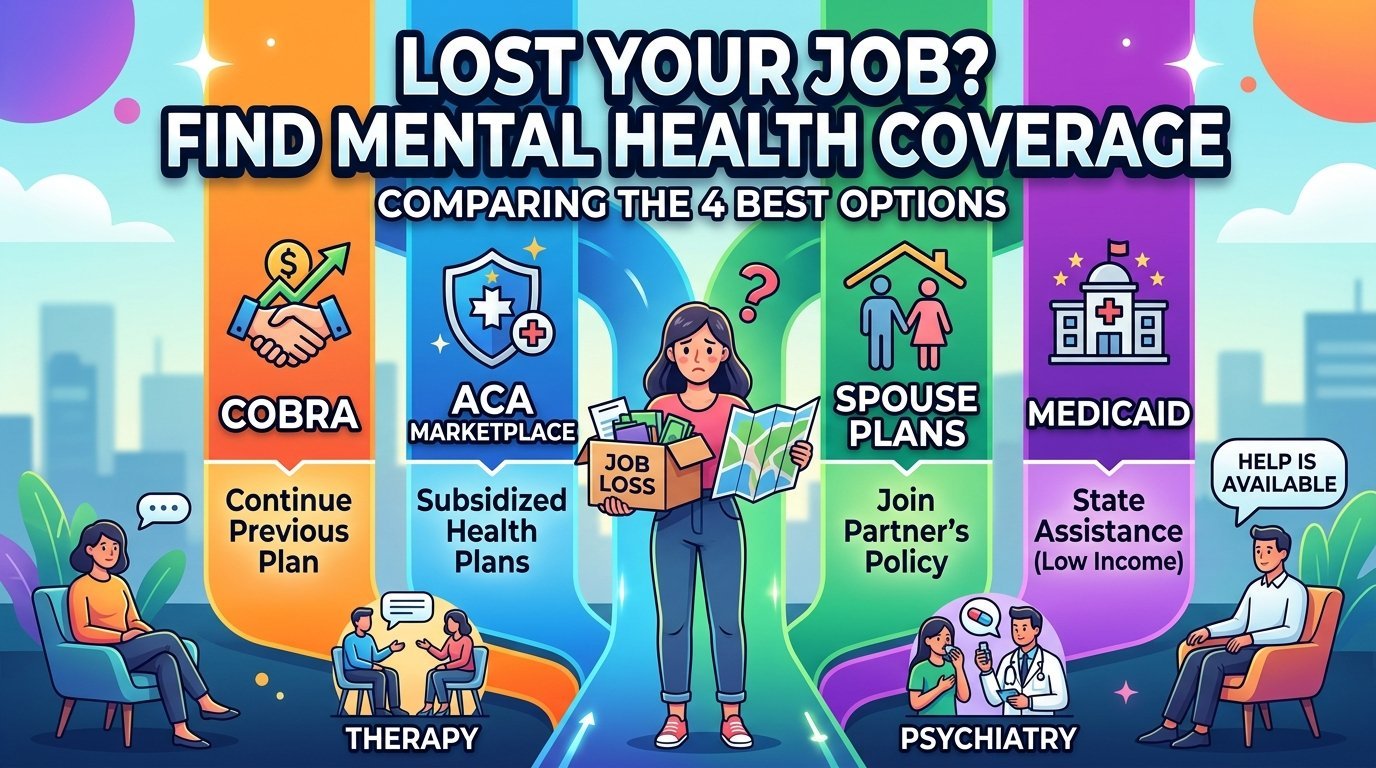
This guide describes the specific options available for maintaining mental health coverage after losing employer-sponsored insurance. The three main paths are COBRA, ACA marketplace coverage, and a spouse’s plan. Each has different cost structures, different timelines, and different implications for treatment continuity. Choosing the right path quickly, often within sixty days of losing coverage, prevents both treatment gaps and surprise costs.
COBRA: Continuity at Real Cost
COBRA, the Consolidated Omnibus Budget Reconciliation Act, allows employees who lose employer-sponsored insurance to continue the same coverage for up to eighteen months, sometimes longer for certain qualifying events. The coverage is identical to what the employee had as an active employee, including the same network, the same providers, and the same benefits. For patients in the middle of active mental health care, the continuity matters: the same therapist remains in network, the same psychiatrist continues prescribing, and the treatment arc proceeds without administrative disruption.
The cost is the catch. COBRA premiums include both the employee’s previous contribution and the employer’s contribution, plus a small administrative fee. The total monthly cost is often three to five times what the employee was paying as an active employee. For a single employee, the COBRA premium can run six hundred to one thousand dollars per month. For a family, it can exceed two thousand dollars per month. The cost is the reason most people who could use COBRA do not.
COBRA elections must be made within sixty days of losing coverage, and the coverage is retroactive to the loss date if elected. This means that patients who are uncertain whether to elect COBRA can wait the full sixty days while exploring other options, and still have the ability to elect retroactively if they incur medical or mental health expenses during the gap. The strategy preserves optionality during a high-stress decision window.
ACA Marketplace Coverage: Often the Better Deal
For most people losing employer coverage, the ACA marketplace produces a better financial outcome than COBRA. Job loss is a qualifying life event that opens a special enrolment period, allowing immediate enrolment in marketplace plans. The premium subsidies available through the marketplace are based on current income, and a person who has just lost their job often has dramatically lower income than their pre-job-loss situation, which produces correspondingly larger subsidies.
For mental health care continuity, the marketplace option requires verifying that your current therapist and psychiatrist are in the network of any plan you consider. If they are, the transition is smooth: you continue with the same providers, your insurance simply changes from your previous employer to the marketplace plan. If they are not, you face the choice of switching providers or paying out-of-network rates. Networks behind UnitedHealthcare therapists, Aetna therapists, Cigna therapists, and Blue Cross Blue Shield variants typically have multiple plan offerings on the marketplace, increasing the chance that your existing providers participate in at least one of them.
Spouse’s Plan: A Low-Friction Option When Available
If you have a spouse with employer-sponsored insurance, joining their plan is often the simplest path. Job loss qualifies as a special enrolment event, allowing immediate addition to a spouse’s plan even outside the normal annual open enrolment period. The premium for adding a spouse to an existing plan is usually substantially less than the COBRA cost for individual coverage and often less than the marketplace cost.
The trade-off is that the spouse’s plan may have a different network than your previous plan. Your existing therapist and psychiatrist may or may not be in network. Verify before committing. If they are, this option often combines low cost with high mental health care continuity. If they are not, the same network-switching considerations apply as with marketplace plans.
Medicaid: The Floor That Catches Many People
For people whose income drops significantly after job loss, Medicaid eligibility often opens. The eligibility threshold in expansion states is one hundred thirty-eight percent of the federal poverty level. A person who was earning fifty or sixty thousand dollars before losing their job may suddenly qualify for Medicaid based on the lower current income from unemployment benefits or part-time work.
Medicaid covers mental health care extensively, often more comprehensively than commercial plans. The trade-off is provider availability, which is thinner than commercial networks in most regions. For people whose existing therapist accepts Medicaid, the continuity is preserved at much lower cost. For people whose therapist does not, switching to a Medicaid-accepting provider through community mental health centres or Medicaid managed care plans is the practical path.
Comparing the Options Quantitatively
For a typical patient considering the three main options, a rough comparison helps. COBRA might cost eight hundred dollars per month for individual coverage. The same patient might find a comparable marketplace plan with subsidies for two hundred dollars per month. Adding to a spouse’s plan might cost three hundred dollars per month. Medicaid is usually free or nearly free.
The pure cost comparison favours marketplace, spouse’s plan, or Medicaid over COBRA in most cases. The continuity comparison can favour COBRA if your existing providers are not in alternative networks. The decision often comes down to weighing cost savings against provider continuity. For patients in the middle of active treatment with a specific therapist or psychiatrist, the value of provider continuity can justify the COBRA premium for a defined window. For patients with more flexible provider relationships, the cost savings of alternatives are often worth the network switch.
Maintaining Medications During Transition
Psychiatric medication continuity during insurance transition is a specific concern. Switching insurance plans typically requires re-establishing prescriptions through the new plan’s pharmacy benefit. Most plans approve continuity-of-care requests for stable medication regimens, particularly when the prescriber documents the medical necessity of the specific drug. Networks behind UnitedHealthcare therapists, Optum, Aetna, Cigna, and Blue Cross Blue Shield variants generally support these requests as a routine matter.
Practical tips: refill medications to maximum quantities before the insurance transition, request a written treatment plan from your prescriber describing the medications and their necessity, and submit a formulary exception request immediately upon enrolling in the new plan if any medications are not covered at the same tier. Many transitions produce no medication disruption at all when these steps are taken. Some produce one or two weeks of friction. Few produce significant gaps when actively managed.
A Decision Timeline That Works
The practical timeline for most people is to make the major decision within thirty days of losing coverage, with the option to elect COBRA retroactively as a fallback. Within the first week, calculate marketplace subsidy estimates based on projected current income, verify provider participation in candidate plans, and consult with a spouse if applicable. By the end of week two, decide on the path. Within thirty days, complete enrolment in the chosen plan.
The deliberate process prevents the two most common mistakes in this transition: defaulting to COBRA without comparing alternatives, and letting the sixty-day window close without electing anything. Both produce significant downstream consequences for mental health care continuity that are largely avoidable with thirty minutes of comparison.
This article is informational and does not constitute legal or tax advice. For specific coverage questions, contact HealthCare.gov, your state-based marketplace, or a qualified benefits advisor. If you or someone you know is in crisis, call or text 988 in the United States.