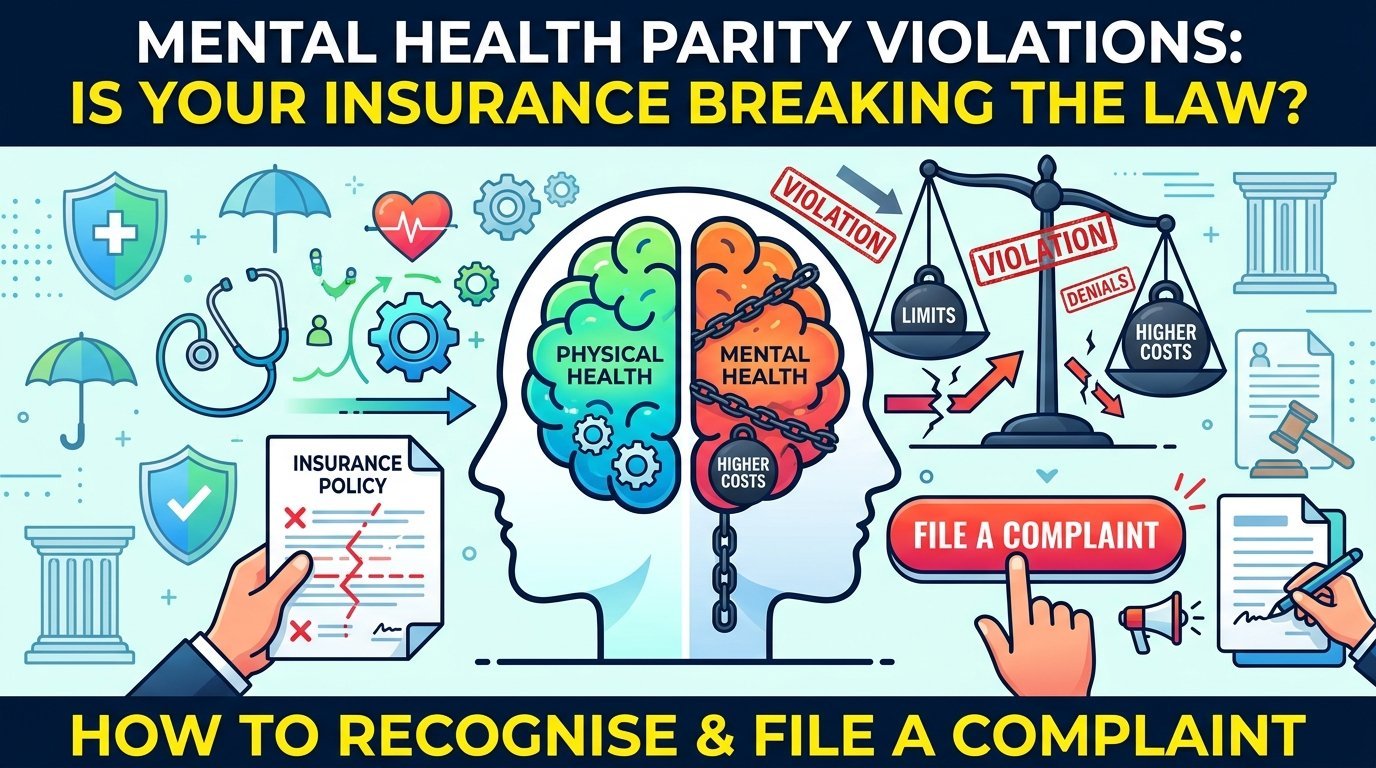
Mental Health Parity Is the Law That Most Patients Do Not Know They Have
Federal law has required most health plans to cover mental health care at the same level as medical care since the Mental Health Parity and Addiction Equity Act passed in 2008. The law was strengthened by the Affordable Care Act, which extended parity protections to more plans and required behavioural health coverage as an essential health benefit. Despite the legal framework, parity violations remain widespread. Plans still impose stricter prior authorisation requirements on mental health services, maintain narrower behavioural health networks, and reimburse mental health providers at lower rates than medically equivalent services.
Most patients who experience parity violations do not recognise them as violations. The friction feels like normal insurance friction. The denial feels like a routine coverage decision. The result is that violations persist, and patients continue to absorb costs and delays that should not exist under the law. This guide describes what parity actually requires, how to recognise a violation, and how to file a complaint that produces a real response.
What Parity Requires in Plain Language
The Mental Health Parity and Addiction Equity Act requires that group health plans and most individual plans treat mental health care insurance benefits at no greater restriction than medical and surgical benefits. Specifically, the law applies to financial requirements like copays, coinsurance, and deductibles, and to treatment limitations like visit caps, prior authorisation, and concurrent review.
In practice, this means your therapy copay should not be higher than your primary care copay. Your behavioural health visit cap, if there is one, should not be lower than for medical specialty visits. Your prior authorisation requirements for IOP, PHP, residential, and inpatient care should not be more burdensome than for comparable medical services. The deductible structure should treat mental health and medical services similarly. If your plan deviates from any of these in ways that disadvantage mental health care, you have grounds to investigate further.
Common Violations Patients Encounter
The most common parity violations fall into a few categories. Network adequacy violations occur when a plan’s behavioural health network is so thin that patients cannot find in-network providers within reasonable geographic and temporal access standards, while the medical network is robust. Many plans behind UnitedHealthcare therapists, Aetna, Cigna, and Blue Cross Blue Shield variants have been cited for behavioural health networks where the listed providers are not actually accepting new patients, do not match the listed specialty, or do not respond to phone calls.
Authorisation violations occur when plans require more frequent or burdensome prior authorisation for behavioural health services than for medical services. Daily continued-stay reviews on a residential treatment admission, when comparable medical admissions are reviewed less frequently, can constitute a violation. Length-of-stay limits applied to mental health treatment that do not exist for medical conditions are another common violation.
Reimbursement violations are subtler but well-documented. Plans that pay out-of-network mental health providers at lower percentages of usual and customary rates than they pay out-of-network medical providers can be violating parity. The patient does not see the underlying reimbursement rate directly, but the result is that mental health providers leave networks at higher rates, which compounds the network adequacy problem.
Recognising a Violation in Your Own Plan
The first step is to compare your plan’s mental health rules against its medical rules, side by side, in the summary of benefits and coverage. Look at copays, coinsurance, deductibles, visit limits, and prior authorisation requirements. If anything is more restrictive on the mental health side, document it.
The second step is to test the network. Search the behavioural health provider directory for clinicians in your area. Call ten of them. Document how many are accepting new patients, how soon they have availability, and how many calls go unreturned. Compare with a similar test of the medical specialty network. If the behavioural health side is dramatically less accessible, that may be a network adequacy violation worth pursuing.
The third step is to track your own coverage decisions. Save denial letters. Save authorisation reviews. Save explanation of benefits forms. The documentation is the evidence base if you escalate. Many parity violations become provable only with patient-collected documentation, since plans rarely volunteer the information that would prove the violation.
How to File a Complaint
Patients who believe they have experienced parity violations have several escalation paths. The first is the plan’s internal appeals process. Every coverage denial in mental health care can be appealed internally, with specific timelines and procedures documented in the denial letter. Internal appeals occasionally reverse the denial, particularly when the patient or provider provides clinical documentation supporting medical necessity.
The second is the external review process. After exhausting internal appeals, most plans must allow an independent external review by an organisation not affiliated with the plan. The external review process is free for patients in most states and can produce reversals that internal appeals did not. The independent reviewer applies medical-necessity standards rather than plan-specific guidelines.
The third is regulatory complaint. State insurance departments handle complaints about state-regulated plans. The federal Department of Labor handles complaints about employer-sponsored ERISA plans. The Department of Health and Human Services handles complaints about federal exchange plans. Each agency has a complaint process accessible online, and parity violations are an explicit category they investigate. Patient complaints have produced settlements that reformed plan practices and recovered patient costs in some recent cases.
Working With Your Provider on Documentation
Parity complaints are most successful when they include provider documentation. A letter from your therapist or psychiatrist describing the medical necessity of the denied service, the clinical impact of the denial, and the comparison to medical services that are routinely covered can substantially strengthen the case. Providers are generally willing to write such letters, particularly when the denial involves a service the provider believes was clearly indicated.
Some providers also keep records of their experience with specific plans across multiple patients. A provider who has observed a pattern of denials for a specific service across many patients may be willing to share aggregate observations, which can be more persuasive than a single patient’s experience.
Class Actions and Systemic Enforcement
Some of the most consequential parity enforcement has come through class action lawsuits and systemic regulatory action. Recent settlements with major carriers have produced multimillion-dollar recoveries for affected patients and structural changes to plan practices. Patients who suspect their experience may be part of a broader pattern can sometimes find advocacy organisations, including the Kennedy Forum and the Mental Health Parity Advisor, that track and pursue systemic violations.
Individual complaints contribute to the systemic enforcement record. Even when an individual complaint does not produce a satisfactory result for the complainant, the documentation contributes to the data set that regulators and litigators use to identify patterns. Filing a complaint, in this sense, is both a personal and a collective action.
A Realistic Note on Effort
Pursuing a parity complaint takes time. Internal appeals can take thirty to sixty days. External reviews add additional weeks. Regulatory complaints can take months. Class action processes take years. The time investment is real, and patients in the middle of active mental health care needs may not have capacity to pursue every violation.
Choose your battles. The violations most worth pursuing are the ones that affect significant clinical or financial outcomes, the ones that have clear documentation, and the ones where reversal would substantially help your access to care. The friction is real. The legal protection is real. The combination produces meaningful enforcement only when patients use it.
This article is informational and does not constitute legal advice. For specific complaint procedures, contact your state insurance department, the federal Department of Labor, or a qualified attorney. If you or someone you know is in crisis, call or text 988 in the United States.