The Phase Most Patients Underestimate
Discharge from inpatient psychiatric hospitalisation is the moment most mental health care narratives end. The patient was in crisis, then in the hospital, then home, and the story is over. The clinical reality is the opposite. The discharge is the start of the most consequential phase of the recovery arc. The decisions made in the first thirty days after a hospital stay determine whether the patient stabilises or returns to crisis, whether the gains from the hospitalisation translate into durable change, and whether the family develops the systems that will support long-term recovery.
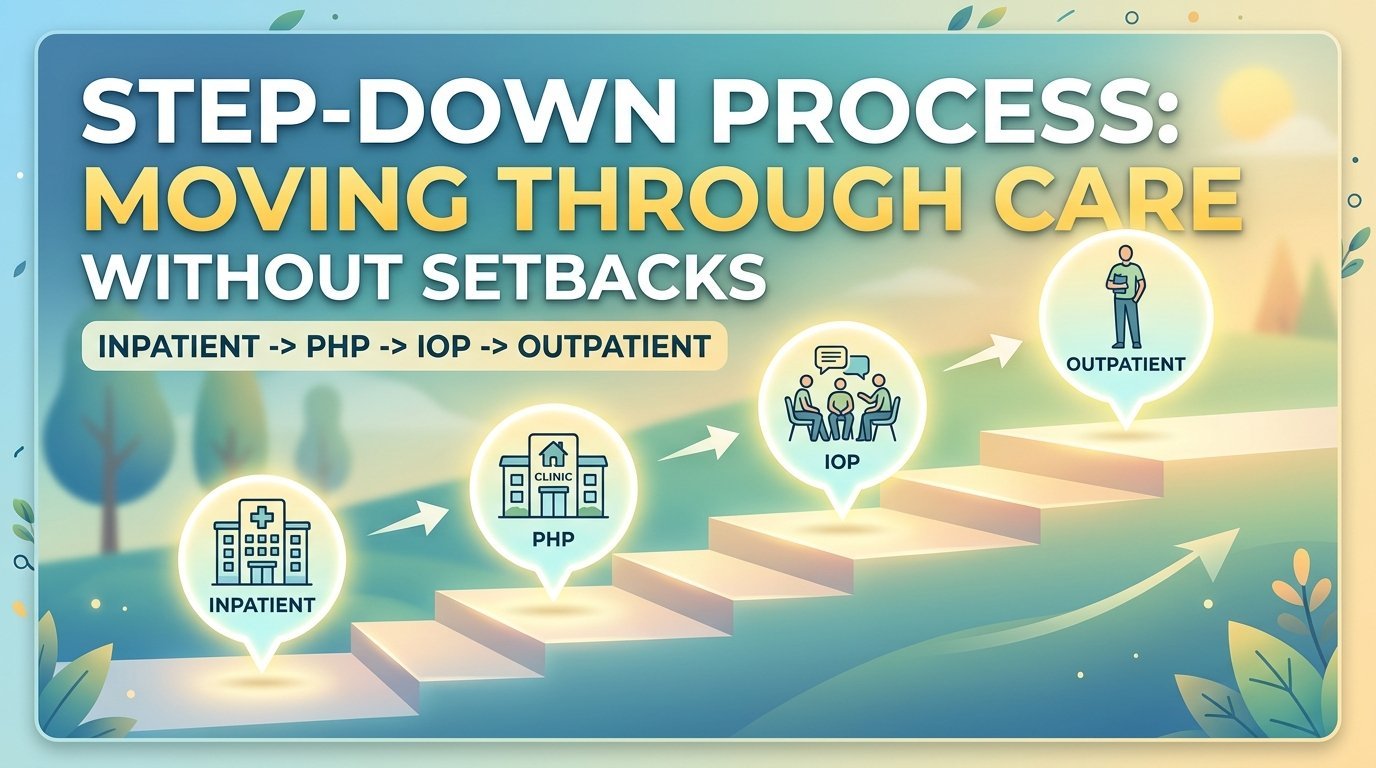
The step-down process moves a patient through descending levels of care. From inpatient to partial hospitalisation. From partial hospitalisation to intensive outpatient. From intensive outpatient to standard outpatient. From standard outpatient to maintenance care. Each transition is a clinical event with its own challenges, and patients who navigate the descent thoughtfully are far more likely to stay well than patients who try to leap directly from a hospital stay back to weekly therapy.
The First Transition: Inpatient to PHP
The most important transition is the first one. Patients who step down from inpatient hospitalisation directly to weekly outpatient have measurably worse outcomes than patients who step down to partial hospitalisation. The reason is that the gap between locked-unit care, where every minute is supervised, and weekly therapy, where the patient sees a clinician for fifty minutes per week, is too large to bridge safely for most acute presentations.
Partial hospitalisation provides six hours of structured mental health care per day, five days per week, while the patient sleeps at home. The continuity of clinical contact, the ongoing medication management, and the structured daily activity prevent the destabilisation that often follows abrupt discharge to lower levels. The typical PHP stay after inpatient is two to four weeks, after which the patient steps down further.
Insurance plans, including networks behind UnitedHealthcare therapists, Optum behavioural health, Aetna, Cigna, and Blue Cross Blue Shield variants, increasingly authorise inpatient-to-PHP transitions as a connected continuum, with discharge planning beginning within the first forty-eight hours of admission. The smooth handoff is one of the strongest predictors of avoiding readmission.
The Second Transition: PHP to IOP
The transition from PHP to IOP usually occurs after two to four weeks of PHP, when the patient has stabilised enough to spend most of the day outside a clinical setting. IOP provides nine to twelve hours of structured care per week, often three afternoons or evenings, allowing the patient to begin reintegrating into work, school, or family responsibilities while still receiving substantial clinical contact.
The IOP phase typically lasts six to twelve weeks. The longer duration is part of the design. The descent in clinical intensity needs to be paced gradually, and IOP gives the patient time to adapt to a daily life that includes responsibilities outside treatment. Patients who try to compress this phase often experience destabilisation when the clinical container is removed too quickly.
During IOP, the patient typically reconnects with their pre-hospitalisation outpatient mental health providers near me in preparation for the next transition. The reconnection allows the new and existing clinicians to coordinate the transfer of care.
The Third Transition: IOP to Standard Outpatient
The transition from IOP back to standard outpatient mental health care is the moment when most patients return to recognisable daily life. Standard outpatient typically means weekly therapy, monthly or quarterly psychiatric medication management, and continued use of the relapse prevention skills learned in IOP. The patient is no longer in a structured program, no longer attending multiple weekly appointments, and beginning to integrate the work of the past several months into ongoing life.
The risk in this transition is the abrupt drop in support. Patients sometimes experience the first week or two after IOP discharge as more difficult than the early days of treatment, because the structured container is gone and the responsibility for maintaining stability has returned to the patient. Programs that prepare patients for this transition explicitly, with detailed relapse prevention plans and clear escalation pathways, produce better outcomes than programs that simply discharge to weekly therapy.
The Fourth Transition: Outpatient to Maintenance
Many patients eventually transition from active outpatient treatment to maintenance care, where the cadence of appointments decreases over time. Weekly therapy might become biweekly, then monthly, then as-needed. Medication management might shift from monthly to quarterly visits. The relationship with the mental health care provider remains active but operates at a lower intensity.
Maintenance care is not no care. It is structured, low-intensity continuity that allows the patient to escalate quickly if symptoms return. The maintenance relationship is the safety net that catches early prodromal signs before they become full episodes. Patients who fully discontinue care after recovery often face higher friction returning to treatment when needed, while patients who maintain a low-intensity relationship can re-engage rapidly.
When Step-Downs Should Slow or Reverse
Not every step-down should proceed on schedule. Patients who experience destabilisation during a transition may need to remain at the current level longer or step back up to a higher level temporarily. The clinical signs to watch for include returning prodromal symptoms, missed appointments, sleep disruption, increasing substance use, and family observations of decline.
Stepping back up is not a failure. It is the system working as designed. Patients who recognise destabilisation early and step back up briefly often avoid the longer admission they would have needed if they had pushed through. The willingness to revise the descent rate is part of mature engagement with mental health care.
The Family Role at Each Level
Family involvement looks different at each level of the descent. During inpatient hospitalisation, family typically participates in family sessions and discharge planning, with limited daily contact. During PHP, family is more involved in evening and weekend support, often participating in weekly family sessions. During IOP, family supports daily life around the program schedule and often participates in periodic family work. During standard outpatient and maintenance care, family is the primary source of daily relational support, with the therapist seen periodically.
The family’s job through the descent is to provide stable presence without trying to be the therapist. Specific actions like driving to appointments, supporting medication adherence, maintaining household routines, and noticing warning signs are most useful. Trying to provide the clinical content the patient receives in treatment usually backfires.
Insurance Continuity Across Transitions
Insurance preauthorisation needs to be completed for each transition, not just for the initial admission. The clinical team typically handles the authorisations, but patients should confirm that each next level is approved before transferring to it. Gaps in authorisation can produce unexpected out-of-pocket costs, particularly if a patient transitions to a different facility or program for a step-down level.
Patients with commercial insurance, including networks behind UnitedHealthcare therapists, Aetna, Cigna, and Blue Cross Blue Shield, should also confirm that the step-down provider is in their plan’s network. Out-of-network step-down can negate much of the cost protection that the in-network inpatient stay provided. The intake clinician at each next level can verify network status before admission.
A Step-Down Done Well
A well-executed step-down process takes two to four months from inpatient admission to maintenance care, depending on the patient’s stability and the levels involved. The investment of time produces durable change. Patients who complete the full descent thoughtfully tend to maintain their gains for years afterwards. Patients who try to compress or skip levels tend to experience readmissions and the cycling that exhausts both the patient and the family.
The clinical team’s job during this period is to choreograph the transitions. The patient’s job is to engage with the work at each level. The family’s job is to provide stable, non-clinical support. When all three roles are filled, the descent works. The system was built for exactly this arc.
This article is for educational purposes and does not constitute personalised medical advice. If you or someone you know is in crisis, call or text 988 in the United States.